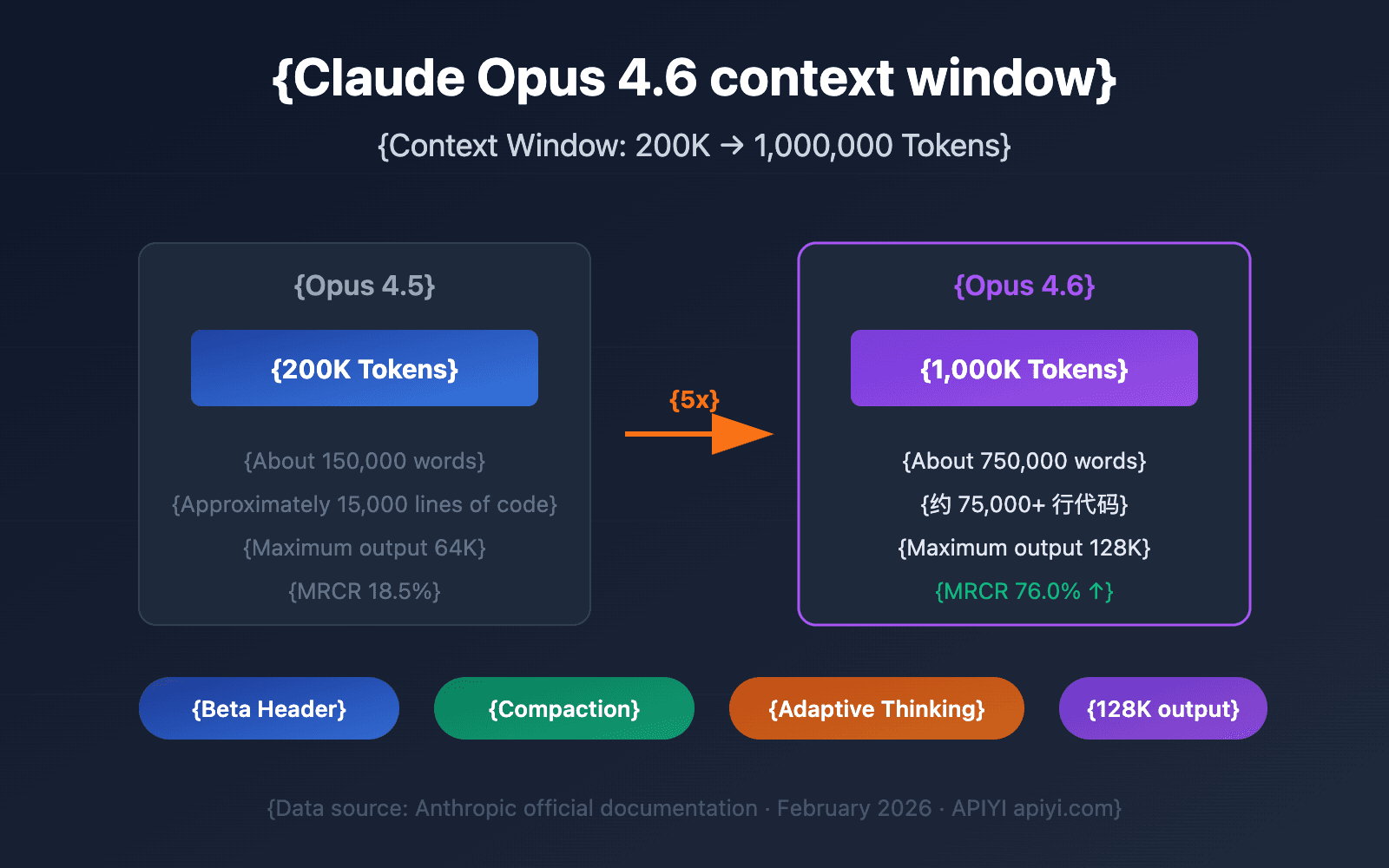
In the rapidly evolving landscape of artificial intelligence, a persistent challenge has separated theoretical capabilities from practical applications: the effective utilization of long-context windows. While models have progressively expanded their token limits—from thousands to hundreds of thousands and eventually millions—simply increasing capacity hasn't translated to usable functionality. That is, until now. Anthropic's Claude Opus 4.6 represents what appears to be a fundamental architectural breakthrough that makes million-token contexts genuinely usable, moving beyond brute-force scaling to create what the developers describe as "the architecture of autonomy."
The Long-Context Problem: More Than Just Token Counting
For years, the AI community has operated under a somewhat misleading premise: that longer context windows automatically equate to better performance. In reality, simply increasing a model's capacity to process more tokens has created significant practical limitations. Early attempts at long-context models suffered from what researchers call "context dilution"—the phenomenon where important information gets lost in vast amounts of text, leading to degraded performance on tasks requiring precise recall and reasoning.
The technical challenges are substantial. As context length increases linearly, the computational complexity grows quadratically in standard transformer architectures due to the attention mechanism. This creates practical barriers to deployment and makes real-time interaction with lengthy documents nearly impossible. More fundamentally, there's the cognitive challenge: how does an AI system effectively manage, prioritize, and reason across information spanning hundreds of thousands of words?
Claude Opus 4.6's Architectural Innovation
According to analysis published on Towards AI, Claude Opus 4.6's breakthrough lies not in simply expanding capacity but in fundamentally rethinking how large language models process and utilize extended contexts. The system appears to implement what the article describes as a "hierarchical attention architecture" that operates on multiple levels of abstraction simultaneously.
At its core, the innovation seems to involve several key components:
Dynamic Memory Management: Rather than treating the entire context as a uniform block, Claude Opus 4.6 implements sophisticated memory management systems that can prioritize, compress, and retrieve information based on relevance to the current task. This allows the model to maintain "working memory" of critical details while storing less immediately relevant information in accessible but less computationally intensive formats.
Multi-Scale Processing: The architecture processes information at different granularities simultaneously—from individual tokens and sentences to paragraphs, sections, and entire documents. This hierarchical approach enables the model to maintain both detailed understanding and high-level comprehension across massive contexts.
Autonomous Reasoning Loops: Perhaps most significantly, Claude Opus 4.6 appears to implement what the source describes as "self-directed reasoning cycles" where the model can autonomously identify gaps in understanding, formulate questions to itself, and iteratively refine its comprehension of complex documents.
Practical Implications: From Theory to Application
The practical implications of this architectural breakthrough are substantial. Where previous long-context models struggled with practical applications, Claude Opus 4.6 demonstrates genuine utility across several domains:
Legal and Contract Analysis: The model can process entire legal codes, case law collections, or complex contracts while maintaining precise understanding of how individual clauses relate to broader legal frameworks. This enables nuanced legal reasoning that was previously impossible with AI systems.
Scientific Research Synthesis: Researchers can now upload entire bodies of literature—dozens of papers spanning thousands of pages—and receive coherent synthesis that identifies patterns, contradictions, and research gaps across the entire corpus.
Enterprise Documentation: Large organizations can leverage the system to understand their complete documentation ecosystems, from technical manuals and policy documents to historical records and procedural guidelines, enabling comprehensive organizational intelligence.
Creative Development: Writers and creators can work with entire novel manuscripts or screenplay series, receiving feedback that considers character development, plot consistency, and thematic elements across the complete work.
The Path to Autonomous Systems
What makes Claude Opus 4.6 particularly significant is how it moves AI systems closer to genuine autonomy. The traditional paradigm of AI assistance involves users carefully crafting prompts and guiding the model through reasoning steps. Claude Opus 4.6's architecture enables what might be described as "self-sufficient comprehension"—the ability to ingest complex information and autonomously develop understanding without constant human guidance.
This represents a shift from tools that execute specific commands to systems that can undertake complex intellectual work with minimal supervision. The implications extend beyond current applications to potential future developments in autonomous research, analysis, and decision-support systems.
Technical Challenges and Future Directions
Despite the breakthrough, significant challenges remain. The computational requirements for processing million-token contexts, even with optimized architectures, are substantial. There are also important questions about how these systems handle conflicting information across lengthy contexts and how they maintain consistency in reasoning over extended interactions.
Future developments will likely focus on several areas:
- Efficiency Optimization: Further reducing the computational overhead of long-context processing
- Specialized Architectures: Developing domain-specific variants optimized for particular types of extended reasoning
- Multi-Modal Extension: Applying similar architectural principles to systems that process not just text but also images, audio, and structured data
- Collaborative Systems: Creating frameworks where multiple AI agents with different specializations can collaborate on massive context problems
Ethical and Societal Considerations
As with any significant AI advancement, Claude Opus 4.6's capabilities raise important ethical questions. The ability to process and reason across entire legal systems, corporate documentation, or scientific literatures creates both opportunities and risks. There are concerns about:
- Information Overload: The potential for systems to identify patterns that humans might miss, for better or worse
- Accountability: How to ensure responsible use of systems that can autonomously analyze massive information sets
- Access Inequality: The potential for such advanced systems to create divides between organizations that can afford them and those that cannot
Anthropic has emphasized their commitment to developing these technologies responsibly, but the broader AI community will need to engage with these questions as similar architectures become more widespread.
Conclusion: A New Era of AI Capability
Claude Opus 4.6 represents more than just another incremental improvement in language model capabilities. It signals a fundamental shift in how we approach AI architecture—from simply scaling existing designs to rethinking the very foundations of how artificial systems process and reason with information.
The breakthrough makes previously theoretical capabilities practically accessible, opening new possibilities for research, business, and creative work. More importantly, it points toward a future where AI systems can genuinely assist with the most complex intellectual challenges humanity faces, from scientific discovery to legal analysis to understanding our own cultural and historical records.
As the Towards AI analysis concludes, this isn't just about processing more tokens—it's about creating systems that can think across scales, from the sentence to the library, and help us make sense of our increasingly information-rich world.
Source: Analysis originally published on Towards AI examining the architectural breakthroughs behind Claude Opus 4.6's long-context capabilities.