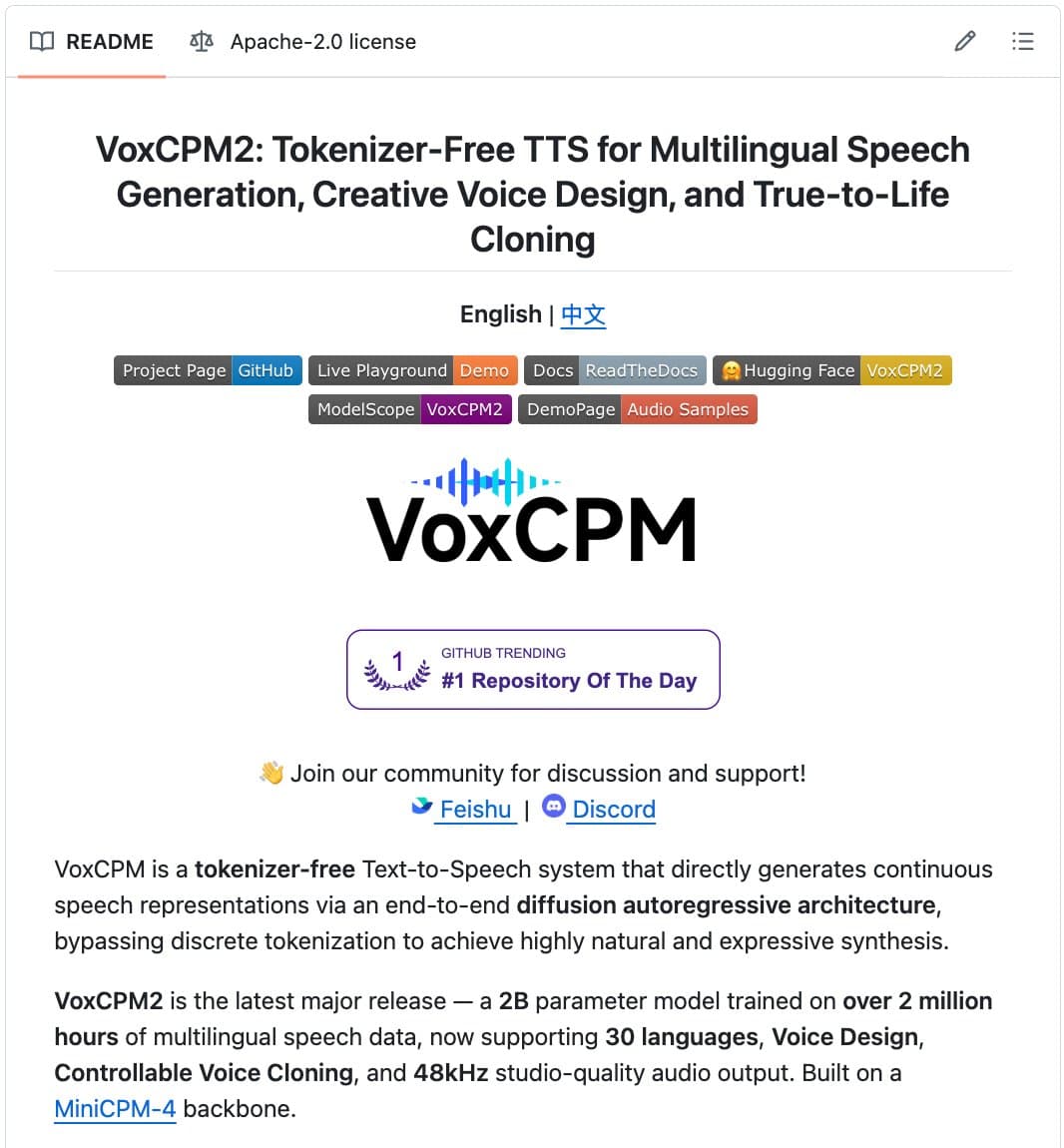
A new open-source voice AI model is challenging the economics of the voice cloning industry. VoxCPM2, a 2-billion parameter model developed by OpenBMB and Tsinghua University, can clone voices from short audio clips or generate entirely new voices from text descriptions—and it's available for free under an Apache 2.0 license.
This release comes as commercial voice AI services like ElevenLabs charge between $5 and $1,320 per month for voice cloning capabilities. VoxCPM2 not only eliminates subscription costs but also outperforms ElevenLabs on key voice similarity benchmarks according to the researchers.
Key Takeaways
- Researchers from OpenBMB and Tsinghua University released VoxCPM2, a 2B-parameter open-source voice AI that clones voices from short clips and creates voices from text descriptions.
- It outperforms ElevenLabs on the Minimax-MLS benchmark and runs locally with no API costs.
What VoxCPM2 Does
VoxCPM2 offers several voice generation capabilities that previously required paid services or professional voice actors:
Voice Design from Text: Users can describe a voice in natural language (e.g., "A young woman, gentle and sweet voice") and the model generates that voice from scratch without any reference audio. This eliminates the need for voice actors or recordings when creating synthetic voices.
Voice Cloning from Audio: Upload a short audio clip, and VoxCPM2 clones the speaker's voice characteristics including timbre, accent, emotion, tone, and pacing. The model then generates any speech in that cloned voice.
Controllable Voice Generation: Users can modify cloned voices with instructions like "slightly faster, cheerful tone" to control emotional delivery and pacing while maintaining voice identity.
Technical Specifications:
- Model Size: 2 billion parameters
- Training Data: 2 million hours of speech across 30 languages
- Output Quality: 48kHz studio quality
- Hardware Requirements: Runs on 8GB VRAM
- Inference Speed: Real-time factor as low as 0.13 on RTX 4090 (faster than playback)
- Fine-tuning: Supports LoRA fine-tuning with 5-10 minutes of audio
- Languages: 30 languages including Arabic, Chinese, English, French, German, Hindi, Japanese, Korean, and Spanish
Key Results: Benchmark Performance vs. ElevenLabs
The most striking comparison comes from the Minimax-MLS voice similarity benchmark, where VoxCPM2 significantly outperforms ElevenLabs across multiple languages:
English 85.4% 61.3% +24.1% Chinese 82.5% 67.7% +14.8% Arabic 79.1% 70.6% +8.5%These results suggest that the open-source model produces more realistic voice clones than the commercial service that charges up to $1,320/month for business plans.
How It Works: Technical Architecture
VoxCPM2 builds on the CPM (Chinese Pretrained Model) architecture, which has been extended for speech generation tasks. The 2-billion parameter model was trained on a massive multilingual dataset of 2 million hours of speech, enabling it to capture subtle vocal characteristics across different languages and accents.
Key Technical Innovations:
- Text-to-Voice Generation: Unlike traditional voice cloning that requires reference audio, VoxCPM2 can generate voices directly from text descriptions using a conditional generation approach that maps semantic descriptions to acoustic features.
- Context-Aware Synthesis: The model analyzes input text to automatically adjust emotion and rhythm—news content sounds formal and measured, while storytelling has appropriate dramatic pacing.
- Efficient Inference: With optimizations for consumer hardware, the model achieves real-time streaming with RTF as low as 0.13 on high-end GPUs, making it practical for real-time applications.
- Multilingual Training: The model was trained on 30 languages without requiring language tags, learning to distinguish languages from acoustic patterns alone.
Installation and Usage
Installation is straightforward:
pip install voxcpm
Basic voice cloning requires just a few lines of code:
import voxcpm

# Clone from audio
cloned_voice = voxcpm.clone_voice("reference_audio.wav")
speech = cloned_voice.generate("Text to speak in cloned voice")

# Create from description
new_voice = voxcpm.create_voice("A young woman, gentle and sweet voice")
speech = new_voice.generate("Hello, this is my new synthetic voice")
Market Context and Implications

The voice cloning market has been dominated by paid services with tiered pricing:
- ElevenLabs: $5-$99/month for individuals, $1,320/month for business
- Professional Voice Actors: $250-$1,000+ per project
- Recording Studios: $200+/hour
VoxCPM2 disrupts this market by providing professional-grade voice cloning capabilities that run locally with no ongoing costs. The Apache 2.0 license allows commercial use, enabling businesses to integrate voice cloning into their products without recurring API fees.
Limitations and Considerations
While VoxCPM2 represents a significant advancement, several considerations remain:
- Hardware Requirements: 8GB VRAM limits deployment to systems with dedicated GPUs
- Training Data Sources: The 2 million hours of training data sources aren't fully documented
- Ethical Considerations: Like all voice cloning technology, VoxCPM2 could be misused for impersonation or fraud
- Commercial Support: Unlike paid services, there's no SLA or dedicated support
The model has already gained significant traction, hitting #1 on GitHub Trending shortly after release.
gentic.news Analysis
VoxCPM2 represents a significant milestone in the ongoing trend of open-source models challenging commercial AI services. This follows a pattern we've seen across multiple AI domains—from image generation (Stable Diffusion vs. Midjourney/DALL-E) to language models (Llama series vs. GPT-4). The voice synthesis space has been relatively insulated from open-source competition until now, with ElevenLabs establishing itself as the dominant commercial player.
Technical Implications: The 24.1% performance gap on English voice similarity is substantial and suggests that open-source approaches may have architectural advantages over commercial implementations. This could pressure commercial providers to either open their models or significantly improve their offerings. The ability to generate voices from text descriptions (without reference audio) is particularly innovative and expands use cases beyond simple voice cloning.
Market Dynamics: This release comes at a critical time for the voice AI market. As we covered in our analysis of ElevenLabs' $80M Series B funding in January 2025, the company has been aggressively expanding its enterprise offerings. VoxCPM2's superior benchmark performance at zero cost creates immediate pricing pressure and could accelerate the commoditization of basic voice cloning capabilities. However, commercial services will likely differentiate through enterprise features, compliance certifications, and integrated workflows.
Practical Considerations for Developers: For AI engineers building voice applications, VoxCPM2 offers a compelling alternative to API-based services, particularly for applications requiring high-volume voice generation or privacy-sensitive use cases. The local deployment eliminates data privacy concerns associated with sending audio to third-party APIs. However, the 8GB VRAM requirement means this isn't suitable for mobile or edge deployment yet—commercial APIs still have an advantage for lightweight applications.
Frequently Asked Questions
How does VoxCPM2 compare to ElevenLabs in real-world usage?
While benchmark scores show VoxCPM2 outperforming ElevenLabs on voice similarity, real-world performance depends on specific use cases. ElevenLabs may still offer advantages in latency, reliability, and additional features like voice library management. For applications where cost is primary and local deployment is feasible, VoxCPM2 offers superior value.
Can VoxCPM2 be used commercially without restrictions?
Yes, VoxCPM2 is released under the Apache 2.0 license, which permits commercial use, modification, and distribution. However, users should ensure their usage complies with applicable laws regarding voice cloning and synthetic media, particularly regarding consent and disclosure requirements.
What hardware is required to run VoxCPM2 effectively?
The model requires approximately 8GB of VRAM for inference, meaning it needs a dedicated GPU. An RTX 4090 achieves real-time performance (RTF 0.13), while older or less powerful GPUs may have slower inference speeds. CPU-only inference is possible but significantly slower.
How does voice cloning from text descriptions work without reference audio?
VoxCPM2 uses a conditional generation approach where text descriptions are encoded into a latent space that maps to acoustic features. During training, the model learns associations between descriptive language ("gentle," "raspy," "authoritative") and corresponding vocal characteristics, allowing it to synthesize novel voices that match textual descriptions.