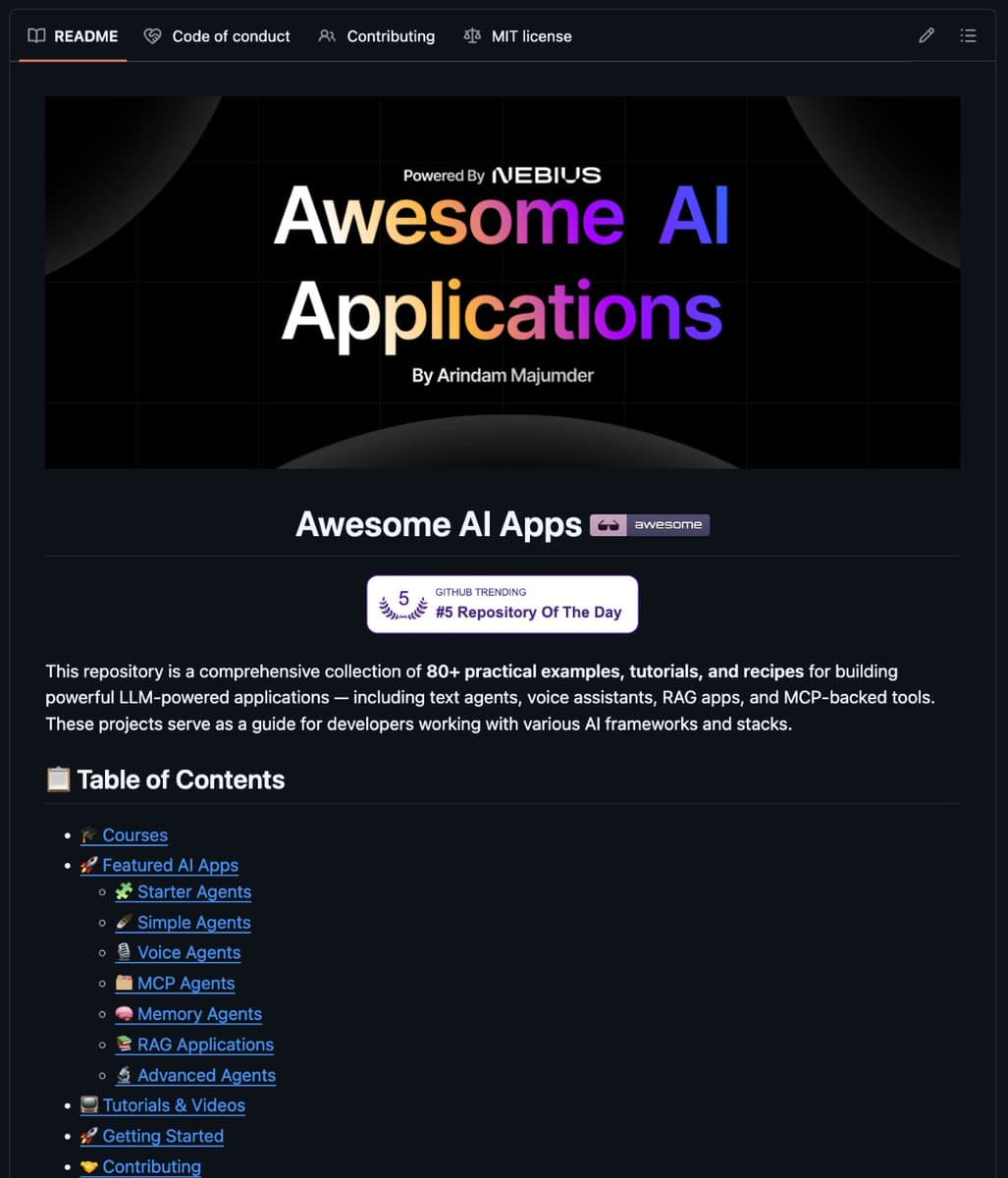
A free, open-source GitHub repository has rapidly become a central learning and prototyping resource for AI agent development. Titled "Awesome AI Apps," the repo distinguishes itself from typical "awesome lists" by providing over 70 self-contained, runnable projects instead of just links to external resources. As of April 2026, it has garnered 9.2K stars and 1.2K forks under an MIT License.
The repository's core value is its structured, executable examples. Each project includes its own README, environment setup instructions, and code that developers can clone and run immediately. This practical, copy-paste-ready approach targets engineers who want to bypass theoretical overviews and start building.
What's in the Repo: A Structured Curriculum for Agent Development
The repository is organized into thematic sections, each containing multiple working applications:
- 13 Starter Agents: Foundational examples across different agent frameworks (e.g., LangChain, LlamaIndex, AutoGen) allowing developers to start with their preferred stack.
- 12 MCP Integration Examples: Projects demonstrating the Model Context Protocol, including a hotel finder, GitHub analyzer, and a Docker sandbox agent.
- 12 Memory Agents: Examples of agents that retain context across sessions for ongoing tasks like job searching, social media management, and brand monitoring.
- 11 RAG Applications: Implementations of Retrieval-Augmented Generation, including one noted for using GPT-5 for "agentic retrieval."
- 14 Advanced Agents: More complex systems such as a car finder, a smart Go-To-Market (GTM) planner, and a conference talk generator.
The scope ranges from simple utilities, like a 3-line weather bot, to sophisticated multi-agent pipelines capable of autonomous financial research.
Beyond Code: Integrated Learning Materials
In addition to the projects, the repository integrates an 8-lesson AWS Strands course directly into its structure. Video playlists are linked within the repo, providing guided, curriculum-based learning alongside the hands-on code examples. This combination of project-based learning and formal instruction is a key differentiator.
How It Compares to Other Learning Resources
Most educational resources for AI agents fall into two categories: high-level conceptual tutorials or isolated, complex research repos. "Awesome AI Apps" fills the gap by offering a breadth of intermediate, production-pattern examples in one place. Its MIT license also removes commercial barriers to use and modification.
Code Readiness Self-contained, runnable projects Links to external repos Often complex, research-focused code Scope 70+ projects across all major frameworks Curated links, no code Single project or method Learning Path Thematic sections + integrated video course None Minimal, assumes expertise License MIT (permissive) Varies by linked project Variesgentic.news Analysis
This repository's traction (9.2K stars) signals a clear market demand for practical, consolidated, and framework-agnostic AI agent examples. The AI agent ecosystem has been fragmented, with developers needing to navigate disparate documentation for LangChain, LlamaIndex, AutoGen, and newer frameworks. A repo that normalizes examples across these tools significantly reduces the initial integration learning curve.
The inclusion of an AWS Strands course is a strategic move that aligns with broader cloud provider efforts to capture the AI developer mindshare. As we covered in our analysis of AWS's 2025 Bedrock Agent expansion, major cloud platforms are aggressively building tooling to make agent development native to their stacks. This repo effectively serves as a large-scale, open-source onboarding funnel for developers into AWS's agent ecosystem, whether intentionally or not.
Furthermore, the emphasis on MCP (Model Context Protocol) examples is timely. MCP, pioneered by Anthropic, has emerged as a critical standard for connecting agents to tools and data sources. Its prominence in this learning resource underscores its transition from a novel protocol to a foundational component of the agent stack, a trend we noted in our report on emergent agent standards in 2025.
The repo's success highlights a maturation in the AI tools market: the initial wave was about creating the core frameworks (LangChain, etc.); the current wave is about democratizing and operationalizing those frameworks for mainstream engineers. The next logical step for such a resource would be to incorporate automated testing, versioning for different model APIs (GPT-4, Claude 3.5, etc.), and perhaps continuous benchmarking.
Frequently Asked Questions
What is the "Awesome AI Apps" GitHub repository?
It is a free, open-source collection of over 70 self-contained, runnable AI agent projects designed for learning and prototyping. Unlike typical lists that only provide links, each project includes its own code, README, and setup instructions, covering everything from simple bots to complex multi-agent systems.
Do I need to pay or have a specific cloud account to use these examples?
No. The repository is released under the permissive MIT License, meaning the code is free to use, modify, and distribute. While some advanced examples may utilize cloud services (like AWS for the integrated course), the vast majority of projects are designed to run locally or with standard API keys from providers like OpenAI or Anthropic.
How is this different from the official documentation for LangChain or AutoGen?
Official documentation is essential for understanding a specific framework's API but often lacks complete, end-to-end application examples. This repository provides full working applications that solve concrete problems (e.g., a job search agent, a car finder), allowing developers to see how different components (memory, tools, RAG) integrate in practice across multiple frameworks.
Is the included AWS Strands course required to use the code?
No, the course is an optional, integrated learning resource. All code projects are standalone and can be run independently of the video lessons. The course is provided as a structured path for those who prefer guided instruction alongside hands-on experimentation.