What Happened
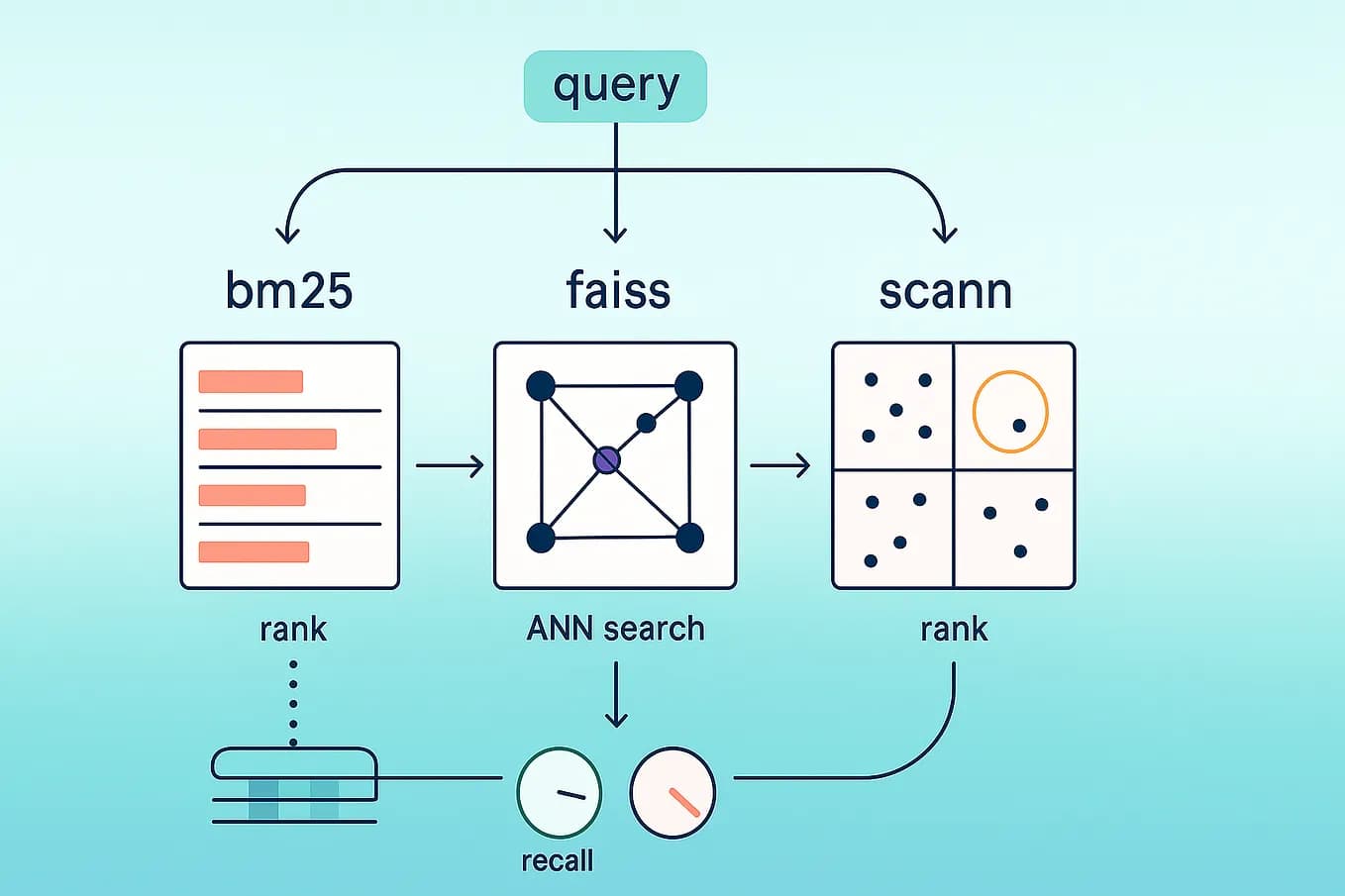
A new research paper titled "Visual Words Meet BM25: Sparse Auto-Encoder Visual Word Scoring for Image Retrieval" introduces BM25-V, a novel approach to image retrieval that bridges classic information retrieval techniques with modern computer vision. The work addresses key limitations of current dense retrieval methods: their computational expense at scale, lack of interpretability, and difficulty in attribution.
BM25-V applies the well-established Okapi BM25 scoring algorithm—traditionally used for text search—to "visual words" generated by a Sparse Auto-Encoder (SAE) operating on Vision Transformer (ViT) patch features. This creates a sparse, efficient representation that can be indexed and searched using inverted-index operations, similar to how text search engines work.
Technical Details
The system follows a clear pipeline:

- Feature Extraction: A Vision Transformer processes an input image, producing patch-level feature vectors.
- Sparse Encoding: A Sparse Auto-Encoder (trained once on ImageNet-1K) converts these dense features into a sparse activation pattern over a dictionary of "visual words."
- Indexing and Scoring: Each image's activated visual words are treated as a "document." The system builds an inverted index mapping visual words to the images containing them. When a query image arrives, BM25 scoring is applied:
- Term Frequency (TF): How often a visual word appears in the query
- Inverse Document Frequency (IDF): How rare that visual word is across the entire gallery
- Document Length Normalization: Accounts for variation in how many visual words different images activate
The researchers discovered that visual-word document frequencies follow a highly imbalanced, Zipfian-like distribution—similar to word frequencies in natural language. This makes IDF weighting particularly effective for suppressing common, low-information visual patterns and emphasizing rare, discriminative ones.
Key Results
Across seven fine-grained retrieval benchmarks, BM25-V demonstrated impressive performance:
- Recall@200 ≥ 0.993: Meaning for 99.3% of queries, the true match appears in the top 200 candidates retrieved
- Efficient Two-Stage Pipeline: BM25-V serves as a first-stage retriever, finding high-recall candidate sets that can then be reranked by more expensive dense models
- Near-Dense Accuracy: By reranking only K=200 candidates per query, the pipeline recovers within 0.2% of the accuracy of full dense retrieval
- Zero-Shot Transfer: The SAE trained on ImageNet-1K transferred effectively to seven different fine-grained benchmarks without any fine-tuning
- Attributable Decisions: Unlike black-box dense models, BM25-V's retrieval decisions can be traced to specific visual words with quantified IDF contributions
Retail & Luxury Implications
While the paper doesn't specifically address retail applications, the technology has clear potential for several luxury and retail use cases:
Visual Search and Discovery
BM25-V's efficient first-stage retrieval could power visual search engines that need to sift through millions of product images. The system's ability to find high-recall candidate sets with minimal computation makes it suitable for real-time visual search at scale—imagine a customer uploading a photo of a handbag they saw on the street and finding similar products in your catalog within milliseconds.
Attribute-Based Filtering and Explainability
The interpretable nature of BM25-V is particularly valuable for luxury retail. When a system retrieves similar products, it could explain why by showing which visual features ("visual words") contributed most to the match. This transparency could build customer trust and help merchandisers understand what visual characteristics drive product associations.
Efficient Catalog Management
For retailers with massive visual catalogs (think luxury marketplaces with millions of SKUs), BM25-V's sparse representations and inverted-index approach could significantly reduce storage and computational requirements compared to dense embedding approaches. The zero-shot transfer capability means a single model could work across different product categories without retraining.
Counterfeit Detection and Authentication
The fine-grained retrieval capabilities demonstrated across seven benchmarks suggest BM25-V could help identify subtle visual similarities and differences—potentially useful for authenticating luxury goods or detecting counterfeit variations.
Hybrid Search Systems
BM25-V naturally complements existing dense retrieval systems. Luxury retailers could implement it as a first-stage filter to reduce the computational load on more accurate but expensive models, creating cost-effective hybrid pipelines without sacrificing accuracy.
Implementation Considerations
For retail AI teams considering this approach:
- Training Requirements: The SAE needs training on a sufficiently diverse visual dataset (ImageNet-1K worked for the researchers)
- Indexing Overhead: Building and maintaining the inverted index requires infrastructure, though this is standard for search systems
- Integration Complexity: BM25-V would need integration with existing visual search pipelines and product databases
- Evaluation Needs: Retail-specific benchmarks would be required to validate performance on fashion/luxury imagery, which has different characteristics from the general benchmarks used in the paper
Limitations and Future Directions
The paper acknowledges that BM25-V alone doesn't match the absolute accuracy of state-of-the-art dense retrievers—hence its positioning as a first-stage filter. The approach also inherits limitations of sparse representations, potentially missing subtle visual relationships that dense embeddings capture.
For retail applications, future work might explore:
- Training SAEs specifically on fashion/luxury imagery
- Incorporating multimodal information (text descriptions, metadata) alongside visual features
- Adapting the visual word dictionary to emphasize retail-relevant attributes (textures, patterns, silhouettes)
BM25-V represents an interesting convergence of classical IR techniques with modern computer vision—a trend that could yield more efficient, interpretable visual search systems for retail applications.