What Happened
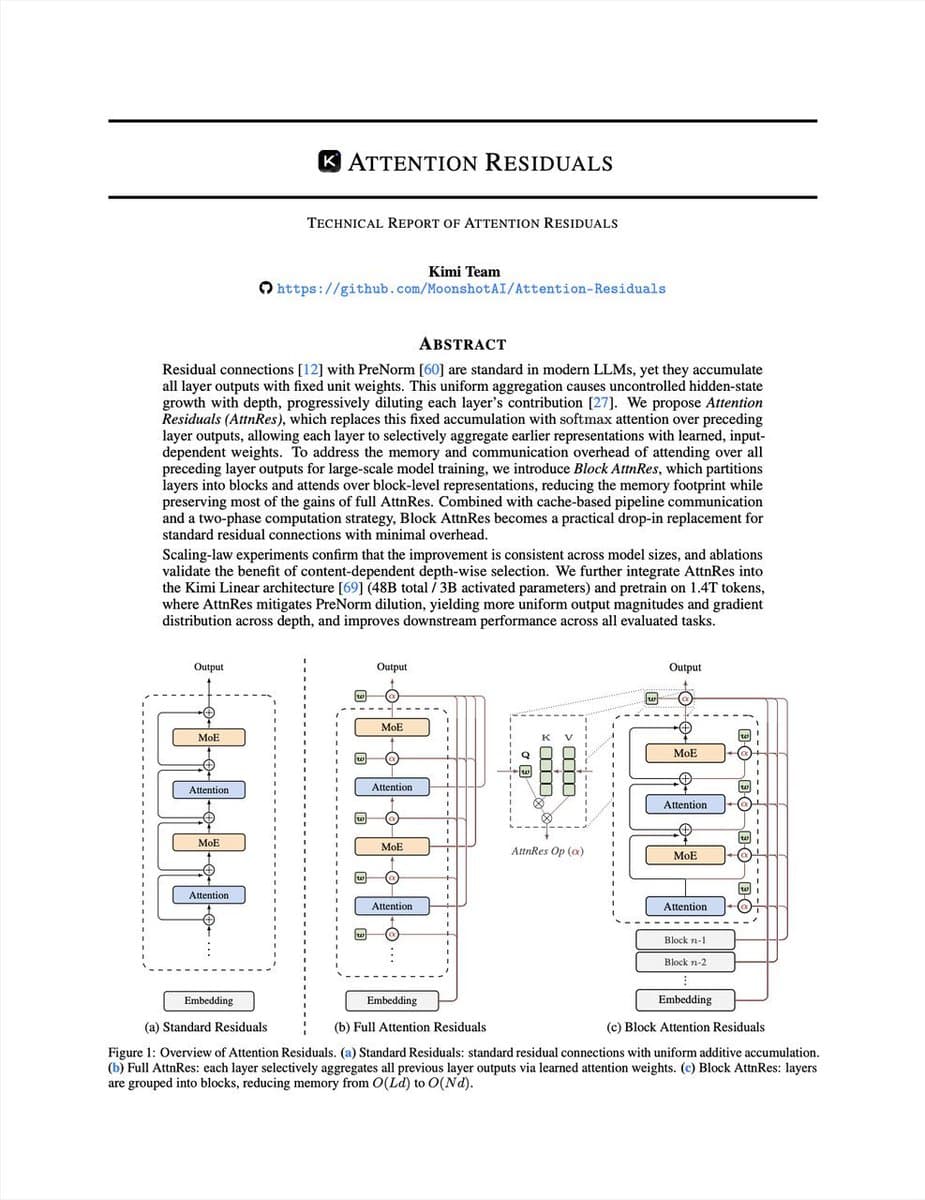
Kimi, the AI company behind the Kimi Chat assistant, has developed and demonstrated a fundamental modification to how deep neural networks pass information between layers. The core innovation replaces the standard practice of uniformly mixing information from all previous layers with a selective routing mechanism.
The Technical Shift
In traditional deep learning architectures, particularly those using residual connections (popularized by ResNet), information from earlier layers is typically blended uniformly into later layers. This approach, while effective for gradient flow, can dilute important signals as they propagate through dozens or hundreds of layers.
Kimi's method introduces a gating or selection mechanism that allows the model to dynamically choose which information from which previous layers is most relevant for processing each token and task. This selective attention to layer contributions helps preserve critical signals that might otherwise be washed out during standard forward propagation.
Demonstrated Results
According to the announcement, this architectural change delivers three key improvements:
Better Results: The selective routing leads to improved model performance on unspecified benchmarks, though exact metrics aren't provided in the source material.
~25% Compute Efficiency: The most concrete claim is approximately 25% improvement in training compute efficiency, meaning models require less computational resources to achieve the same level of performance.
Minimal Inference Overhead: Despite the added complexity of selective routing, the implementation reportedly adds "almost no extra inference slowdown," suggesting efficient implementation that doesn't significantly impact deployment latency.
Context and Significance
This development represents a departure from the residual connection paradigm that has dominated deep learning architecture design since 2015. While various forms of adaptive computation and conditional routing have been explored in research (such as mixture-of-experts, adaptive computation time, and conditional computation), applying selective layer communication at scale to foundation models is less common.
The efficiency gains are particularly relevant given the escalating costs of training large language models. A 25% improvement in compute efficiency could translate to significant reductions in training costs or enable training larger models with the same computational budget.
The claim of minimal inference overhead is crucial for practical deployment, as many architectural improvements that benefit training come with unacceptable inference latency penalties.
What's Missing
The source material doesn't specify:
- Which model architectures or sizes were tested
- What benchmarks were used to measure "better results"
- Whether the 25% efficiency gain is measured in FLOPs, training steps, or wall-clock time
- How the selective mechanism is implemented (attention-based, gating networks, etc.)
- Whether this has been applied to Kimi's production models
Until Kimi publishes a technical paper or provides more detailed benchmarks, the exact implementation and full evaluation remain unclear.