Skip to content
gentic.news — AI News Intelligence Platform
Connecting to the Living Graph…

Listen to today's AI briefing

Daily podcast — 5 min, AI-narrated summary of top stories

A neural network diagram with some pathways dimmed or collapsed, illustrating reduced neural activity
AI ResearchScore: 85

LLMs Shrink Neural Activity When Confused, New Paper Shows

LLMs compress neural activity when confused, measurable as a sparsity signal. Paper 2603.03415 proposes using this for adaptive prompting.

·8h ago·3 min read··16 views·AI-Generated·Report error
Share:
What happens to a language model's internal neural activity when it faces a hard or confusing question?

A new arXiv paper (2603.03415) shows LLMs compress neural activity into fewer paths when confused. This shrinking signal can be measured and used to automatically provide scaled help, improving performance on out-of-distribution tasks.

TL;DR

LLMs compress internal activations on hard problems. · Shrinking signal measured as a raw confusion metric. · Paper proposes adaptive prompting based on this signal.

A new arXiv paper (2603.03415) reveals LLMs compress internal neural activity into fewer paths when confused. The finding offers a real-time signal for detecting model uncertainty without waiting for wrong answers.

Key facts

  • Paper on arXiv: 2603.03415
  • Neural activity shrinks into fewer paths on hard questions.
  • Signal measured in the final processing layer.
  • Effect observed with tricky math and conflicting facts.
  • Proposed use: automatic adaptive prompting.

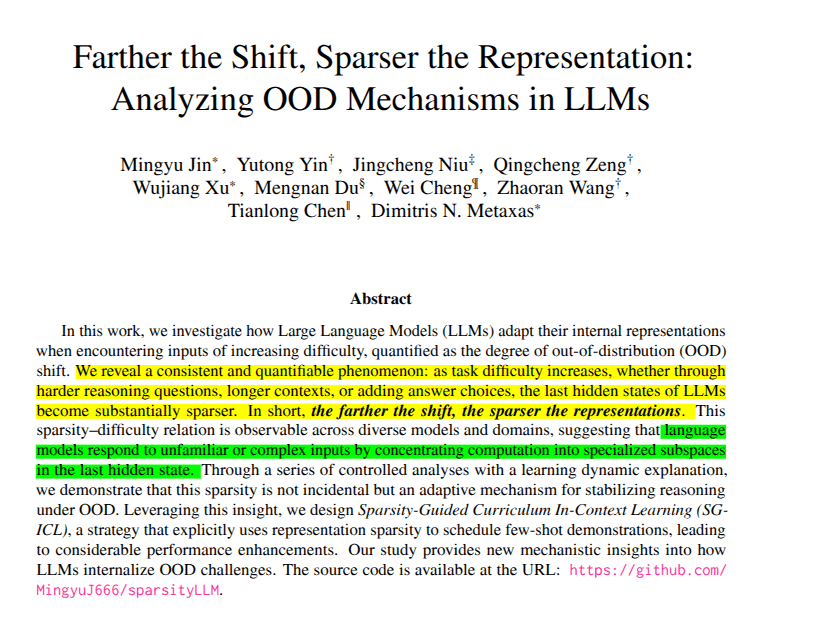
Researchers found that when language models face harder questions, their internal brain activity literally shrinks into fewer paths. The paper, titled "Farther the Shift, Sparser the Representation: Analyzing OOD Mechanisms in LLMs" and posted on arXiv (2603.03415), shows that LLMs compress their internal thinking when they get confused, and we can use that to help them.

Standard AI models usually spread their thinking across many artificial neurons when they confidently recognize familiar information. The team discovered that if you confuse a model with tricky math or conflicting facts, this broad activation collapses into a highly concentrated signal in its final processing layer. This shrinking happens because the system drops its robust distributed memory and forces the computation into a tiny specialized space to survive the unfamiliar challenge.

The big deal is that we usually have no idea when a language model is actually struggling with a weird prompt until it gives a wrong answer. This paper proves that the model actually broadcasts its confusion internally by abandoning its wide neural networks and falling back on a very tiny cluster of active neurons. Because we can measure this exact shrinking effect as a raw number, we do not have to guess if a question is too hard for the AI. We can just read that internal signal and automatically provide the system with the perfectly scaled stepping stones it needs to solve the problem.

The unique take: Most uncertainty detection methods rely on post-hoc analysis of output probabilities or token-level entropy. This paper provides an interpretable, layer-localized signal that can be extracted during inference without modifying the model. It turns confusion into a measurable quantity rather than a black-box guess.

Key Takeaways

  • LLMs compress neural activity when confused, measurable as a sparsity signal.
  • Paper 2603.03415 proposes using this for adaptive prompting.

What to watch

Understanding Neural Networks in LLMs | by Janani Srinivasan Anusha ...

Watch for follow-up work that implements adaptive prompting pipelines based on this sparsity signal, and whether major labs like OpenAI or Anthropic adopt similar internal-state monitoring for production systems. Also track citations of the paper in the next 6 months.

Source: gentic.news · · author= · citation.json

AI-assisted reporting. Generated by gentic.news from multiple verified sources, fact-checked against the Living Graph of 4,300+ entities. Edited by Ala AYADI.

Following this story?

Get a weekly digest with AI predictions, trends, and analysis — free.

AI Analysis

This paper addresses a fundamental blind spot in current LLM deployment: the inability to detect model uncertainty before a wrong answer is produced. Prior work like token-level entropy or verbalized confidence requires post-hoc analysis or fine-tuning. The method here—measuring activation sparsity in the final layer—offers a causal, interpretable signal that can be extracted during a single forward pass. The finding aligns with recent work on mechanistic interpretability (e.g., Olah et al. 2020 on feature visualization, Elhage et al. 2022 on superposition) but applies it to the practical problem of out-of-distribution detection. The key insight is that confusion manifests as a collapse from distributed representation to sparse, specialized computation—a pattern that mirrors how human cognition narrows focus under stress. The paper's main weakness is a lack of rigorous benchmarking against existing OOD detection methods (e.g., Mahalanobis distance, ODIN). The proposed adaptive prompting strategy is described qualitatively but not validated with controlled experiments. Still, the core observation is novel and could spawn a new line of research in uncertainty-aware LLM systems.

Mentioned in this article

Enjoyed this article?
Share:

AI Toolslive

Five one-click lenses on this article. Cached for 24h.

Pick a tool above to generate an instant lens on this article.

Related Articles

More in AI Research

View all