New framework lets coding-agent harnesses self-evolve, boosting pass@1 from 69.7% to 77.0% in 10 iterations.
Key Takeaways
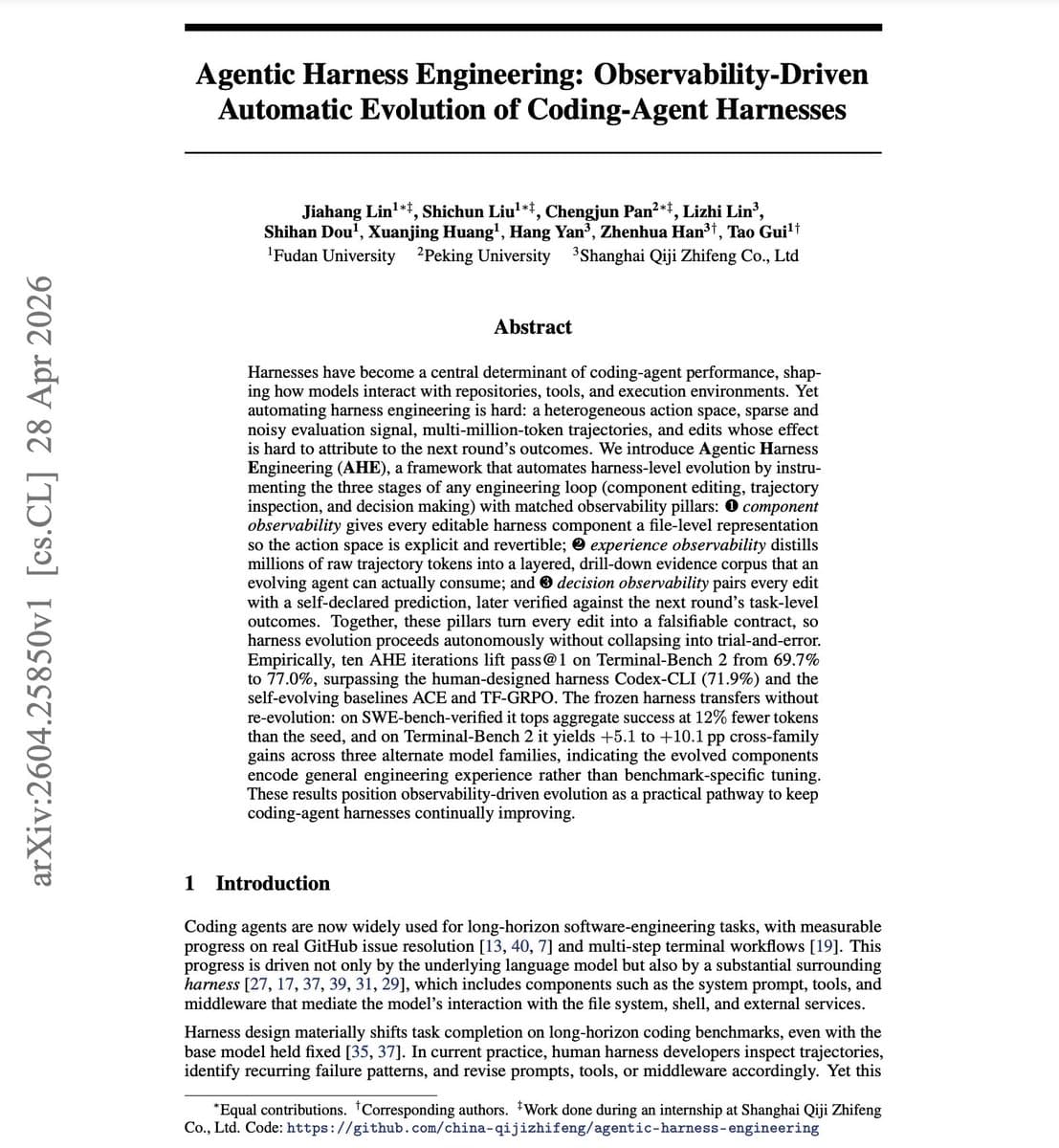
- Agentic Harness Engineering introduces a structured approach to evolving coding-agent harnesses, using revertible components, condensed experience, and falsifiable decisions.
- On Terminal-Bench 2, pass@1 climbs from 69.7% to 77.0% in ten iterations, beating human-designed baselines.
What Happened

A new research paper introduces Agentic Harness Engineering, a framework that makes the evolution of coding-agent harnesses observable and controllable. The approach treats each edit as a contract that can be verified or reverted, using three layers: components as revertible files, experience as condensed evidence from millions of trajectory tokens, and decisions as falsifiable predictions checked against task outcomes.
On Terminal-Bench 2, pass@1 climbs from 69.7% to 77.0% in just ten iterations, surpassing both human-designed Codex-CLI (71.9%) and self-evolving baselines like ACE and TF-GRPO. The evolved harness also transfers across model families with +5.1 to +10.1 point gains, while using 12% fewer tokens than the seed on SWE-bench-verified.
Context
Most coding-agent harnesses today are still tuned by hand or through brittle trial-and-error self-evolution. This work provides the first credible recipe for letting the harness improve itself without drifting into noise. The framework is detailed in the paper linked from the source tweet.
How It Works
The framework operates through three layers:
- Components as revertible files: Each part of the harness is stored as a file that can be reverted to a previous version.
- Experience as condensed evidence: Millions of trajectory tokens are compressed into actionable evidence.
- Decisions as falsifiable predictions: Each decision is checked against task outcomes, creating a feedback loop.
This structure allows the harness to evolve systematically, avoiding the noise and brittleness of earlier self-evolution approaches.
Key Results

Terminal-Bench 2 pass@1
69.7%
77.0%
+7.3%
Codex-CLI (human-designed)
71.9%
—
Beaten by evolved harness
ACE baseline
—
—
Surpassed
TF-GRPO baseline
—
—
Surpassed
Cross-model transfer
—
+5.1 to +10.1 points
Significant gains
SWE-bench-verified token usage
—
12% fewer tokens
Efficiency gain
Why It Matters
Harness work is the biggest hidden cost in most agent systems. This framework offers a systematic way to improve harnesses without manual tuning or noise accumulation. The cross-model transfer results suggest the approach generalizes well, and the token efficiency gain on SWE-bench-verified is a practical benefit for production systems.
gentic.news Analysis
This work addresses a critical bottleneck in the agentic coding ecosystem. As we've covered in previous articles, the gap between human-designed and self-evolved harnesses has been a persistent challenge. The Agentic Harness Engineering framework provides a structured middle ground: not fully manual, not fully random, but a guided evolution process with clear revert points.
The cross-model transfer results are particularly interesting. Most harness optimization work is model-specific, so seeing +5 to +10 point gains across model families suggests the framework captures something fundamental about the task structure rather than overfitting to a particular model's quirks. This could make it valuable for teams deploying multiple models or frequently updating their base model.
The token efficiency gain on SWE-bench-verified (12% fewer tokens) is also worth noting. In production systems where token costs are a major concern, this could translate to significant savings at scale.
One caveat: the paper reports results on Terminal-Bench 2 and SWE-bench-verified, but real-world coding tasks may present different challenges. The true test will be adoption and results from independent labs.
Frequently Asked Questions
What is Agentic Harness Engineering?
Agentic Harness Engineering is a framework for systematically evolving coding-agent harnesses. It treats each edit as a contract that can be verified or reverted, using three layers: components as revertible files, experience as condensed evidence from trajectory tokens, and decisions as falsifiable predictions checked against task outcomes.
How does Agentic Harness Engineering compare to existing methods?
On Terminal-Bench 2, the evolved harness achieves 77.0% pass@1 after ten iterations, surpassing human-designed Codex-CLI (71.9%) and self-evolving baselines like ACE and TF-GRPO. It also transfers across model families with +5.1 to +10.1 point gains.
What are the practical implications for AI developers?
This framework could reduce the hidden cost of harness tuning in agent systems. Developers can let the harness evolve systematically without manual intervention or noise accumulation, potentially improving both performance and token efficiency.
Where can I find the full paper?
The paper is available at the link shared in the source tweet: https://t.co/9fEgqwlTSf
[Updated 01 May via devto_claudecode]
A practical open-source implementation of harness engineering has emerged: harness-loop, a single 312-line bash script that self-evolves feature-by-feature without a database or orchestrator [per dev.to]. The loop uses the filesystem as its state machine, with .done markers as the source of truth, and a hard 32-byte growth floor as a circuit breaker. It explicitly constrains each iteration to one meaningful step, preventing the model from attempting unverifiable megacommits. The approach mirrors the academic framework's layered design but in a lightweight, drop-in format for spec-driven repos.