What Happened

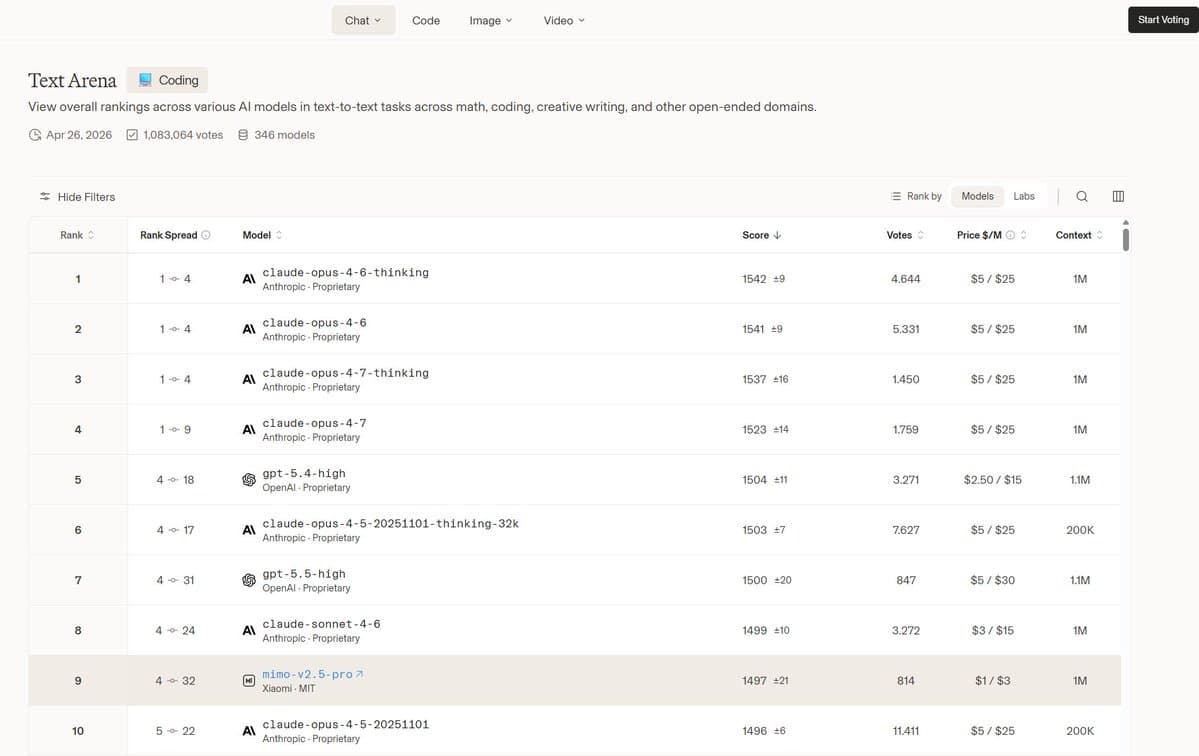
In a surprising development for the open-source AI community, Xiaomi's MiMo v2.5 Pro model has reportedly surpassed Opus 4.5 on the Arena benchmark. The announcement came via a tweet from @kimmonismus, highlighting the model's MIT license as a key differentiator. While detailed benchmark scores and methodology were not provided in the source tweet, the claim represents a notable milestone: an open-weight model from a Chinese consumer electronics giant outperforming a flagship model from a Western AI lab.
The Model: MiMo v2.5 Pro
MiMo is Xiaomi's multimodal AI model, designed to handle text, image, and potentially other modalities. The v2.5 Pro version appears to be the latest iteration, optimized for competitive performance. The MIT license is significant — it permits unrestricted use, modification, and distribution, including for commercial applications. This contrasts with many leading models that use more restrictive licenses (e.g., OpenAI's proprietary, Meta's Llama custom license).
Key details from the source:
- Model: Xiaomi MiMo v2.5 Pro
- License: MIT (fully open-source)
- Benchmark: Arena (likely the Chatbot Arena or a similar crowdsourced evaluation platform)
- Claim: Surpasses Opus 4.5
Context: Opus 4.5
Opus 4.5 is a model from Anthropic, part of the Claude family. Claude Opus has been positioned as Anthropic's most capable model, competing directly with GPT-4 and Gemini Ultra. If MiMo v2.5 Pro indeed outperforms Opus 4.5 on Arena, it would represent a significant achievement for Xiaomi and the open-source community.
What This Means in Practice
The combination of high performance and MIT licensing is rare. Most top-tier models are either proprietary (GPT-4, Gemini, Claude) or released under restrictive licenses (Llama 3). A model that can match or exceed Opus 4.5 while being fully open-source would:
- Allow developers to fine-tune and deploy it without licensing fees
- Enable academic researchers to study and improve the architecture
- Potentially accelerate innovation in multimodal AI
Limitations and Caveats
- Source reliability: The claim comes from a single tweet, not an official Xiaomi announcement or peer-reviewed paper.
- Benchmark specificity: "Arena" could refer to multiple benchmarks (Chatbot Arena, Arena-Hard, etc.). The exact metric and methodology are unclear.
- No raw numbers: The tweet does not provide specific scores, making it impossible to verify the margin of improvement.
- Model availability: It's unclear if the model weights are publicly downloadable or if this is a future release.
gentic.news Analysis
This development fits a broader trend we've been tracking at gentic.news: the democratization of AI capabilities through open-weight models. In recent months, we've covered:
- DeepSeek-R1's rise on SWE-Bench
- Alibaba's Qwen2.5 series matching GPT-4 on multiple benchmarks
- Mistral's Mixtral 8x22B pushing the frontier for open models
Xiaomi's entry is notable for two reasons. First, as a consumer electronics company (not primarily an AI lab), they bring manufacturing and distribution muscle that could accelerate real-world deployment. Second, the MIT license is the most permissive possible — more open than even Meta's Llama license. This could pressure other companies (especially Chinese rivals like Baidu, Alibaba, and ByteDance) to release their best models under similarly open terms.
However, we should temper expectations until we see third-party verification. The AI field has seen many "benchmark-beating" claims that later proved to be cherry-picked or non-reproducible. If Xiaomi publishes a paper with full methodology and model weights, this will be a genuinely significant event.
Frequently Asked Questions
What is Xiaomi MiMo v2.5 Pro?
MiMo v2.5 Pro is Xiaomi's latest multimodal AI model, released under the MIT open-source license. It reportedly outperforms Anthropic's Opus 4.5 on the Arena benchmark.
How does MiMo compare to GPT-4 or Claude?
Based on the claim, MiMo v2.5 Pro exceeds Opus 4.5 (Anthropic's best model) on Arena. Direct comparison to GPT-4 would require additional benchmarks, but this puts MiMo in the top tier of AI models.
Is MiMo v2.5 Pro available to use?
The tweet suggests an MIT license, implying open availability. However, the exact release date and download location have not been confirmed. Check Xiaomi's official AI channels for updates.
What does the MIT license mean for developers?
The MIT license allows anyone to use, modify, distribute, and commercialize the model without restrictions. This is more permissive than most AI model licenses and enables broad adoption in both research and production.
[Updated 04 May via the_decoder]
Xiaomi claims MiMo-V2.5-Pro burns 40–60% fewer tokens than Claude Opus 4.6 on coding tasks while nearly matching its performance, per The Decoder. The company is positioning the model for hours-long autonomous coding, shifting the competition from raw benchmark scores to cost efficiency and sustained task execution. This aligns with a broader strategy among Chinese open-weight providers like DeepSeek to optimize for practical deployment rather than leaderboard peaks.