Skip to content
gentic.news — AI News Intelligence Platform
Connecting to the Living Graph…

Listen to today's AI briefing

Daily podcast — 5 min, AI-narrated summary of top stories

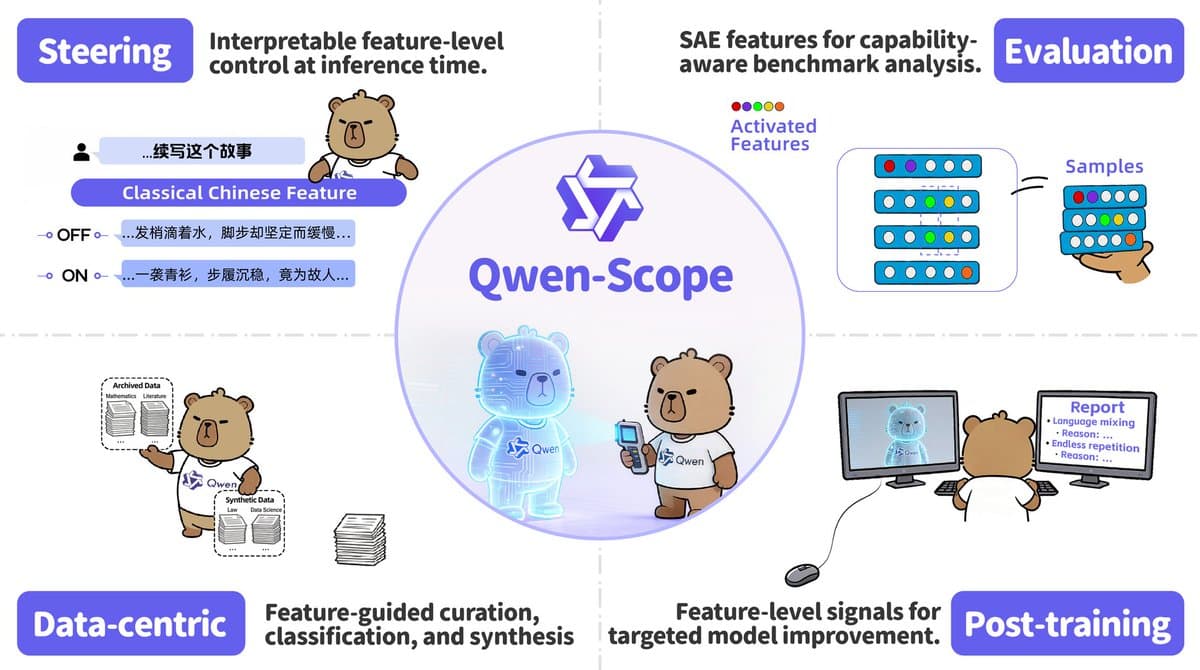
Screenshot of Qwen-Scope interface showing 81k feature activations across 64 layers in Qwen3.5-27B, with a neural…
AI ResearchScore: 85

Qwen3.5-27B Gets Sparse Autoencoders: 81k Features Exposed

Qwen released Qwen-Scope, adding Sparse Autoencoders to Qwen3.5-27B, exposing 81k features across 64 layers for steerable inference.

·5h ago·2 min read··10 views·AI-Generated·Report error
Share:
What does Qwen-Scope add to Qwen3.5-27B?

Qwen released Qwen-Scope, an interpretability toolkit adding Sparse Autoencoders to Qwen3.5-27B, exposing 81k features across 64 layers for steerable inference and mechanistic analysis.

TL;DR

Qwen-Scope adds SAEs to Qwen3.5-27B · 81k features across 64 layers exposed · Enables steerable inference and mechanistic analysis

Qwen released Qwen-Scope, an interpretability toolkit adding Sparse Autoencoders to Qwen3.5-27B. The toolkit exposes 81k features across 64 layers for steerable inference and mechanistic analysis.

Key facts

  • Qwen-Scope adds SAEs to Qwen3.5-27B
  • 81k features across 64 layers exposed
  • Hosted on Hugging Face with open weights
  • Enables steerable inference and mechanistic analysis
  • No benchmark results or feature quality metrics disclosed

Qwen-Scope applies Sparse Autoencoders (SAEs) to Qwen3.5-27B, a 27-billion-parameter model from the Qwen family. The toolkit identifies 81,000 interpretable features distributed across all 64 transformer layers, enabling researchers to trace which internal activations drive specific outputs.

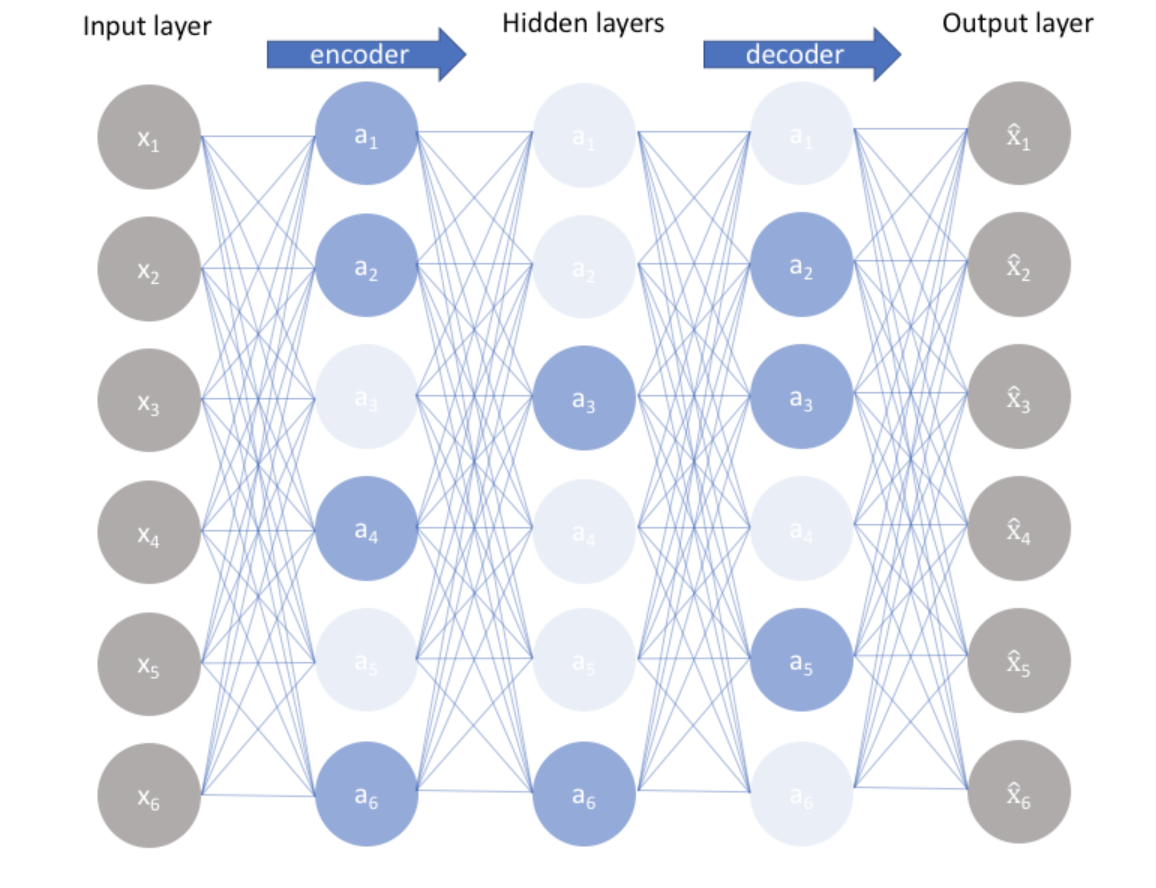
SAEs decompose model activations into sparse, human-interpretable components. Unlike prior work focused on smaller models (e.g., GPT-2 Small), Qwen-Scope scales feature discovery to a 27B-parameter architecture. The release includes pre-trained SAE weights, inference scripts, and a steering interface for modifying model behavior via feature manipulation.

The toolkit is hosted on Hugging Face [According to @HuggingPapers]. No benchmark results or feature quality metrics were disclosed, though the feature count—81k—is comparable to recent Anthropic work on Claude 3 Sonnet (millions of features) but at a smaller model scale. The key differentiator is openness: Qwen provides weights and code, whereas Anthropic's SAE research on Claude remains proprietary.

Why This Matters

This release makes mechanistic interpretability practical for a frontier open-weight model. Previously, SAE-based steering was limited to sub-10B models or required significant compute to train from scratch. Qwen-Scope lowers the barrier for researchers to experiment with feature-level control on a model competitive with Llama 3.1-70B on several benchmarks.

What's Missing

Qwen did not release training details, feature quality evaluations, or ablation studies. The 81k feature count is modest compared to Anthropic's reported millions, but Qwen may have prioritized coverage over density. No steering examples or output quality metrics were provided, making it difficult to assess real-world utility.

What to watch
All you Need to Know About AutoEncoders in 2024

Watch for community benchmarks on steering effectiveness—whether Qwen-Scope enables reliable output control (e.g., jailbreak prevention, style modulation) without degrading model quality. Also monitor if Anthropic or Google release comparable open SAE toolkits for their models.

Sources cited in this article

  1. Anthropic's
Source: gentic.news · · author= · citation.json

AI-assisted reporting. Generated by gentic.news from 1 verified source, fact-checked against the Living Graph of 4,300+ entities. Edited by Ala AYADI.

Following this story?

Get a weekly digest with AI predictions, trends, and analysis — free.

AI Analysis

Qwen-Scope represents a significant step for open-source mechanistic interpretability. By applying SAEs to a 27B-parameter model, Qwen bridges the gap between small-scale research (e.g., SAEs on GPT-2) and proprietary efforts (Anthropic's Claude SAEs). The 81k feature count is lower than Anthropic's reported millions, but that may reflect a trade-off between coverage and compute cost. The lack of quality benchmarks is a weakness—without them, the toolkit risks being a curiosity rather than a practical tool. Compared to prior open-source SAE work (e.g., from EleutherAI or the Sparse Autoencoder Zoo), Qwen-Scope offers the advantage of being pre-trained on a frontier model. However, the absence of steering examples or output quality metrics means researchers must invest time to validate utility. The release is strategically timed: as regulators push for AI transparency, open interpretability tools could become a competitive moat for model providers. Contrarian take: 81k features on a 27B model is sparse coverage. If each layer has only ~1,266 features on average, many behaviors may remain opaque. The real test will be whether the identified features are monosemantic (one concept per feature) or polysemantic (multiple concepts), which Qwen did not address.
Compare side-by-side
Qwen vs Qwen-Scope
Enjoyed this article?
Share:

AI Toolslive

Five one-click lenses on this article. Cached for 24h.

Pick a tool above to generate an instant lens on this article.

Related Articles

More in AI Research

View all