What Happened
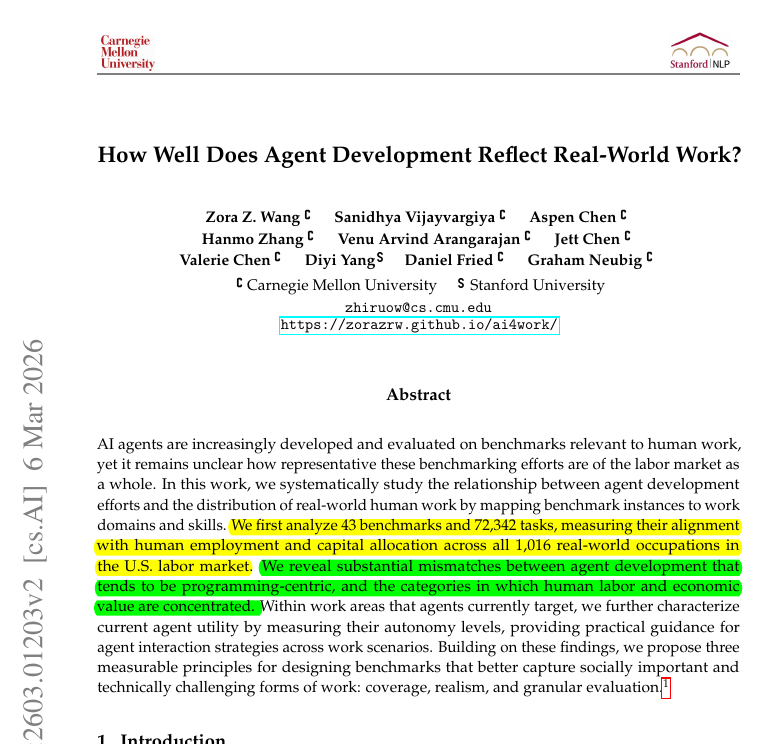
A research team from Stanford University and Carnegie Mellon University has published a study analyzing the relationship between common AI performance benchmarks and actual human job tasks. The core finding, as highlighted in a social media post by AI researcher Rohan Paul, is that current benchmarks "heavily ignore actual human economics."
The study systematically maps AI capabilities measured by standard benchmarks—like those for coding, writing, or image generation—to the tasks that constitute real-world occupations. The researchers then compare the benchmark's focus to the economic importance (measured by factors like wages, employment volume, and task complexity) of those corresponding job tasks.
Context
This work enters a growing conversation about "benchmark-driven" AI development. For years, progress in fields like natural language processing and computer vision has been largely tracked through performance on curated datasets like MMLU (massive multitask language understanding), HumanEval (code generation), or various image classification challenges. These benchmarks have served as proxies for general capability.
However, critics have argued that high scores on these benchmarks do not necessarily translate to useful, reliable, or economically valuable performance in real-world applications. This study provides a formal, data-driven critique of that misalignment, grounding the discussion in labor economics.
The research suggests that the AI community's focus on optimizing for narrow benchmark performance may be steering development away from capabilities that would have greater practical impact on the economy and workforce.