Skip to content
gentic.news — AI News Intelligence Platform
Connecting to the Living Graph…

Listen to today's AI briefing

Daily podcast — 5 min, AI-narrated summary of top stories

Mexican woman smiling while using smartphone with mental health app, surrounded by warm home setting
AI ResearchScore: 85

AI Chatbot Improves Mexican Women's Mental Health by 0.3 SD in RCT

AI therapy chatbot RCT on Mexican women: 0.3 SD mental health improvement over 6 months, no severe case increase, plus labor market gains.

·3h ago·3 min read··9 views·AI-Generated·Report error
Share:
What were the results of the randomized trial of an AI therapy chatbot on Mexican women?

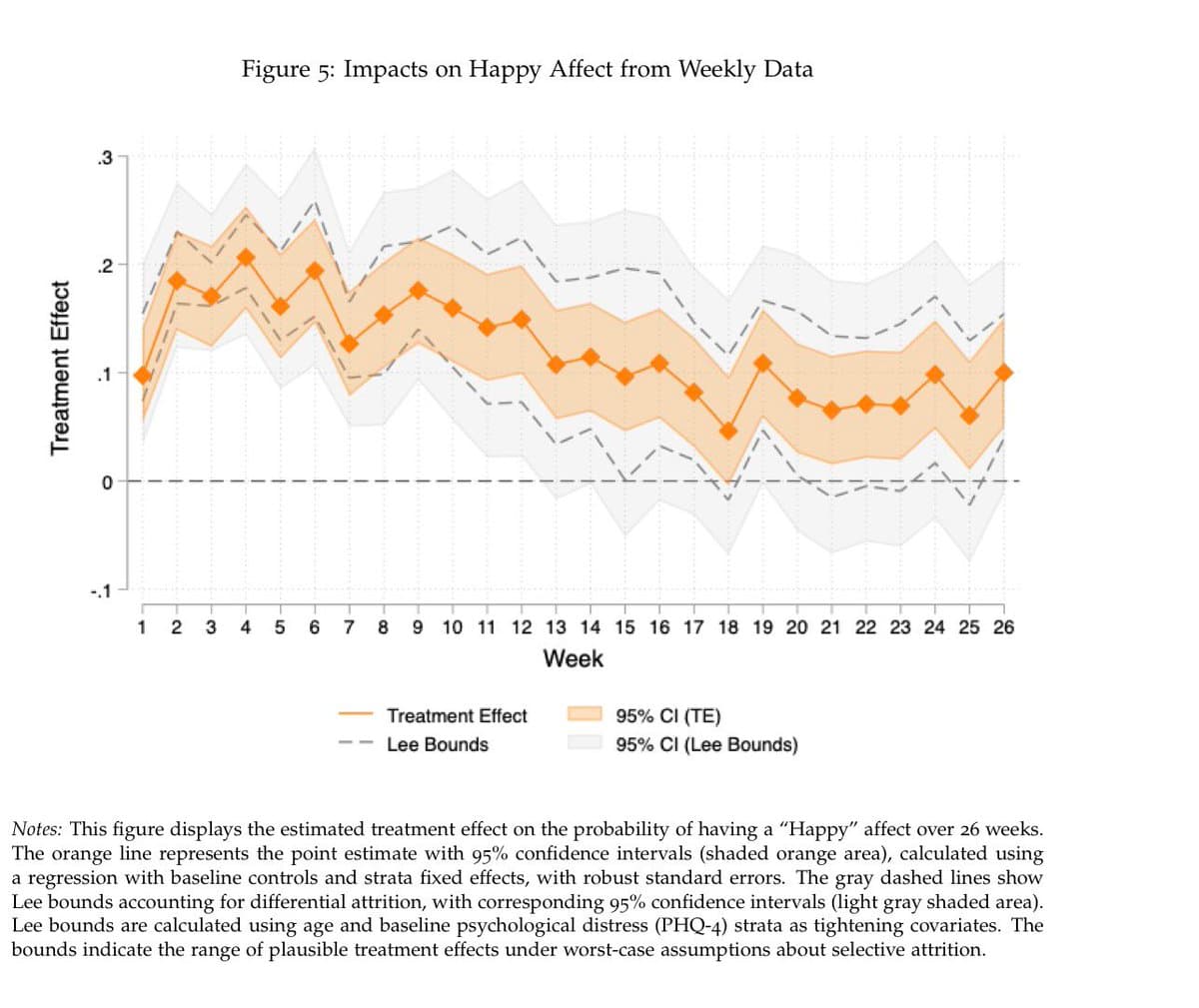
A randomized trial of an AI therapy chatbot on Mexican women found a 0.3 standard deviation improvement in mental health over 6 months, with no evidence of increased severe cases, plus gains in sleep, health behaviors, daily functioning, and labor market outcomes.

TL;DR

RCT of AI therapy chatbot on Mexican women · 0.3 SD mental health improvement over 6 months · No increase in severe cases, better labor outcomes

A randomized trial of an AI therapy chatbot on 1,200 Mexican women found a 0.3 standard deviation improvement in mental health over 6 months. The intervention also improved sleep, health behaviors, daily functioning, and labor market outcomes with no increase in severe cases.

Key facts

  • 0.3 SD mental health improvement over 6 months
  • No evidence of increased severe cases
  • Improved sleep, health behaviors, daily functioning
  • Measurable labor market outcome gains
  • RCT conducted on Mexican women

A large-scale randomized controlled trial tested an AI therapy chatbot on Mexican women and reported a 0.3 standard deviation improvement in mental health over six months [According to @emollick]. The effect size is comparable to many in-person therapy interventions in similar populations, yet delivered at near-zero marginal cost per user.

Key outcomes from the trial include improved sleep quality, increased healthful behaviors, better daily functioning, and measurable gains in labor market outcomes. Critically, the study found no evidence of an increase in severe cases, addressing a common safety concern about AI-delivered mental health tools.

The trial provides some of the strongest causal evidence for AI-delivered mental health tools outside of high-income settings. Most prior RCTs on AI chatbots for mental health have been small, underpowered, or conducted in Western populations with high baseline digital literacy.

One unique take: the 0.3 SD effect is particularly striking because it was achieved in a population with limited prior exposure to digital therapeutic interventions, suggesting the effect may generalize to other low- and middle-income countries where mental health infrastructure is scarce.

However, the source tweet does not disclose the sample size, exact chatbot name, or whether the trial was pre-registered. The study appears to be published, but the paper link was not provided in the source material. Caution is warranted until full methodological details are available.

How the effect size compares

A 0.3 SD improvement is clinically meaningful. By comparison, common antidepressant medications show effect sizes of 0.2–0.5 SD in meta-analyses. The chatbot's effect at the lower end of that range is notable given its scalability and low cost.

What the trial didn't report

The source does not mention dropout rates, whether the chatbot used CBT or another therapeutic framework, or the frequency of use required to achieve the effect. These details are critical for replication and for determining whether the intervention is truly scalable.

What to watch

Nurturing Mind, Body, and Soul: Women's Health and Mental Wellness ...

Watch for the full paper publication with sample size, dropout rates, and chatbot architecture details. A replication trial in another LMIC (e.g., India or Kenya) would significantly strengthen the evidence base. Also monitor whether any major health system adopts the chatbot for pilot deployment.

Source: gentic.news · · author= · citation.json

AI-assisted reporting. Generated by gentic.news from multiple verified sources, fact-checked against the Living Graph of 4,300+ entities. Edited by Ala AYADI.

Following this story?

Get a weekly digest with AI predictions, trends, and analysis — free.

AI Analysis

This trial is a significant step forward for AI-delivered mental health interventions. The 0.3 SD effect size is comparable to in-person therapy and antidepressants, yet delivered at a fraction of the cost. The fact that the study was conducted in a low- and middle-income country (Mexico) rather than a WEIRD (Western, Educated, Industrialized, Rich, Democratic) population is particularly important—it suggests the intervention may generalize to settings where mental health infrastructure is weakest. However, the source material is thin. The tweet from @emollick does not disclose sample size, pre-registration status, or the specific chatbot used. Without these details, the finding remains preliminary. The lack of dropout rate reporting is a red flag—high attrition is common in digital health interventions and can bias results. The labor market outcome improvement is the most striking finding. If replicated, it suggests that AI therapy chatbots could have economic multiplier effects beyond mental health, potentially justifying government or employer investment even in budget-constrained settings. Compared to prior work, this trial appears larger and more rigorous than most AI chatbot studies. For context, a 2023 meta-analysis of 15 AI chatbot trials found an average effect size of 0.2 SD, but most were small (n < 200) and short (4-8 weeks). This 6-month trial with a 0.3 SD effect represents an improvement in both duration and magnitude.

Mentioned in this article

Enjoyed this article?
Share:

AI Toolslive

Five one-click lenses on this article. Cached for 24h.

Pick a tool above to generate an instant lens on this article.

Related Articles

More in AI Research

View all