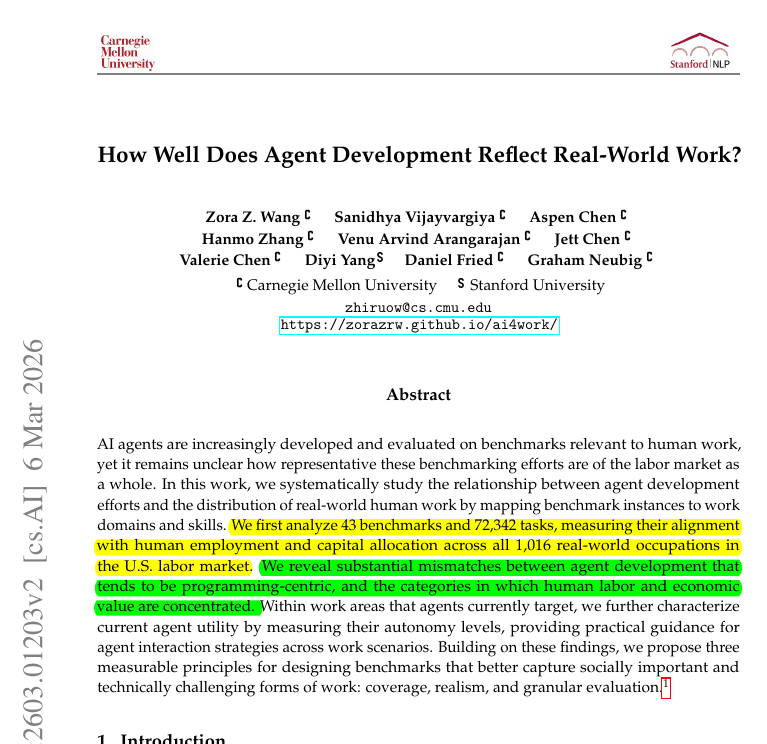
A new paper from Stanford University and Carnegie Mellon University reveals a stark disconnect between what AI researchers measure and what the actual labor market does. The study, titled "How Well Does Agent Development Reflect Real-World Work?" (arXiv:2603.01203), systematically maps 43 popular AI agent benchmarks against a massive government occupational database containing over 72,000 real-world job tasks.
The core finding: current AI benchmarks focus almost exclusively on programming and mathematical reasoning, which together account for only 7.6% of actual human economic work. Meanwhile, highly digitized, high-value fields like management, legal work, and roles requiring complex interpersonal skills—which represent a massive portion of the modern economy—receive almost zero attention in AI evaluation.
What the Researchers Did
The team conducted a large-scale mapping exercise between two datasets:
- AI Benchmarks: 43 popular benchmarks used to evaluate AI agents, comprising thousands of individual tasks.
- Occupational Database: The U.S. Department of Labor's O*NET database, which contains detailed descriptions of tasks, skills, and knowledge requirements for over 72,000 job roles across the economy.
They categorized each AI benchmark task into occupational categories based on the skills and knowledge required to perform it, then compared this distribution to the actual distribution of work in the economy.
Key Results: The 7.6% Disconnect
The analysis revealed a dramatic skew:
- Programming and mathematical reasoning tasks dominate AI benchmarks, representing the vast majority of evaluated capabilities.
- These two categories, however, correspond to only 7.6% of actual job tasks in the economy.
- Management, legal, administrative support, and interpersonal work—which constitute a large portion of high-value economic activity—are virtually absent from current benchmarks.
The researchers note that this skew isn't accidental. Developers focus heavily on building agents for software engineering because it offers easy automatic grading—code can be run and tested against predefined solutions. Tasks in management, legal analysis, or interpersonal coordination lack such clear-cut evaluation metrics.
How Current Benchmarks Fall Short
The paper identifies two major gaps in current AI agent evaluation:
1. Task Complexity Mismatch
Most benchmark tasks require simple information gathering or straightforward problem-solving. Real-world work, especially in high-value domains, involves complex coordination, negotiation, judgment under uncertainty, and multi-step planning—none of which are captured by current benchmarks.
2. Skill Category Blindness
Benchmarks completely ignore the interpersonal and communication skills that are critical in most workplaces. Skills like persuasion, mentoring, conflict resolution, and team management—which appear repeatedly in the occupational database—have no corresponding evaluation in AI agent research.
Why This Matters
The study argues that this benchmark bias creates a distorted feedback loop in AI development. Researchers optimize for what's measured—programming and math—while neglecting the capabilities that actually drive economic value. This could lead to AI systems that excel at narrow technical tasks but remain incapable of assisting with the broader range of work that constitutes the modern labor market.
The authors conclude: "Current AI agent progress-benchmarks are fundamentally disconnected from the actual high-value tasks that drive the modern labor market."
The Paper
- Title: "How Well Does Agent Development Reflect Real-World Work?"
- Authors: Researchers from Stanford University and Carnegie Mellon University
- Link: arXiv:2603.01203
- Method: Mapping analysis of 43 AI benchmarks against 72,000+ job tasks from the O*NET database