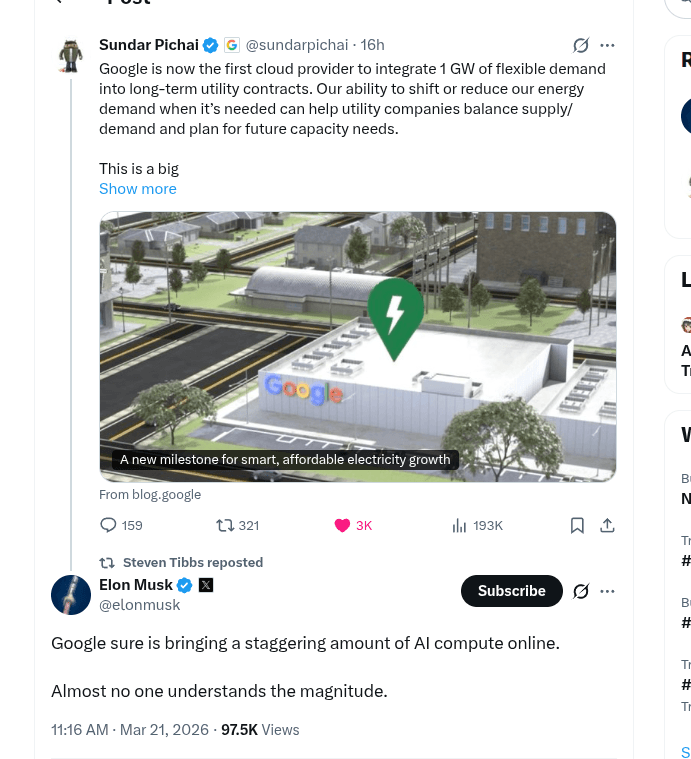
Google has announced a series of energy agreements totaling 1 gigawatt (GW) of flexible capacity, designed to demonstrate that large-scale data centers—particularly those running energy-intensive AI workloads—can help stabilize electricity grids and potentially reduce costs.
The core mechanism is a flexible demand response system. When local power grids approach capacity limits or experience high demand, Google can temporarily pause or reschedule non-urgent, compute-heavy AI tasks. This reduces instantaneous demand on the grid, helping utility operators balance supply and demand in real time.
According to the announcement, this approach allows the entire electricity system to operate more efficiently. By using data centers as a controllable, large-scale load, the need for utilities to activate expensive "peaker" plants or invest in new permanent generation capacity may be reduced. Google states this improves grid reliability for all customers in the affected service areas.
The company has established new agreements with utility partners, including Minnesota Power and DTE Energy, to integrate this flexible demand into grid operations. These deals indicate the model is scaling from pilot projects to part of a broader, national energy strategy.
How the Flexible Demand System Works
The system treats Google's data center load as a grid resource. During periods of peak demand or grid congestion, Google receives a signal from its utility partners. In response, it can shift flexible computing workloads—such as training certain AI models or running batch inference jobs—to a different time. This is analogous to large-scale industrial demand response programs but applied to hyperscale computing.
The 1GW capacity figure represents the aggregate amount of load Google can theoretically adjust across its participating data centers. For context, 1GW is roughly the output of a large nuclear reactor or natural gas plant, or enough electricity to power approximately 750,000 homes.
The AI Compute Angle
AI training and, to a lesser extent, inference are notably energy-intensive processes. By targeting these specific workloads, which can often be batch-scheduled, Google is applying demand response to one of the fastest-growing segments of data center energy consumption. The strategy explicitly links the growth of AI compute to potential grid solutions, rather than just presenting it as a demand problem.
Reported Benefits and Goals
The stated objectives are twofold:
- Grid Stability: Provide utilities with a reliable, large-scale tool for balancing supply and demand, increasing overall system resilience.
- Cost Reduction: By flattening demand peaks and reducing the need for costly grid infrastructure, the approach aims to lower system-wide electricity costs over time.
Google's announcement frames this as a proof point that data centers, often criticized for their high energy use, can be designed to become a net benefit to grid operations.