What Happened
Stripe has proposed an open specification called the Machine Payments Protocol (MPP), designed to enable AI agents and autonomous software to make payments without human intervention. The protocol repurposes the long-dormant HTTP 402 status code ("Payment Required") to initiate a standardized machine-to-machine payment negotiation. The full specification is published at mpp.dev and has been submitted to the IETF as a proposed standard HTTP authentication scheme.
How the Protocol Works
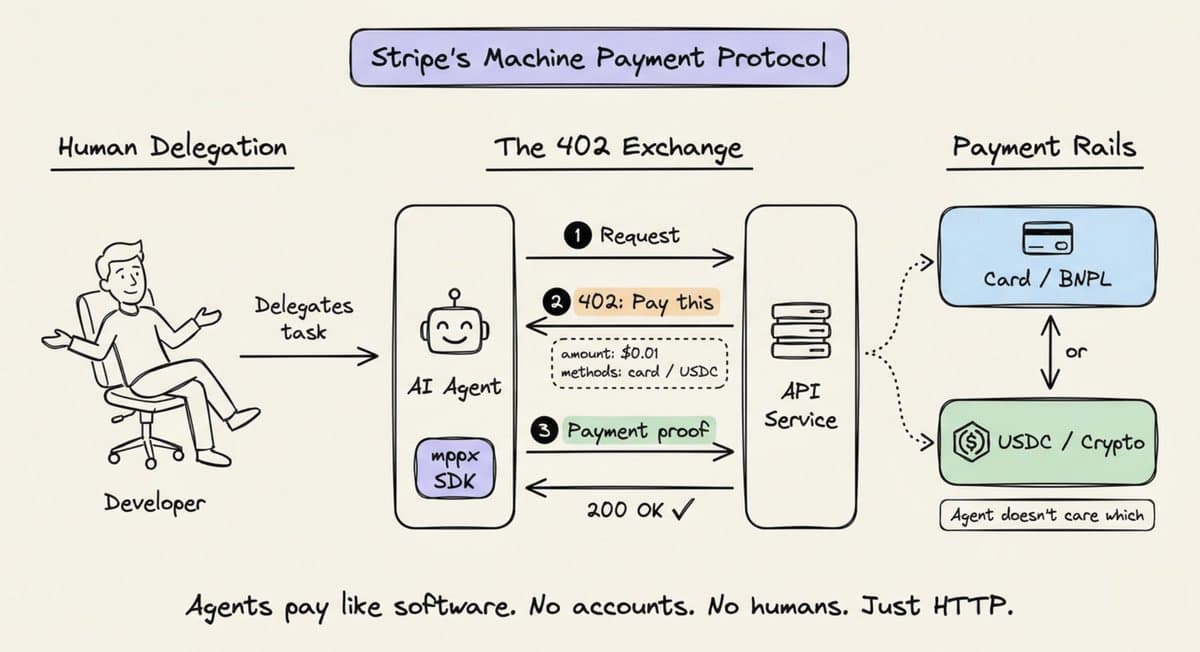
The core flow is a six-step exchange between an AI agent and a paid API service:
- Task Delegation: A developer delegates a task to an agent.
- API Request: The agent requests a service from a paid API.
- Payment Request: The API responds with
HTTP 402 Payment Required, a status code defined in HTTP/1.0 but rarely used. This signals that payment is needed to proceed. - Terms Discovery: The
402response includes machine-readable payment terms: amount, currency, and accepted payment methods. - Payment & Retry: The agent fulfills the payment and retries the original request, attaching cryptographic proof of payment.
- Service Delivery: The server verifies the proof and responds with
200 OKand the requested service/data, plus a receipt.
The entire exchange is autonomous, requiring no redirects to payment pages, pop-ups, or human confirmation.
Technical Details: Payment Rails & Sessions
MPP abstracts two interchangeable payment rails:
- Fiat Rail: The agent pays using traditional methods like credit cards or buy-now-pay-later services. Stripe issues a scoped token for the transaction, locking the authorization to a specific seller, amount, and expiry window. This prevents the agent from overspending or paying the wrong party.
- Crypto Rail: The agent pays using USDC stablecoin, settled on Stripe's Tempo blockchain. Transactions confirm in under one second, a critical feature for agents making hundreds of micro-payments in rapid succession.
The agent's logic does not need to differentiate between the rails.
To make high-frequency, low-value API calls economically viable, MPP introduces a session mechanism. Instead of settling a blockchain or card transaction for every call, the agent locks a small deposit upfront. It then uses off-chain, signed vouchers for individual requests within the session. All obligations settle in a single transaction when the session closes.
Context & Implications
Current methods for enabling agent spending—such as handing over a credit card or hardcoding static API keys—are brittle, difficult to revoke, and prone to abuse. MPP proposes a native payment layer for machines where every authorization is scoped, traceable, and limited to pre-approved parameters.
By standardizing the payment discovery and execution process, MPP could reduce the integration complexity for developers building agents that interact with paid services, from AI research APIs to cloud computing resources.