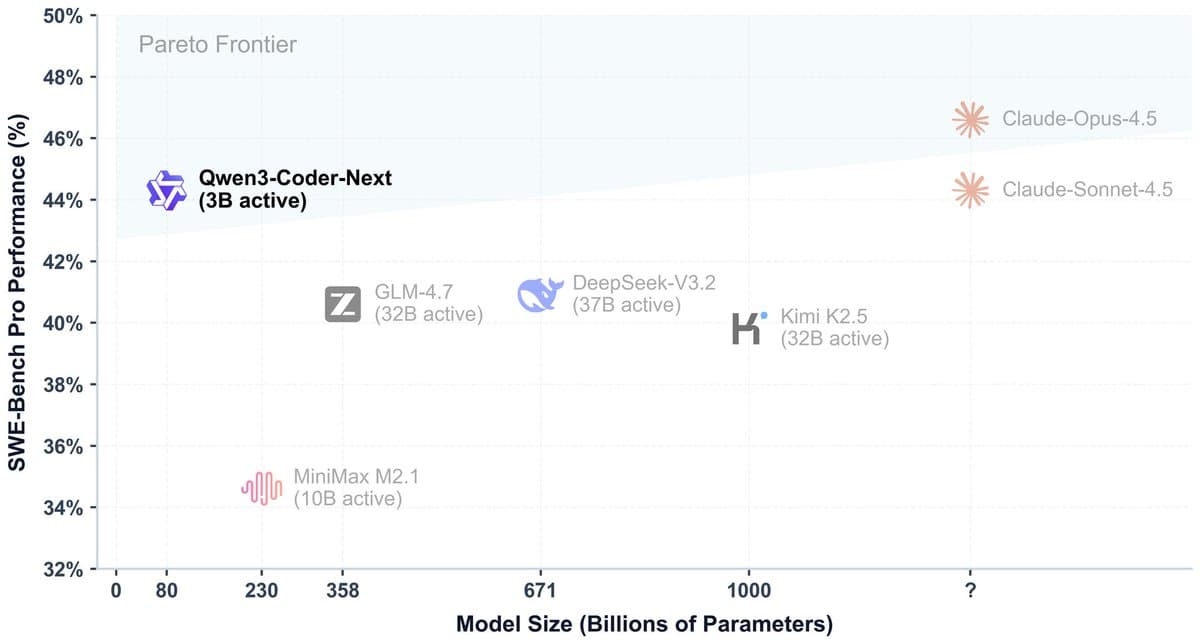
Alibaba has introduced Qwen3-Coder-Next, a groundbreaking coding agent model that represents a significant leap forward in AI-assisted software development. According to a report from HuggingPapers, this 80-billion parameter model activates only 3 billion parameters during inference while maintaining competitive performance on major coding benchmarks. This development signals a new approach to balancing model capability with computational efficiency.
The Technical Breakthrough: Selective Parameter Activation
The most remarkable aspect of Qwen3-Coder-Next is its ability to operate with just 3B active parameters despite having an 80B parameter foundation. This selective activation mechanism represents a sophisticated approach to model efficiency that could redefine how large language models are deployed in production environments.
Traditional large language models activate their entire parameter set during inference, leading to substantial computational costs. Alibaba's approach appears to implement a more dynamic system where only relevant portions of the model are engaged based on the specific coding task at hand. This selective parameter activation could dramatically reduce inference costs while maintaining the benefits of a large, knowledgeable model.
Benchmark Performance and Capabilities
Qwen3-Coder-Next has demonstrated competitive performance on two significant benchmarks: SWE-Bench and Terminal-Bench. SWE-Bench evaluates models on real-world software engineering problems drawn from actual GitHub repositories, making it one of the most challenging and realistic assessments of coding ability. Terminal-Bench focuses on command-line interface tasks, testing a model's ability to work with shell commands and terminal operations.
The model's strong performance on these benchmarks suggests it can handle complex, practical coding scenarios rather than just theoretical exercises. This practical orientation aligns with the growing demand for AI assistants that can meaningfully contribute to real software development workflows.
The 256K Context Window Advantage
Another key feature of Qwen3-Coder-Next is its support for a 256,000-token context window. This extended context capacity allows the model to process and understand significantly larger codebases, documentation, and project structures than models with smaller context windows.
For software development tasks, this expanded context is particularly valuable. Developers often need to reference multiple files, understand complex dependencies, and maintain awareness of project architecture while working on specific coding problems. A 256K context window enables Qwen3-Coder-Next to maintain this broader project awareness, potentially making it more effective at understanding and contributing to large-scale software projects.
Implications for the AI Coding Assistant Landscape
The release of Qwen3-Coder-Next comes at a time when AI coding assistants are becoming increasingly sophisticated and widely adopted. Tools like GitHub Copilot, Amazon CodeWhisperer, and various open-source alternatives have established the value proposition of AI-assisted development. Alibaba's entry with this efficiency-focused approach could shift competitive dynamics in several ways.
First, the selective parameter activation approach addresses one of the primary barriers to deploying large coding models: computational cost. If Alibaba can maintain high performance while dramatically reducing inference costs, this could make advanced coding assistance more accessible to organizations with limited computational resources.
Second, the combination of large parameter foundation with selective activation represents a potentially scalable approach to model development. As models continue to grow in size, techniques that allow selective engagement of relevant capabilities will become increasingly important for practical deployment.
The Broader Context of AI Model Efficiency
Qwen3-Coder-Next arrives amid growing industry focus on making large language models more efficient and practical for production use. Techniques like mixture-of-experts architectures, quantization, pruning, and distillation have all gained attention as methods to reduce the computational burden of large models while preserving capabilities.
Alibaba's approach appears to fit within this broader trend toward efficiency, but with a distinctive implementation focused on parameter-level selectivity rather than architectural modifications or post-training compression. This suggests that multiple paths to efficiency are being explored simultaneously across the AI research community.
Potential Applications and Use Cases
Given its capabilities, Qwen3-Coder-Next could find applications across various software development scenarios:
- Enterprise software development: Large organizations with complex codebases could benefit from the model's extended context window and efficient inference.
- Education and training: The efficiency of the model could make it more accessible for educational institutions teaching programming.
- Open-source development: Individual developers and small teams could leverage the model despite limited computational resources.
- Code review and quality assurance: The model's understanding of larger code contexts could enhance automated code review systems.
Looking Ahead: The Future of Efficient AI Coding
The introduction of Qwen3-Coder-Next represents more than just another entry in the crowded field of coding assistants. It demonstrates a viable path toward making large, capable models more practical for everyday use through intelligent parameter management.
As the software development industry continues to integrate AI tools into workflows, efficiency will become an increasingly important differentiator. Models that can provide advanced capabilities without prohibitive computational costs will likely gain adoption advantage, particularly in cost-sensitive environments.
Alibaba's approach also raises interesting questions about the future direction of model architecture. If selective parameter activation proves successful at scale, we may see more models designed with similar efficiency principles from the ground up, potentially changing how researchers think about model size and capability trade-offs.
Source: HuggingPapers report on Alibaba's Qwen3-Coder-Next release