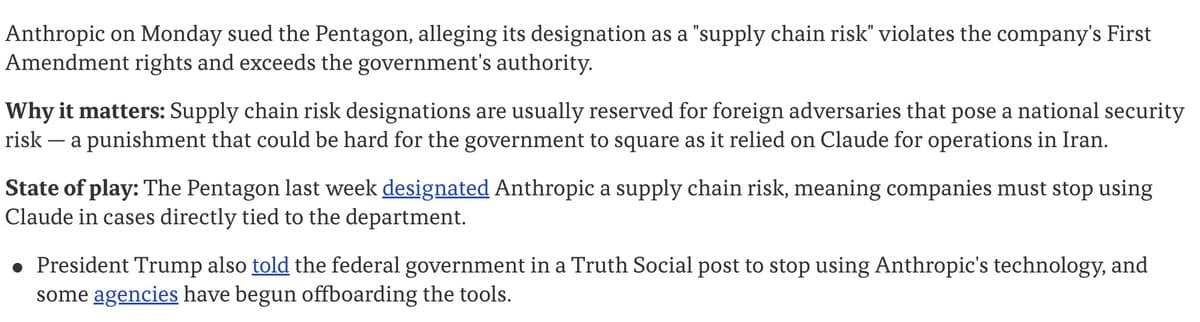
In a landmark legal confrontation between the artificial intelligence industry and the U.S. military establishment, Anthropic—the AI safety company behind Claude—has filed two lawsuits against the Department of Defense. The legal action comes in response to the Pentagon designating Anthropic as a "supply chain risk," a classification that has traditionally been reserved for foreign adversaries and companies posing national security threats.
The Unprecedented Designation
The "supply chain risk" designation represents a significant escalation in the government's approach to AI companies. According to reporting from Axios, this label is typically applied to entities with foreign ownership, control, or influence that might compromise the integrity of defense supply chains. By applying this classification to Anthropic—a U.S.-based company founded by former OpenAI researchers—the Pentagon has effectively placed the AI safety firm in the same category as potential foreign adversaries.
Anthropic's legal filings argue that this designation creates substantial business disadvantages, potentially limiting the company's ability to contract with government agencies and damaging its reputation in both public and private sectors. The classification could trigger additional scrutiny under defense procurement regulations and create barriers to partnerships with other technology companies that work with the Department of Defense.
First Amendment at the Core
At the heart of Anthropic's legal argument is the claim that the Pentagon's action violates the company's First Amendment rights. The lawsuits contend that the "supply chain risk" designation functions as punishment for Anthropic's public advocacy regarding AI safety and ethical constraints on military applications of artificial intelligence.
Anthropic has been notably vocal about establishing safeguards against certain uses of AI technology, particularly opposing applications in mass surveillance systems and autonomous weapons platforms. The company's leadership, including co-founder Dario Amodei, has consistently emphasized the importance of developing AI with built-in safety constraints and ethical boundaries.
The legal filings suggest that the Pentagon's designation represents a form of viewpoint discrimination—penalizing Anthropic for expressing positions on AI ethics that may conflict with military interests or procurement objectives. This raises fundamental questions about whether government agencies can use administrative classifications to disadvantage companies based on their policy advocacy.
Broader Implications for AI Governance
This legal confrontation occurs against a backdrop of increasing tension between AI developers and government agencies over the appropriate governance framework for advanced artificial intelligence. The Department of Defense has been actively pursuing AI capabilities for various military applications, while companies like Anthropic have advocated for more cautious approaches that prioritize safety and ethical considerations.
The case highlights the growing divide between AI companies that emphasize safety constraints and those more willing to engage in military applications. It also raises questions about how the government should categorize and regulate domestic AI companies that develop dual-use technologies with both civilian and military applications.
Industry observers note that the outcome of this legal battle could establish important precedents for how AI companies interact with defense agencies and whether ethical positioning on military applications can result in formal government sanctions. The case may also influence how other AI firms approach public advocacy on sensitive topics related to national security and military technology.
The Evolving AI-Military Relationship
The Anthropic-Pentagon conflict reflects broader shifts in the relationship between technology companies and military institutions. In recent years, several major tech companies have faced internal and external pressure regarding military contracts, with employee protests at Google over Project Maven and similar controversies at Microsoft and Amazon.
Anthropic's case represents a new dimension in this ongoing tension—a company facing potential government sanctions specifically because of its ethical stance on military AI applications. This suggests that the debate has moved beyond voluntary corporate decisions about military contracts to potential government actions against companies based on their policy positions.
The legal proceedings will likely examine whether the Pentagon's designation represents a legitimate national security assessment or an improper response to Anthropic's advocacy. The case may also explore what constitutes appropriate grounds for "supply chain risk" classifications and whether domestic companies can be categorized alongside foreign adversaries based on their policy positions rather than actual security threats.
Looking Ahead
As the lawsuits progress through the legal system, several key questions will come into focus: How will courts balance national security concerns with First Amendment protections for corporate speech? What standards should govern "supply chain risk" designations for domestic technology companies? And how should the government approach AI companies that develop potentially dual-use technologies while advocating for constraints on military applications?
The outcome could have far-reaching implications for the AI industry, potentially influencing how companies engage in policy debates about military applications of artificial intelligence. It may also affect the Defense Department's approach to working with AI companies that have ethical constraints on certain applications of their technology.
This case represents a critical test of how American institutions will navigate the complex intersection of technological innovation, free speech protections, and national security imperatives in the age of advanced artificial intelligence.
Source: Reporting based on information from Axios via @kimmonismus on X/Twitter