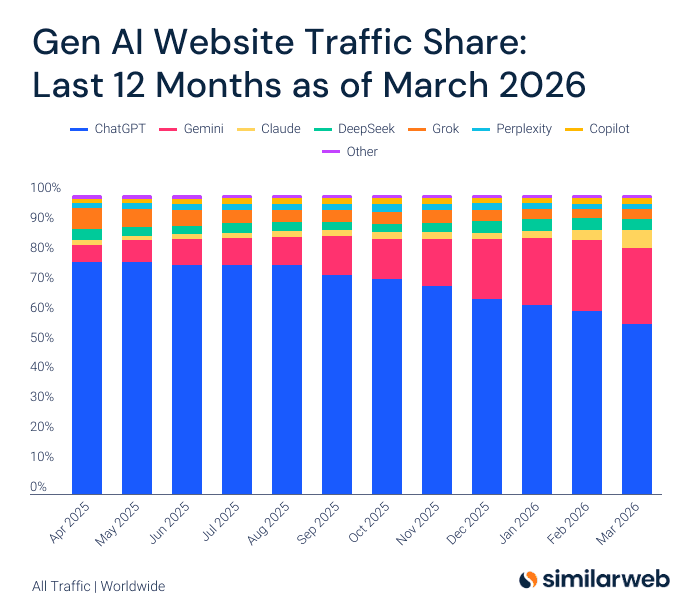
New data indicates a dramatic shift in the generative AI landscape, with OpenAI's ChatGPT losing significant market share to competitors from Google and Anthropic. According to traffic analysis, ChatGPT's share of generative AI traffic has fallen from 77% to 57% over the past twelve months—a 20 percentage point decline that signals the end of its early monopoly.
Key Takeaways
- ChatGPT's share of generative AI traffic fell from 77% to 57% over twelve months.
- Google's Gemini now holds 25% and Anthropic's Claude has grown to 6%, creating a three-way market race.
The New Competitive Landscape
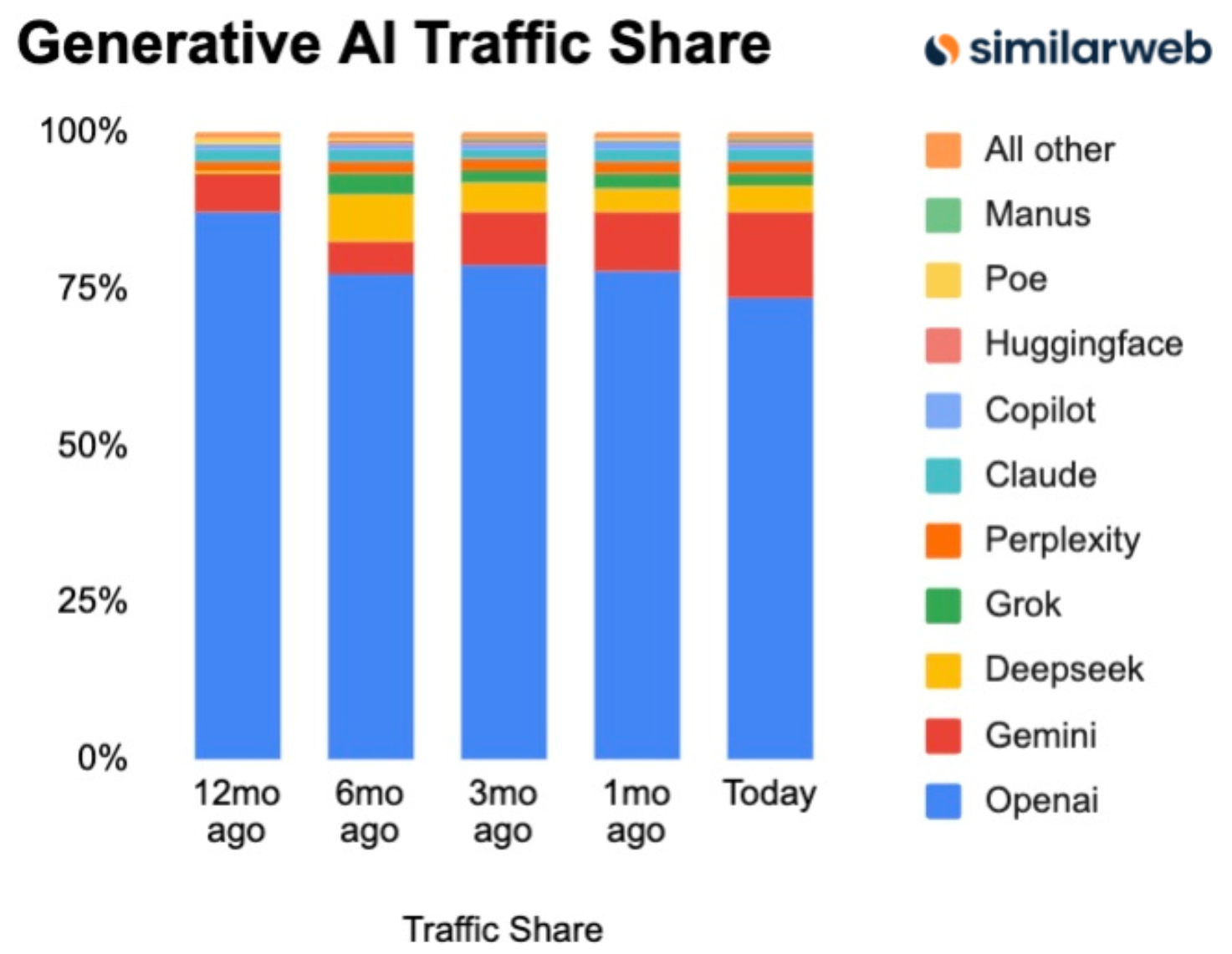
The most significant gainer has been Google's Gemini, which now commands 25% of generative AI traffic. This surge reflects Google's ecosystem advantage, with Gemini integrated across Search, Workspace, Android, and other core products that reach billions of users.
Anthropic's Claude has shown particularly rapid growth, nearly tripling its share to reach 6% in just the past month. This acceleration coincides with heated public debate about Claude's "Mythos" persona, which appears to have served as effective marketing despite—or perhaps because of—the controversy.
The Also-Rans
Other players remain in single-digit territory:
- DeepSeek: Below 4%
- Grok: Below 4%
- Microsoft Copilot: Below 4%
- Perplexity: Below 4%
This distribution suggests the market has consolidated into a genuine three-way race between OpenAI, Google, and Anthropic, with other providers struggling to break through the 4% threshold.
What's Driving the Shift
Google's Distribution Moat: Google's massive existing user base across Search, Gmail, Docs, and Android provides a built-in advantage for Gemini adoption. Users don't need to seek out a new service—they encounter Gemini within products they already use daily.
Claude's Quality Perception: Despite having far less distribution than either OpenAI or Google, Anthropic has gained traction through perceived quality. The data suggests that even general consumers are willing to switch platforms for what they perceive as superior performance, particularly in areas like reasoning and safety.
Market Maturation: As generative AI moves from novelty to utility, users are becoming more discerning and willing to experiment with alternatives. The initial "ChatGPT or bust" mentality has given way to more nuanced evaluation of different models for different tasks.
What This Means for Developers and Businesses
For AI developers and companies building on these platforms, the fragmentation creates both challenges and opportunities:
Multi-Model Strategies: Companies can no longer assume ChatGPT integration will cover their entire user base. Supporting multiple AI backends (ChatGPT, Gemini, Claude) may become necessary to reach different user segments.
Pricing Leverage: With genuine competition emerging, platform providers may face pressure on pricing and terms. The era of take-it-or-leave-it API pricing may be ending.
Specialization Opportunities: As the market fragments, there's room for providers to differentiate through specialization—whether by use case (coding, creative writing, analysis), industry verticals, or performance characteristics.
gentic.news Analysis
This traffic shift represents the most significant redistribution of market power since ChatGPT's initial launch in November 2022. The data confirms what industry observers have suspected: Google's ecosystem advantage is translating into rapid adoption, while Anthropic's focus on model quality is resonating with users despite limited marketing spend.
The timing is particularly notable given recent developments across all three companies. OpenAI continues to iterate with GPT-4o and rumored GPT-5 developments, but faces increasing competition on both the consumer and enterprise fronts. Google has been aggressively integrating Gemini across its product suite since the Gemini 1.5 Pro launch in February 2024, and this data suggests those integrations are paying dividends. Anthropic's growth spike coincides with increased public discussion of Claude 3.5 Sonnet's capabilities and the controversial "Mythos" persona debate, which appears to have driven awareness and trial.
Looking forward, the key question is whether this represents a temporary rebalancing or the beginning of sustained fragmentation. Google's distribution advantage suggests Gemini's gains may be durable, while Anthropic will need to maintain its quality edge as OpenAI and Google continue to improve their models. For the sub-4% players, the challenge becomes finding sustainable niches or differentiators that can help them break out of the pack.
Frequently Asked Questions
How was this AI traffic share data collected?
The source doesn't specify the methodology, but similar analyses typically come from web analytics platforms tracking visits to AI service websites and applications, API usage patterns from developer platforms, or aggregated data from browser extensions and toolbars. The key insight is the relative change over time rather than absolute numbers.
Does this mean ChatGPT is losing users?
Not necessarily—the generative AI market overall is growing rapidly. ChatGPT could be gaining absolute users while still losing relative market share as competitors grow even faster. However, a 20-point decline in share over twelve months suggests competitive pressure is real and significant.
Why is Google Gemini growing so quickly?
Google's primary advantage is distribution: Gemini is integrated into products used by billions, including Google Search, Gmail, Docs, and Android. Users don't need to seek it out—they encounter it naturally within their existing workflows. This "ecosystem moat" is difficult for standalone services to compete against.
Can Anthropic's Claude compete without Google's distribution?
The data suggests yes, at least to a point. Claude has reached 6% share primarily through word-of-mouth and perceived quality rather than massive distribution. However, to grow beyond single digits, Anthropic will likely need either strategic partnerships (similar to OpenAI's with Microsoft) or significant investment in distribution channels.