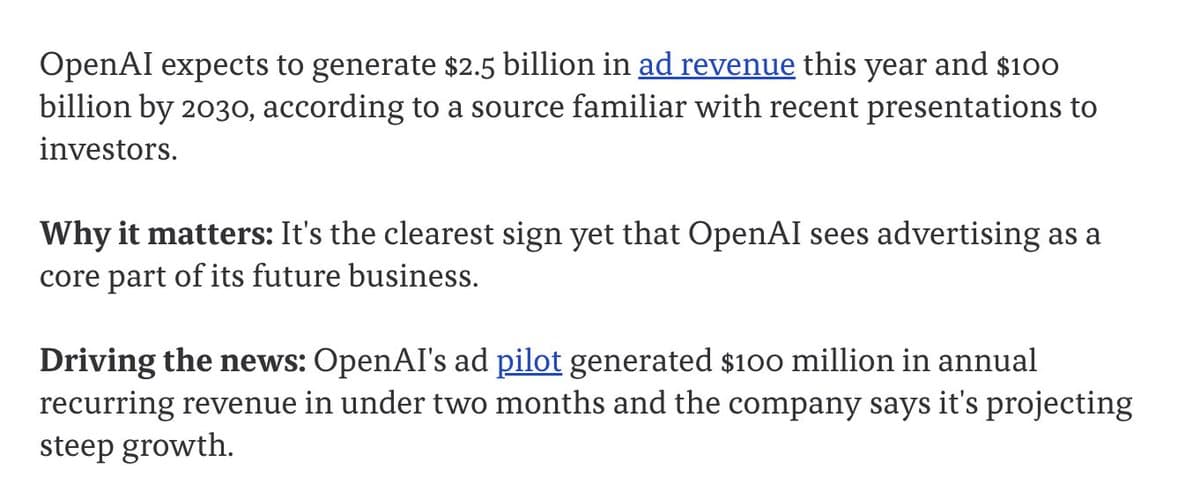
OpenAI is making a massive, explicit bet on advertising as a core revenue pillar, projecting $2.5 billion in ad revenue for 2026 with an audacious goal of scaling to $100 billion by 2030. This strategic pivot, reported by Axios, is based on projections that OpenAI's products will reach 2.75 billion weekly users by the end of the decade, allowing it to capture a significant share of the global digital advertising market.
The move represents a fundamental shift in the company's business model and places it in direct competition with the current titans of digital advertising: Google, Meta, Amazon, and TikTok. It also creates a stark philosophical and strategic divide with key rival Anthropic, which has publicly committed to keeping its Claude assistant ad-free.
The Advertising Ambition
The core of OpenAI's projection hinges on achieving unprecedented user scale. The company's models, including ChatGPT and any future integrated consumer products, would need to reach nearly 2.75 billion weekly active users by 2030 to support a $100 billion advertising business. For context, Meta's family of apps (Facebook, Instagram, WhatsApp, Messenger) currently serves over 3.98 billion monthly active users.
OpenAI's reported thesis is that chatbot interactions provide a "unique advantage" because users explicitly state their intent, needs, and what they want to buy. This declared intent could theoretically allow for more precise, contextually relevant, and higher-conversion advertising compared to the keyword-based or interest-inferred models used by current platforms.
The Competitive Landscape
This strategy puts OpenAI on a collision course with the world's largest companies.
Direct Competitors:
- Google: Dominates search advertising ($237.86 billion in revenue in 2023). ChatGPT and AI-powered search directly threaten Google's core query-based ad model.
- Meta: Leader in social media advertising ($134.90 billion in 2023). AI assistants could absorb time spent and intent that currently flows to social platforms.
- Amazon: Leader in retail/media advertising ($46.9 billion in 2023). Product discovery and purchasing intent in chatbots could bypass Amazon's marketplace.
AI Industry Divergence: The move creates a clear fork in the road for AI business models. Anthropic has staked its position on being ad-free, potentially relying on subscription fees (Claude Pro) and enterprise API sales. OpenAI now appears to be pursuing a hybrid model: subscription tiers (ChatGPT Plus) for premium access, enterprise API sales, and a massive, scaled advertising business for its free or lower-tier consumer products.
Technical and Product Implications
For this strategy to work, OpenAI's product roadmap will need to evolve significantly:
Massive Scale & Integration: Achieving 2.75B weekly users likely requires deep integration of OpenAI's models into operating systems (like the reported Apple partnership), social platforms, and other ubiquitous consumer software, far beyond a standalone chat interface.
Ad Format Innovation: Simply slapping banner ads into a chatbot would be ineffective and jarring. OpenAI would need to pioneer new, native ad formats that feel organic to a conversational interface—think sponsored suggestions, product comparisons within a dialogue, or affiliate-style recommendations.
Intent & Privacy Engine: The "unique advantage" of declared intent relies on building a sophisticated real-time intent-parsing and ad-matching engine. This also raises immediate and significant questions about user privacy, data usage, and opt-out mechanisms, areas where tech giants are under constant regulatory scrutiny.
What This Means in Practice
If executed, this would transform OpenAI from a primarily B2B/developer-focused API company and niche consumer app into one of the world's largest media companies. The $100 billion target is staggering; for comparison, the entire global digital advertising market was estimated at $455 billion in 2023. OpenAI is aiming to capture over a fifth of a vastly larger future market.
gentic.news Analysis
This is a tectonic shift in OpenAI's strategy and the AI industry's economic landscape. For years, the dominant question was whether the future of AI monetization lay in enterprise APIs (like OpenAI's own GPT-4 Turbo) or consumer subscriptions. OpenAI is now signaling a third, far more aggressive path: building a user base at Meta-like scale and monetizing it through advertising at Google-like efficiency.
This aligns with the broader trend of AI companies seeking diversified, scaled revenue. Microsoft, OpenAI's primary investor and partner, has successfully layered advertising into its ecosystem (LinkedIn, Bing, Xbox). OpenAI's move can be seen as an attempt to build its own independent, scaled revenue stream beyond Microsoft's cloud credits, reducing long-term dependency. It also follows the natural lifecycle of many digital platforms: attract users with a free, powerful utility, achieve network effects at massive scale, and then monetize through advertising.
The direct contrast with Anthropic is the most immediate industry implication. Anthropic's "ad-free" commitment is a core part of its brand identity around safety and user alignment. OpenAI's ad-driven path will test user tolerance for commercial messages within an assistant they may rely on for sensitive tasks. This creates a clear market segmentation: Anthropic for the privacy-conscious and premium experience, OpenAI for the ubiquitous, free (ad-supported) utility.
Finally, the $100 billion by 2030 target is an audacious declaration of war on Google and Meta. It assumes OpenAI can not only build a superior AI product but also master the immensely complex arts of ad tech, real-time bidding, brand safety, and global sales—domains where the incumbents have decades of experience and entrenched relationships. The success of this bet hinges entirely on whether conversational AI becomes the primary interface for the internet, displacing traditional search and social feeds.
Frequently Asked Questions
How does OpenAI plan to show ads in a chatbot?
The source material does not specify exact formats, but the stated advantage is "chatbot users explicitly state what they want to buy." This suggests ads could be integrated as sponsored suggestions, product recommendations, or comparative shopping links within the conversation flow, triggered by user intent. It would likely be more native than traditional banner ads.
Is ChatGPT going to have ads now?
The projections are for 2026 and beyond. While the free tier of ChatGPT is the most obvious starting point, the scale required (2.75B weekly users) implies ads will be integrated across a much broader suite of future OpenAI-powered products and partnerships, not just the current ChatGPT interface.
How does OpenAI's ad plan compare to Google's business?
OpenAI is directly targeting Google's core search advertising business. Google's ads are based on parsing search query intent. OpenAI believes the richer, declarative context of a conversation (e.g., "I need a comfortable running shoe for long distances on pavement") provides even better intent signals than a short search query (e.g., "best running shoes"), potentially allowing for more valuable ads.
Why is Anthropic against ads for Claude?
Anthropic has stated a commitment to keeping Claude ad-free, aligning with its principles of building safe, trustworthy AI. The company likely views advertising as a potential misalignment incentive that could compromise the assistant's neutrality or push it to optimize for engagement and commercial outcomes over user benefit.