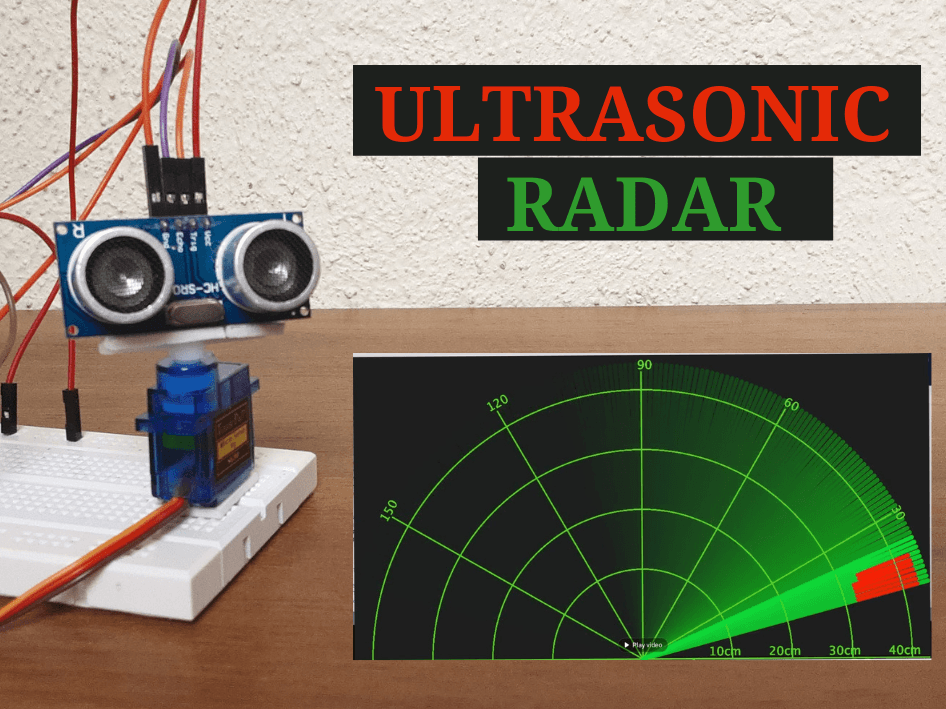
A recent hobbyist project demonstrates that sophisticated real-time environmental sensing and spatial mapping can be achieved with remarkably simple, low-cost hardware. The build, highlighted by the @_vmlops account, uses an Arduino microcontroller, a standard HC-SR04 ultrasonic sensor, and a servo motor to create a functional, radar-like scanning system.
What Was Built
The core system is an electromechanical scanner. A servo motor rotates an ultrasonic sensor through a sweeping arc, typically 180 degrees. As it rotates, the sensor continuously emits ultrasonic pulses. When these sound waves encounter an object, they reflect back to the sensor. The Arduino measures the time delay between the pulse emission and the echo return.
Using the known speed of sound, the microcontroller calculates the distance to the object with the formula: Distance = (Speed of Sound × Time Delay) / 2. The division by two accounts for the sound wave's round trip.
How the System Works
The process creates a polar coordinate map. For each angular position of the servo (theta) and each calculated distance (r), the system plots a point. This data is sent in real-time to a connected computer, where a simple processing script (often in Python using libraries like Pygame or Matplotlib) visualizes the points on a radar-style display. Closer objects appear as points or blips nearer the center of the circular sweep; the angle corresponds to the object's relative bearing.
Key Technical Components:
- Microcontroller: An Arduino Uno or similar (ATmega328P, 16 MHz clock, 2KB SRAM).
- Sensor: HC-SR04 Ultrasonic Sensor (range ~2cm to 400cm).
- Actuator: Standard hobby servo motor (e.g., SG90).
- Logic: Basic control loop: position servo, trigger sensor, listen for echo, calculate, transmit data via serial.
This project requires no machine learning model or neural network. The "intelligence" is the elegantly simple physical scanning procedure and the fundamental physics-based calculation performed by the microcontroller. It's a textbook example of a cyber-physical system.
Why This Matters for Embedded AI & Sensing
While not AI in the ML sense, this project embodies core principles relevant to the edge AI and TinyML communities:
- Minimalist Compute: It performs a useful sensing task—real-time spatial mapping—on a microcontroller with kilobytes of memory and no operating system. It challenges the assumption that advanced sensing always requires high-performance processors.
- Sensor Fusion Pattern: The project combines a distance sensor with a positional actuator (servo) to create a new capability (2D scanning) that neither component has alone. This pattern is fundamental in robotics.
- Accessibility & Education: The total hardware cost is under $30. It serves as a perfect, tangible introduction to real-time systems, sensor interfacing, serial communication, and data visualization—key concepts for embedded AI development.
Limitations and Reality Check
The system has clear constraints. The HC-SR04 sensor has a wide beam angle, leading to low angular resolution and fuzzy object edges. Measurement accuracy is affected by temperature and humidity (which change the speed of sound) and can struggle with sound-absorbing materials. The refresh rate is limited by the servo's speed and the sensor's measurement cycle time. It is a demonstrator, not a production-grade LIDAR alternative.
However, its value is pedagogical and inspirational. It proves a complex sensing concept can be implemented and understood from the ground up.
gentic.news Analysis
This project sits at the intersection of two growing trends we track closely: the democratization of hardware prototyping and the push toward efficient, specialized edge compute. While major industry efforts (like NVIDIA's Jetson platform, Google's Coral Edge TPU, or the rise of RISC-V) focus on enabling more complex ML models at the edge, this Arduino build represents the opposite, equally important pole: solving problems with the least possible compute.
This philosophy aligns with the broader "right-sizing" movement in AI infrastructure. Not every task needs a transformer. As covered in our analysis of [RELATED ARTICLE: e.g., 'MLPerf Tiny Benchmark Results Highlight Diversity of Edge AI Approaches'], the benchmark for success at the edge is often power efficiency, cost, and latency—not just raw accuracy. This ultrasonic radar is an extreme example of optimizing for cost and simplicity.
Furthermore, it highlights the enduring importance of fundamental robotics and signal processing skills. Before layering on deep learning for object classification, a developer must reliably gather spatial data—exactly what this project teaches. It's a foundational skill set that remains critical even as higher-level AI tools become more accessible. This build is a reminder that sometimes the most elegant solution is a clever application of physics and a few lines of C++, not a 100MB neural network.
Frequently Asked Questions
Can this Arduino radar system identify what objects are?
No, in its basic form, it cannot identify objects. It is a rangefinder that maps distance points. It can tell you "something is 50cm away at 30 degrees," but not whether that something is a person, a chair, or a wall. Adding object identification would require integrating a camera and running a computer vision model, which is far beyond the capability of a basic Arduino Uno.
How accurate is this DIY ultrasonic radar compared to LIDAR?
It is significantly less accurate and has lower resolution than even low-cost LIDAR sensors. LIDAR uses laser light, which has a very narrow beam, allowing for precise point measurements. Ultrasonic sensors have a wide beam, resulting in poor angular resolution. LIDAR is also faster and more accurate over longer ranges. This Arduino project is best for understanding principles and detecting coarse object presence, not for high-fidelity mapping.
What programming languages are used for a project like this?
The firmware on the Arduino is typically written in C++ using the Arduino IDE. The visualization on the connected computer is commonly written in Python due to its excellent libraries for data plotting (Matplotlib) and simple GUI creation (Pygame, Tkinter). The two programs communicate via a serial (USB) connection.
Is this considered an Artificial Intelligence project?
Not in the contemporary sense of machine learning or neural networks. It is a sensing and automation project. However, it demonstrates embedded intelligence—the ability of a simple system to perceive its environment and represent it meaningfully. The data it produces could be fed into an AI system for further analysis, making it a potential front-end sensor for a larger intelligent system.