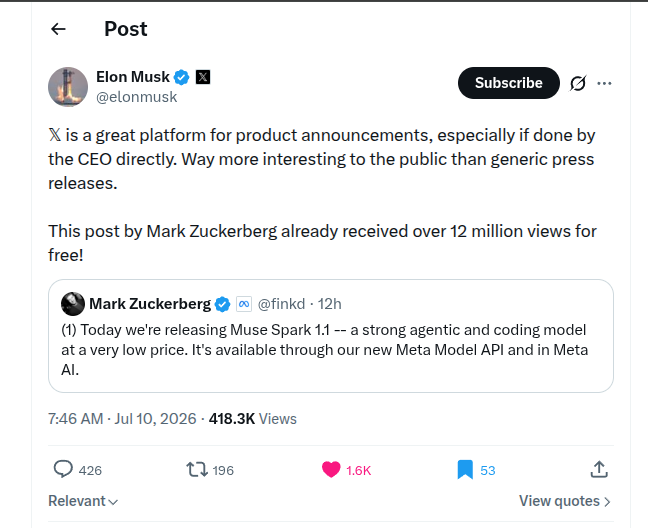
Meta has released a new AI model named Muse Spark, marking the company's first model launch since CEO Mark Zuckerberg publicly committed to a massive increase in AI investment and a strategic shift toward open-source development earlier this year.
The announcement was highlighted by AI commentator Rohan Paul, who noted the release follows a period where Zuckerberg has been "writing checks like crazy" for AI infrastructure and talent.
What Happened
Meta's AI research division has launched Muse Spark, a new model whose specific architecture, capabilities, and scale have not yet been detailed in the initial announcement. The launch represents the first tangible output from Meta's renewed and heavily funded AI push, which Zuckerberg framed as essential to the company's future.
Context
This release follows Zuckerberg's January 2026 announcement where he stated Meta would "go all in on AI" and dramatically increase spending on AI infrastructure, including plans to acquire hundreds of thousands of next-generation GPUs. He emphasized a commitment to open-source AI development, positioning Meta against more closed approaches from competitors like OpenAI and Google.
The launch of Muse Spark suggests Meta's AI research teams are beginning to ship products from this accelerated investment cycle. The model's name hints at possible creative or multimodal capabilities, but technical specifications, benchmarks, and availability details are pending further official communication from Meta AI.
What to Watch
Practitioners should monitor for the release of a technical report or paper detailing Muse Spark's architecture, training data, and performance metrics. Key questions include:
- Is Muse Spark a text, multimodal, or code model?
- What scale is it (parameter count)?
- Will it be released under an open-source license, as per Zuckerberg's stated direction?
- How does it compare to Meta's previous flagship models like Llama 3?
gentic.news Analysis
This launch is the first concrete step in validating Zuckerberg's aggressive AI strategy. In early 2026, he committed to building "the most popular and most advanced AI products and services," directly challenging the current landscape dominated by OpenAI's GPT models and Google's Gemini. The Muse Spark release indicates that Meta's internal R&D pipeline is active and beginning to output new models, likely aiming to close the perceived gap with industry leaders.
The strategic context is critical. Zuckerberg's shift to champion open-source AI (evident in the Llama series releases) created a distinct niche for Meta, appealing to developers and researchers frustrated by closed APIs. If Muse Spark follows this open approach, it could quickly become a foundational model for the open-source community, similar to how Llama 2 and 3 were adopted. However, if it's a closed product, it would represent a significant pivot and a more direct confrontation with OpenAI's business model.
Timing is also key. The AI landscape in early 2026 is intensely competitive, with rapid iterations from all major players. A new model release from Meta was expected, but the speed of this launch—just months after the funding announcement—suggests either a repackaging of existing research or a highly accelerated development cycle fueled by massive compute investment. The AI engineering community will scrutinize Muse Spark's performance closely; it needs to be competitive with the latest offerings from Anthropic's Claude 3.5 Sonnet and Google's Gemini 1.5 Pro to be taken seriously as a top-tier model.
Frequently Asked Questions
What is Meta's Muse Spark AI model?
Muse Spark is a newly announced AI model from Meta. It is the first model the company has released since CEO Mark Zuckerberg's public commitment in early 2026 to massively increase AI spending and infrastructure. Specific technical details about its capabilities, size, and architecture are not yet available.
Is Muse Spark open source?
The licensing model for Muse Spark has not been announced. However, Meta's recent strategy, articulated by Zuckerberg, has strongly favored open-source AI development (as seen with the Llama series). The community expects Muse Spark to be released under a permissive open-source license, but this remains unconfirmed.
How does Muse Spark compare to Llama 3?
Without published benchmarks or a technical paper, a direct comparison is impossible. The name "Muse Spark" suggests it may be a different class of model than the Llama series, potentially focusing on creative tasks, multimodality, or a specific application. It could also be a successor or a larger-scale version built on similar principles.
Why is Meta releasing new AI models now?
Meta is executing on a strategic pivot announced in early 2026, where CEO Mark Zuckerberg stated the company would "go all in" on AI to remain competitive. The release of Muse Spark is the first visible output of that initiative, which includes procuring vast amounts of new GPU hardware and focusing R&D efforts on generative AI.