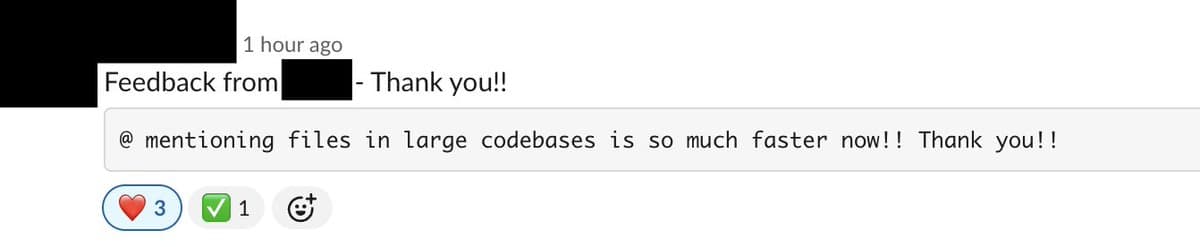
Anthropic has detailed a significant performance optimization for its Claude Code AI coding assistant, specifically targeting the @-mention feature used to reference files, functions, and symbols within massive enterprise codebases. The update, prompted by feedback from a major enterprise customer, results in a 3x speed improvement for this common developer workflow in large-scale environments.
Key Takeaways
- Anthropic has released technical details on optimizing the @-mention feature in Claude Code, achieving a 3x speedup for large enterprise codebases.
- This addresses a critical performance bottleneck for developers working in massive, legacy code repositories.
What Happened
Boris Cherny, Head of Product at Anthropic, shared on X that a "big enterprise customer" using Claude Code within "one of the world's biggest codebases" provided positive feedback, which led the team to investigate and optimize the performance of @-mentions. The @ feature allows developers to quickly reference and insert code from other parts of the repository directly into their current context, a critical capability when navigating complex, million-line codebases.
The Performance Bottleneck & Fix
In large enterprise codebases—often characterized by decades of legacy code, monolithic architectures, and complex dependency graphs—the initial implementation of the @-mention feature faced scalability challenges. The system needed to search, index, and retrieve relevant code symbols across potentially hundreds of thousands of files. The performance lag directly impacted developer productivity, creating friction in an otherwise streamlined AI-assisted workflow.
While the specific technical details of the optimization were not fully disclosed in the public thread, such improvements typically involve:
- Enhanced Indexing: Moving from on-the-fly searches to pre-computed, incremental, or more efficient symbol indexes.
- Query Optimization: Rewriting the search and retrieval algorithms to reduce complexity, perhaps leveraging vector similarity more effectively or pruning irrelevant search branches faster.
- Caching Strategies: Implementing smarter, context-aware caching of frequently accessed symbols or file structures specific to a developer's current working module.
The result is a feature that now responds three times faster in the environments where performance matters most: the sprawling, intricate codebases of large financial institutions, tech giants, and legacy enterprises.
Why This Matters for Enterprise AI Adoption
This optimization is a textbook example of product-market fit refinement for AI developer tools in the enterprise. While raw benchmark scores on curated coding challenges are important for marketing, real-world adoption hinges on solving specific, painful workflows. For enterprise developers, latency is a primary killer of tool adoption. A feature that takes 3 seconds feels broken; one that takes 1 second feels seamless. By directly addressing a performance pain point reported by a large customer, Anthropic is signaling a focus on the practical, day-to-day usability of Claude Code, not just its theoretical capabilities.
This move also highlights the competitive battleground in AI-assisted coding. It's no longer just about which model can solve the most LeetCode problems. The race is increasingly about integration depth, workflow understanding, and performance at scale. Speed and reliability inside massive, real-world codebases are features that directly compete with established tools like GitHub Copilot Enterprise, which is deeply integrated into the IDE and optimized for large repositories.
gentic.news Analysis
This performance tweak, while seemingly minor, is strategically significant. It demonstrates Anthropic's responsive enterprise engagement model and its commitment to optimizing for scale—a core differentiator for Claude models, which are often marketed on their robustness and safety for large organizations. This follows Anthropic's established pattern of targeting the enterprise segment with Claude 3.5 Sonnet and its suite of tool-use features, positioning itself against OpenAI's ChatGPT Enterprise and Microsoft's GitHub Copilot suite.
The feedback loop described—a major enterprise customer reporting an issue, leading to a targeted, publicized optimization—is a powerful signal to the market. It shows Anthropic is listening to high-value clients and prioritizing improvements that affect productivity in tangible ways. This aligns with the broader industry trend we noted in our coverage of Datadog's AI monitoring report, where inference latency and cost were identified as the top two concerns for companies deploying AI applications. Anthropic is attacking the latency problem at the feature level.
Furthermore, this underscores a key trend in the AI coding assistant space: the fight is moving from capability to experience. Most top-tier models (GPT-4, Claude 3.5 Sonnet, DeepSeek-Coder) can generate competent code. The winners will be those that best integrate into developer workflows, with minimal friction and maximal understanding of project context. Anthropic's deep optimization for large codebases is a direct play to win the trust of developers in the most complex environments, where the productivity payoff is highest.
Frequently Asked Questions
What is the @-mention feature in Claude Code?
The @-mention feature allows developers to reference specific files, functions, classes, or other code symbols from anywhere in their codebase directly within their chat prompt to Claude Code. For example, typing @ might bring up a list of relevant functions from a utils.js file to easily insert or discuss them, saving the developer from manually finding and copying code snippets.
Why is speed for this feature so important in enterprise codebases?
Enterprise codebases can contain millions of lines of code across hundreds of thousands of files. A slow search across this vast, interconnected graph of code can halt a developer's flow, making the AI tool feel sluggish and impractical. A 3x speedup turns a potentially frustrating wait into a near-instantaneous action, which is critical for maintaining productivity and developer satisfaction.
How does Claude Code's optimization compare to GitHub Copilot's performance?
While direct, head-to-head benchmarks on this specific feature are not publicly available, the announcement is a clear competitive move. GitHub Copilot, deeply integrated into IDEs like VS Code, has invested heavily in context-aware completions and understanding large repositories. Anthropic's optimization directly addresses a perceived weakness to compete on equal footing in the enterprise environment, where Copilot Enterprise is a strong incumbent.
Does this optimization apply to all users of Claude Code?
The optimization is likely most pronounced and impactful for users working with very large code repositories. Users with smaller projects may not notice a significant difference, as performance was likely already adequate. The fix is engineered specifically for the scale and complexity challenges unique to massive enterprise systems.