What Happened
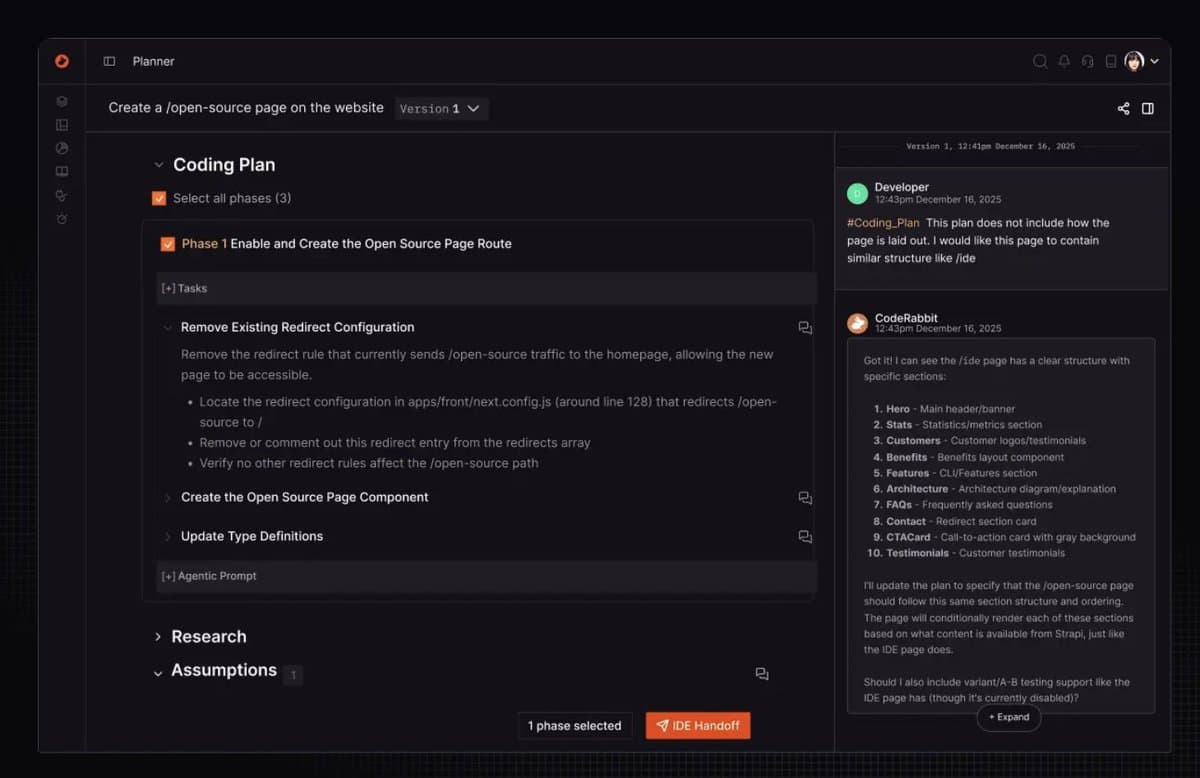
CodeRabbit, an AI-powered code review platform, has launched a new feature called Planner. According to the announcement, Planner is designed to address a fundamental problem in AI-assisted development: most failures originate not from bad code generation, but from inadequate planning and architectural misalignment before implementation begins.
The core workflow is:
- Describe what you want to build.
- Attach relevant context: Product Requirements Documents (PRDs), existing documentation, or relevant code.
- Generate a structured implementation plan.
- Align your team on this plan.
- Build the feature according to the agreed-upon architecture.
The stated goal is to transform the pull request review process from a stage for architectural debate into one for validation against a pre-approved plan.
Technical Details & Integration
A key technical specification mentioned is agent lock-in avoidance. CodeRabbit states Planner works with multiple popular AI coding environments and assistants, specifically naming:
- Cursor
- Claude Code
- Codex
This suggests the planning output is likely a structured document (e.g., a specification, task breakdown, or architecture diagram) that can be consumed by a developer using their tool of choice, rather than being tightly coupled to CodeRabbit's own code generation agent.
Context
CodeRabbit is primarily known for its AI reviewer that analyzes pull requests, provides feedback, and can suggest changes. The launch of Planner represents a strategic expansion upstream in the development lifecycle, positioning the tool at the design and planning phase rather than just the review phase.
The feature directly targets a growing pain point in AI-driven development: while LLMs can generate syntactically correct code rapidly, they often lack the broader context of a codebase's architecture, leading to solutions that are locally correct but globally incompatible. Planner attempts to inject that architectural and planning context at the outset.
The promise is that by forcing alignment before coding begins, teams can reduce costly rework and circular debates during code review, making the review process more efficient and focused on correctness rather than design.