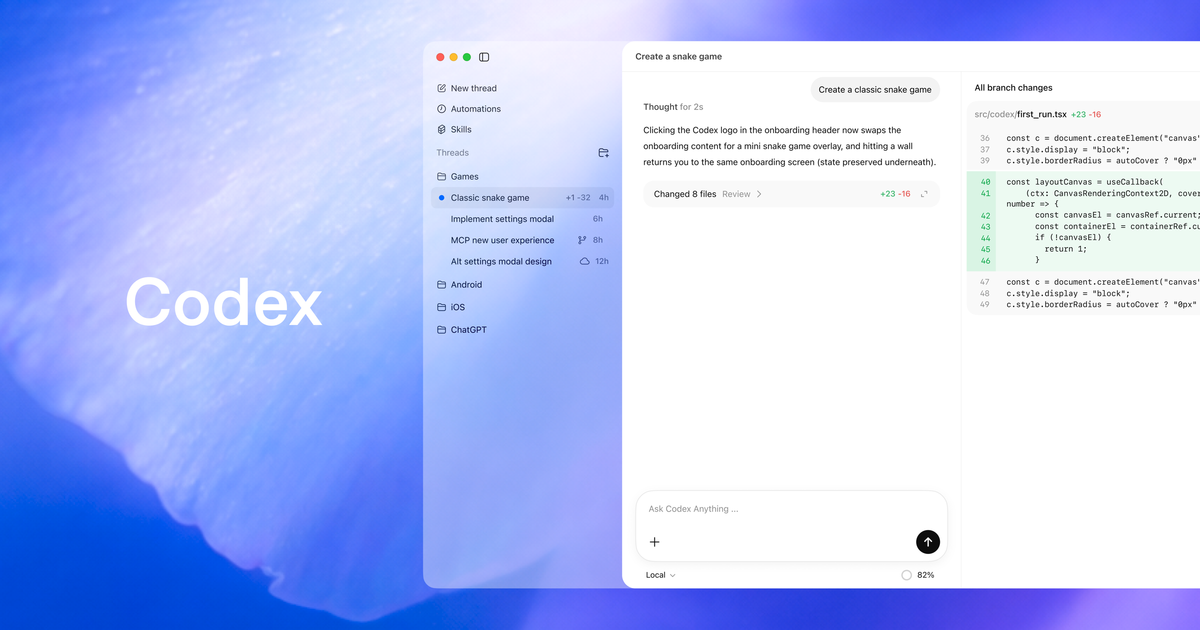
Codex app update cuts GUI workflow latency 42%, per @intheworldofai. The LLM now operates interfaces nearly as fast as a human.
Key facts
- 42% speed improvement in latest Codex update.
- First LLM to operate GUI near human speed.
- Capabilities include full app building and bug fixing.
- Supports reading console and network logs.
- Iterates autonomously until task completion.
The latest Codex app update delivers a 42% speed improvement for GUI workflows, according to a post by @intheworldofai. The claim marks a notable leap: this is the first time an LLM has operated a graphical user interface at near-human speed.
Codex now supports a range of autonomous capabilities: building full applications, testing flows in the browser, clicking through interfaces, detecting and fixing bugs, reading console and network logs, and iterating until a task is complete. The update leverages the underlying Computer Use model, which was previously demonstrated by Anthropic in Claude 3.5 Sonnet for desktop automation.
What’s new vs. what existed
Prior versions of Codex could automate simple web tasks but required explicit step-by-step instructions and often tripped on dynamic UI elements. The 42% speed gain suggests a shift from scripted automation to true agentic behavior — the model now perceives screen state and reacts in real time. Anthropic’s Claude 3.5 Sonnet with Computer Use, released in October 2024, achieved similar autonomous GUI control but at slower latencies (typically 5-10 seconds per action). Codex’s update appears to close that gap.
Unique take
The real signal here isn’t the 42% number — it’s the claim “nearly as fast as a real person.” If true, this collapses the last major argument against AI-driven UI automation: that it’s too slow for production workflows. For enterprise RPA vendors like UiPath and Automation Anywhere, this represents an existential threat — their value prop has been speed and reliability, not intelligence.
Who this affects
Software engineers building internal tools, QA engineers automating browser testing, and product teams prototyping full-stack apps. The capability to “iterate until the task is complete” without human intervention could reduce debugging cycles from hours to minutes.
Limitations
The source is a single social media post with a video demo. No independent benchmarks, no latency histograms, no error-rate data. The 42% improvement is relative to an unspecified baseline — likely the previous Codex version, not a human baseline. The video duration and task complexity are undisclosed.
What to watch
Watch for independent latency benchmarks on SWE-Bench or WebArena. If Codex achieves sub-5-second task completion on standard GUI tests, expect RPA vendors to respond with their own LLM integrations within 90 days.
[Updated 04 May via hn_claude_code]
Security researchers have demonstrated six exploits that broke AI coding agents including Codex, according to VentureBeat. The attacks targeted credential theft by injecting malicious code into the agent's workflow. For example, one exploit tricked Codex into executing a command that exfiltrated environment variables containing API keys. The findings highlight a critical vulnerability: as Codex gains speed and autonomy, its ability to interact with GUIs and logs also exposes it to prompt injection and supply-chain attacks [per VentureBeat].