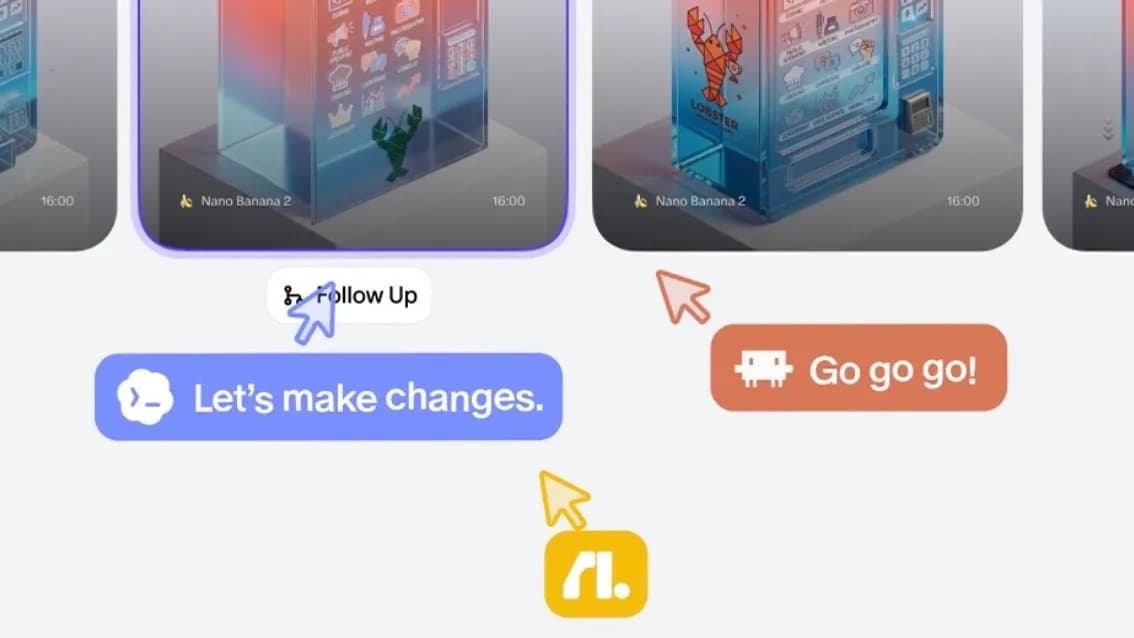
A new platform from Cognition Labs appears to be the first to create a shared, visible digital workspace where multiple AI coding agents and human developers can collaborate in real-time. Based on a demonstration shared online, the platform, tentatively called a "canvas for agents," shows AI systems like OpenAI's Codex and Anthropic's Claude Code operating simultaneously on a shared canvas, with their outputs and actions visible to human collaborators.
What Happened
Cognition Labs, the AI research and product company best known for developing the AI software engineer Devin, has showcased an early version of a collaborative workspace. The demonstration shows multiple AI agents—specifically identified as Codex and Claude Code—actively creating and editing code on a shared digital canvas. The human user is present in the same workspace, able to observe, direct, and presumably edit alongside the AI agents. The core innovation is the visibility and simultaneity: instead of a human typing a prompt into a chat interface and waiting for a single AI's response, multiple specialized agents are visually present and working concurrently.
Context & Technical Implications
This development represents a conceptual leap from the current paradigm of human-AI interaction in coding. Today's tools typically involve a single user with a single AI assistant (like GitHub Copilot or Cursor) in a one-on-one, largely invisible interaction. The agent's "thinking" is hidden behind a chat window. Cognition's canvas makes the agents' contributions tangible and separate, turning collaboration into a multi-party, visual activity.
While specific technical details of the platform are not yet public, the demo suggests several key features:
- Multi-Agent Environment: Support for different AI models (Codex, Claude Code) to be instantiated as distinct agents.
- Shared State & Visibility: A synchronized workspace where all participants see the same canvas and each agent's edits in real-time.
- Orchestration Layer: A system to manage the agents, likely assigning tasks, managing context, and resolving conflicts—a significant technical challenge.
This follows Cognition Labs' established trajectory in agentic AI. After the launch of Devin, an autonomous AI software engineer capable of handling complex engineering tasks from start to finish, the company has been focused on expanding the practical applications of AI agents. A shared canvas is a logical next step, moving from a single, powerful agent to an ecosystem where multiple specialized agents can be managed by a human in a collaborative workflow.
gentic.news Analysis
This demo from Cognition Labs is a significant marker in the evolution of AI from a tool to a teammate. It directly builds upon the company's core thesis, demonstrated with Devin, that AI can handle end-to-end tasks. However, the canvas shifts the focus from full autonomy to supervised collaboration. This may be a strategic pivot acknowledging that for complex, creative, or high-stakes work, humans want to stay in the loop—not just issue a command and wait for a result.
The choice of agents is telling. Codex (powering GitHub Copilot) is renowned for its code completion and generation from context, while Claude Code is recognized for its strong reasoning and instruction-following capabilities. Putting them in the same workspace suggests a vision where a human "manager" can leverage different AI strengths for different subtasks simultaneously, akin to having a speed-coder and a meticulous architect working side-by-side.
This development also intersects with a major trend we've been tracking: the platformization of AI agents. In 2025, we covered the emergence of platforms like smolagents and frameworks from Google and Microsoft aimed at making it easier to build, orchestrate, and deploy multi-agent systems. Cognition's canvas appears to be a bold, productized implementation of this trend, targeting the high-value domain of software creation. It creates a new surface area for human-AI interaction that sits between fully manual coding and fully autonomous AI deployment.
The major unanswered questions are about orchestration and cost. How does the system decide which agent does what? How are conflicts handled if two agents suggest different edits? Furthermore, running multiple state-of-the-art LLMs concurrently is computationally expensive. The business model and practical accessibility of this canvas will be critical to its adoption.
Frequently Asked Questions
What is the "Canvas for Agents"?
It is a collaborative digital workspace developed by Cognition Labs where human software developers can work alongside multiple AI coding agents (like Codex and Claude Code) in real-time. All participants are visible on a shared canvas, allowing for simultaneous editing and observation.
How is this different from GitHub Copilot or Cursor?
Current AI coding assistants are primarily one-to-one tools. You interact with a single AI through a chat or inline suggestions, and its process is largely invisible. The Canvas for Agents is a many-to-many environment. It visualizes multiple AI agents as distinct entities working concurrently, transforming the interaction from using a tool to managing a team.
Which AI models does it support?
Based on the initial demonstration, the platform supports OpenAI's Codex (the model behind GitHub Copilot) and Anthropic's Claude Code. The architecture likely allows for the integration of other coding-focused LLMs or specialized agents.
When will this be available to the public?
Cognition Labs has only shared an early demonstration. There is no official release date or public beta announcement. The company typically moves from research to product cautiously, as seen with the controlled access to Devin.
What are the biggest technical challenges for a platform like this?
The key challenges are agent orchestration (directing tasks, managing context, and resolving conflicts between agents), maintaining a consistent shared state across all participants, and the significant computational cost of running multiple high-performance LLMs simultaneously for a single user session.