What Happened
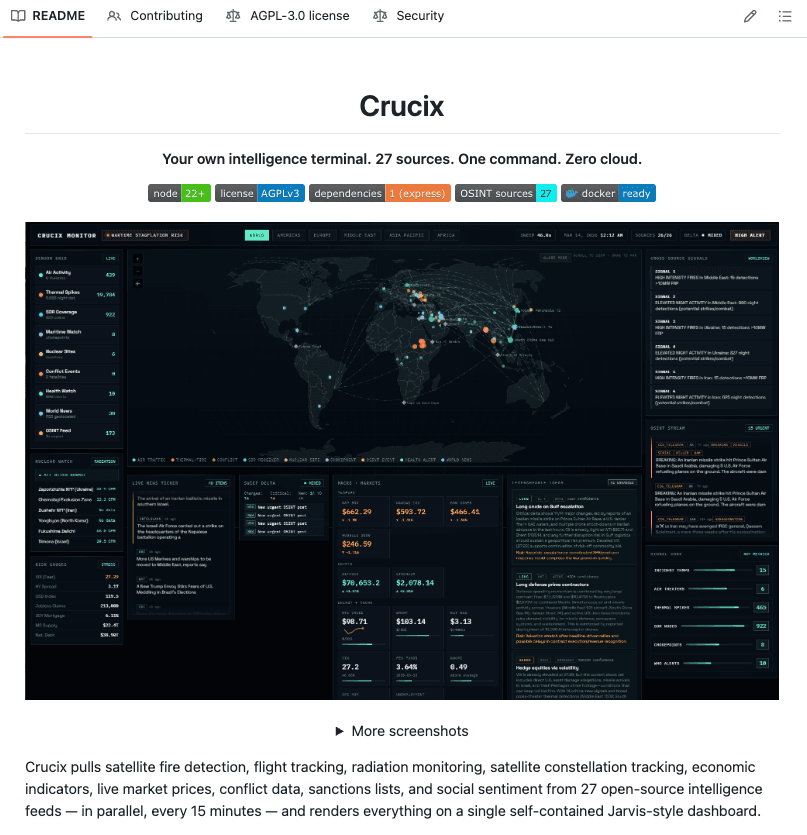
A developer has released Crucix, an open-source personal intelligence terminal that aggregates 26 real-time open-source intelligence (OSINT) feeds into a single dashboard running entirely on local hardware. The tool is distributed under the MIT license with no cloud dependencies, telemetry, or subscription fees.
What It Actually Does
Crucix pulls data from 26 distinct OSINT sources in parallel every 15 minutes, rendering the information on a unified interface. The feeds include:
- NASA satellite fire and thermal anomaly detection (FIRMS)
- Real-time ADS-B flight tracking across six hotspot regions
- Maritime vessel tracking including "dark ships" that go off radar
- Radiation monitoring near six nuclear sites (Safecast + EPA RadNet)
- Armed conflict events including battles, explosions, and protests (ACLED)
- UN humanitarian crisis tracking and WHO disease outbreak alerts
- US Treasury sanctions and global sanctions lists
- FRED economic indicators including yield curve, CPI, VIX, and M2
- Live market data for SPY, QQQ, BTC, Gold, WTI, and VIX
- 17 curated Telegram channels for OSINT, conflict, and finance
- Social sentiment from Bluesky and Reddit
- Global HF radio receiver network (KiwiSDR, approximately 600 receivers)
Two-Way Intelligence Assistant
When connected to a local LLM (via API), Crucix functions as an analytical assistant that can:
- Evaluate signals across all 26 sources simultaneously
- Classify alerts into FLASH, PRIORITY, or ROUTINE tiers
- Generate trade ideas grounded in cross-domain data
- Respond to commands like
/brief,/sweep, and/statusfrom mobile devices
The system also includes Telegram and Discord bots that operate with a rule-based engine when no LLM is connected.
Technical Implementation
Crucix requires no cloud infrastructure and runs entirely on the user's machine. According to the source, 18 of the 26 sources require no API keys at all. The three sources that "unlock the most value"—NASA FIRMS, FRED, and EIA—offer free registration and reportedly take about 60 seconds to set up.
Deployment appears straightforward: running node server.mjs starts the server.
Context
While governments and large organizations typically invest millions in intelligence fusion platforms, Crucix represents a grassroots approach to OSINT aggregation. The tool's value proposition centers on accessibility, privacy (zero telemetry), and cost (free). The inclusion of both passive monitoring and active LLM-assisted analysis distinguishes it from simpler dashboard tools.
No performance benchmarks, system requirements, or detailed architecture documentation were provided in the source material.