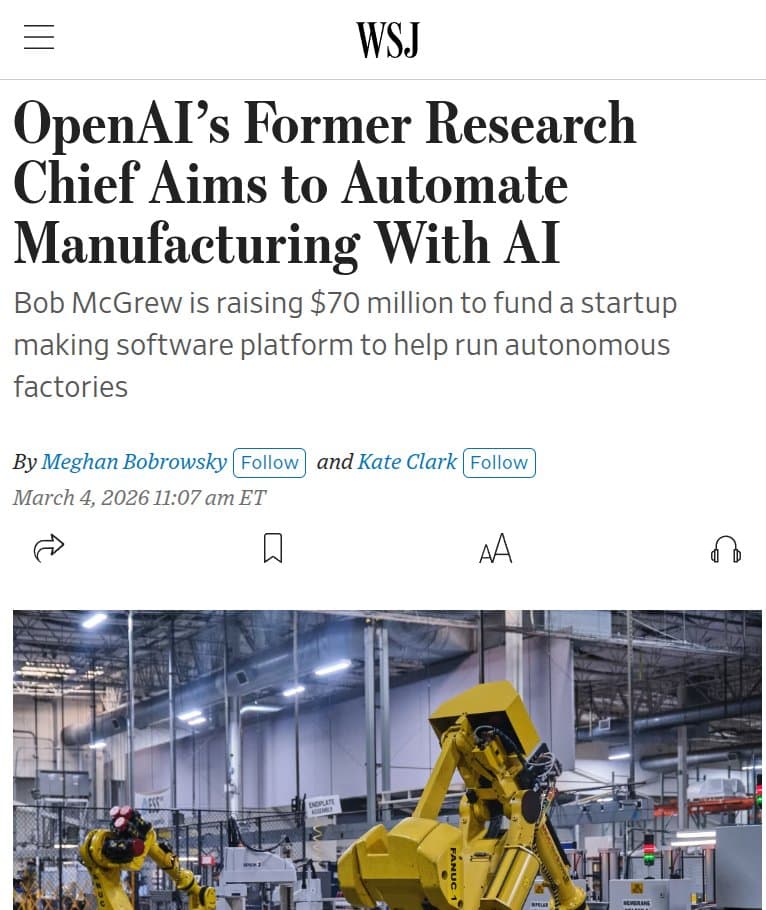
Former OpenAI research chief Bob McGrew is spearheading a bold new venture that could fundamentally transform how factories operate. According to a Wall Street Journal report, McGrew is raising $70 million at a $700 million valuation for his startup Arda, which builds software to automate manufacturing facilities using a novel video-based AI approach.
The Arda Vision: Learning by Watching
At the core of Arda's technology is a simple yet revolutionary concept: instead of programming robots with rigid, predetermined instructions, the company's AI system learns by watching actual footage from production floors. This video-based model observes how tasks are performed by human workers, then uses those visual insights to train robotic systems to handle physical manufacturing jobs autonomously.
"The system uses those visual insights to train robotic systems to handle physical manufacturing jobs autonomously," according to the report. This approach represents a significant departure from traditional industrial automation, which typically requires extensive programming and customization for each specific task.
Bridging the Simulation-to-Reality Gap
McGrew's background is particularly relevant to this challenge. During his eight years at OpenAI, he focused specifically on teaching robots physical tasks, working at the intersection of AI research and practical robotics implementation. This experience gave him firsthand knowledge of one of the most persistent problems in robotics: the "simulation-to-reality gap," where systems that perform well in controlled environments struggle when faced with the messy, unpredictable conditions of real-world factories.
Arda's video-based approach directly addresses this challenge by training AI models on actual factory footage rather than simulated environments. This means the systems learn from real-world variations, unexpected events, and the nuanced ways human workers adapt to changing conditions.
The Team Behind the Technology
McGrew isn't tackling this challenge alone. He's joined by veterans from Adept AI and Palantir, bringing together expertise from some of the most innovative companies in AI and data analytics. This combination of talent suggests Arda is positioned to create not just better robotics, but an integrated platform that can coordinate complex manufacturing operations.
According to the report, "The platform coordinates both machines and human workers across the entire production cycle from early design to final assembly." This holistic approach recognizes that the future of manufacturing isn't about replacing humans entirely, but about creating more effective human-machine collaborations.
Why This Matters: Solving the Automation Bottleneck
The manufacturing industry has been pursuing automation for decades, but progress has often been slow and expensive. Traditional robotic systems require extensive programming and customization, making them inflexible and difficult to adapt to new products or processes. This creates what McGrew and his team see as a major bottleneck in manufacturing innovation.
"Applying generative video models directly to physical robotics solves a major bottleneck by letting machines learn through observation rather than rigid coding," the report notes. This approach could dramatically reduce the time and cost required to implement automation in factories, potentially making advanced robotics accessible to smaller manufacturers who couldn't previously afford such systems.
The Broader Implications for AI and Robotics
Arda's approach represents an important convergence of several AI trends. First, it applies generative video models—similar to those used in creating synthetic media—to the practical challenge of understanding physical processes. Second, it represents a move toward embodied AI, where artificial intelligence isn't just processing information but interacting with the physical world. Third, it demonstrates how foundation models trained on vast amounts of data (in this case, video footage) can be adapted to specific industrial applications.
This development comes at a critical time for global manufacturing. Supply chain disruptions, labor shortages, and increasing pressure to improve efficiency have made automation more urgent than ever. At the same time, advances in AI have created new possibilities for how that automation might be achieved.
Challenges and Considerations
While Arda's approach is promising, it faces significant challenges. Manufacturing environments are notoriously complex, with variations in lighting, materials, and processes that could confuse AI systems. There are also important questions about safety, reliability, and how these systems will integrate with existing manufacturing infrastructure.
Additionally, the human element remains crucial. Even the most advanced AI systems will need to work alongside human workers, requiring careful attention to user interfaces, training, and organizational change management. McGrew's emphasis on coordinating "both machines and human workers" suggests Arda is thinking about these challenges from the start.
The Future of AI-Driven Manufacturing
If successful, Arda could help usher in a new era of adaptive manufacturing, where factories can quickly reconfigure themselves for new products or processes. This would be particularly valuable in industries with short product lifecycles or high customization requirements, such as electronics, automotive, or medical devices.
The $700 million valuation for a company at this early stage reflects both the enormous potential of this market and the confidence investors have in McGrew and his team. Manufacturing represents one of the largest sectors of the global economy, and even small improvements in efficiency could translate to trillions of dollars in value.
As AI continues to advance, we're likely to see more ventures like Arda that apply cutting-edge research to practical industrial problems. The journey from OpenAI's research labs to factory floors represents an important maturation of AI technology—from impressive demonstrations to real-world solutions that could reshape entire industries.
Source: Wall Street Journal report on former OpenAI research chief Bob McGrew's startup Arda