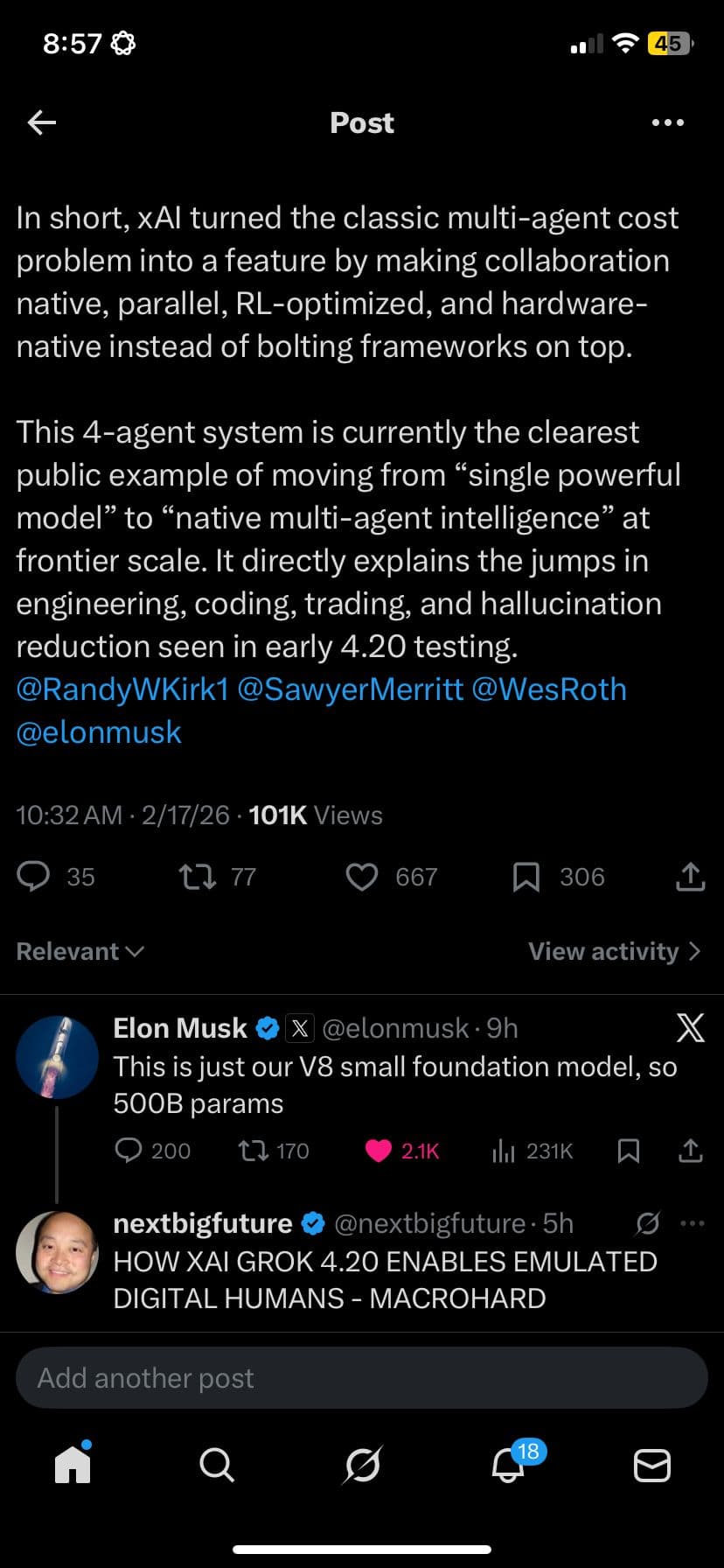
In a significant development in the competitive AI landscape, xAI's Grok 4.20 has emerged as a formidable contender against established frontier models, demonstrating particular strength in practical applications rather than theoretical benchmarks alone. According to exclusive confirmation from Elon Musk to Brian Wang of NextBigFuture, the current beta model operates with approximately 500 billion parameters and shows competitive or superior performance to models like OpenAI's GPT-5, Anthropic's Claude 4/Opus 4.5, and Google's Gemini 3 in key practical domains.
The Practical Performance Edge
Early testing consensus indicates Grok 4.20 excels specifically in areas that translate directly to real-world utility: practical coding, simulations, iterative work, and agentic tasks. This represents a strategic differentiation from models that might perform well on standardized benchmarks but struggle with applied problem-solving. The provisional LMSYS/Arena ELO rating of 1505–1535 places it competitively, with projections suggesting it could reach the #1 position once fully ranked—a significant jump from Grok 4.1 Thinking's 1483 rating.
What makes this development particularly noteworthy is the model's apparent ability to handle complex, multi-step processes that require persistence and adaptation. In agentic tasks—where AI systems must autonomously pursue goals through sequential actions—Grok 4.20 shows particular promise, suggesting advancements in planning and execution capabilities.
Technical Architecture and Scaling
The confirmation that Grok 4.20 is a ~500B parameter base model provides insight into xAI's technical approach. While not the largest model by parameter count (some frontier models exceed 1 trillion parameters), its performance suggests efficient architecture and training methodologies. The upcoming "Heavy mode" scaling to 16 agents represents a substantial increase in concurrent processing capability, potentially enabling more complex distributed problem-solving scenarios.
This development aligns with xAI's recently announced weekly improvement cycle, indicating a rapid iteration approach that contrasts with the longer development cycles of some competitors. The February 17 announcement of recursive intelligence growth implementation suggests xAI is pursuing continuous learning and improvement mechanisms that could accelerate capability development.
Benchmarking Context and the VeRA Framework
The timing of Grok 4.20's emergence coincides with broader developments in AI evaluation methodologies. The recent introduction of the VeRA framework (February 17) addresses longstanding issues with benchmark contamination and memorization by converting static benchmarks into executable specifications. This context is crucial for understanding Grok 4.20's performance claims, as traditional benchmarks have faced increasing criticism for not accurately reflecting real-world utility.
Grok 4.20's apparent strength in practical applications may reflect either intentional design choices by xAI or the limitations of current benchmarking approaches—or possibly both. The model's performance in simulations and iterative work suggests capabilities in dynamic environments that static benchmarks struggle to capture.
Competitive Landscape Implications
The AI competitive landscape has been dominated by a few major players, with OpenAI, Anthropic, and Google maintaining leadership positions. Grok 4.20's competitive performance represents a potential disruption, particularly given xAI's relatively recent entry into the field. The model's specific strengths in practical coding and agentic tasks could carve out a distinct market position, appealing to developers and enterprises seeking applied AI solutions rather than general conversational capabilities.
Anthropic's Claude series has emphasized ethical AI development, while xAI appears focused on rapid iteration and practical utility. These differing priorities reflect broader philosophical divisions in AI development approaches that extend beyond technical considerations alone.
Future Trajectory and Industry Impact
xAI's weekly update model promises recursive intelligence growth, suggesting an ambitious roadmap for continuous improvement. If sustainable, this approach could accelerate capability development beyond traditional training cycles. The Heavy mode's 16-agent scaling points toward increasingly sophisticated multi-agent systems capable of collaborative problem-solving.
For the AI industry, Grok 4.20's emergence signals several trends: the increasing importance of practical over theoretical performance, the potential for newer entrants to challenge established leaders through differentiated approaches, and the growing significance of agentic capabilities as AI moves from conversational interfaces to autonomous action.
The model's performance in simulations is particularly noteworthy given the expanding role of digital twins and simulation environments across industries from manufacturing to urban planning. Strong simulation capabilities could position Grok 4.20 as a valuable tool for predictive modeling and scenario analysis.
Challenges and Considerations
While early indications are promising, several questions remain. The model's performance across diverse real-world scenarios needs broader validation beyond early testers. The balance between rapid iteration and model stability represents an ongoing challenge, particularly for enterprise applications requiring reliability. Additionally, the computational requirements for the 16-agent Heavy mode and implications for accessibility and cost warrant consideration.
Ethical considerations surrounding increasingly capable agentic systems also require attention, particularly as AI systems gain greater autonomy in real-world tasks. xAI's approach to these considerations relative to competitors like Anthropic (with its stated emphasis on ethical AI) will likely influence adoption patterns, particularly in regulated industries.
Conclusion: A New Phase in AI Competition
Grok 4.20 represents more than just another model release—it signals a potential shift in what constitutes competitive advantage in AI. By demonstrating strength in practical applications rather than just benchmark performance, xAI is challenging established metrics of AI capability. The model's upcoming full release and subsequent performance in broader testing will provide clearer indication of whether this represents a temporary advantage or a more fundamental reorientation of AI development priorities.
As the VeRA framework and similar initiatives work to create more meaningful evaluation methodologies, the gap between benchmark performance and real-world utility may narrow. In the meantime, Grok 4.20's apparent strengths in coding, simulations, and agentic tasks suggest xAI has identified and targeted areas of immediate practical value—a strategy that could reshape competitive dynamics in the AI industry.
The coming weeks will reveal whether Grok 4.20 can maintain its projected trajectory to the top of rankings and, more importantly, whether its practical capabilities translate to sustained adoption and impact across industries seeking to leverage AI for complex, real-world problems.