The Innovation — What the Source Reports
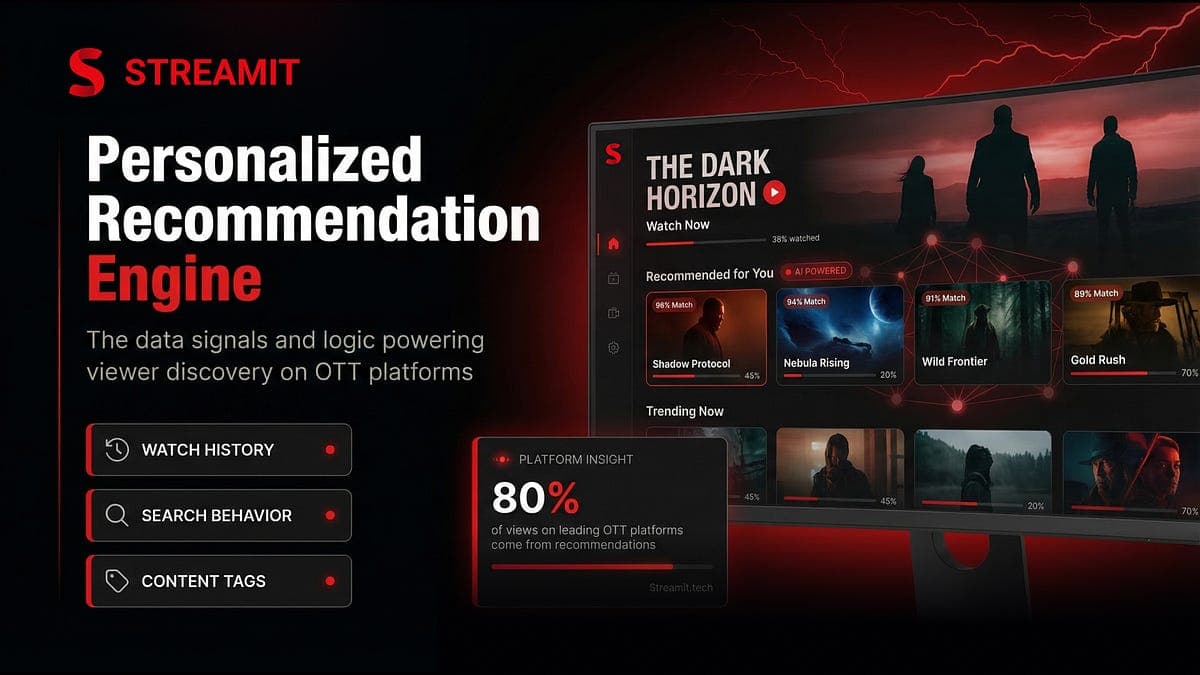
The source is a technical blog post published on Medium, a platform that has become a frequent host for expert implementation guides, as noted in our Knowledge Graph. The article's core claim is a powerful statistic: over 80% of content watched on major streaming platforms (like Netflix, Disney+, or HBO Max) originates from algorithmic recommendations, not from user-initiated search.
While the full article is behind Medium's subscription paywall, the snippet establishes the central thesis: personalized recommendation engines are not a nice-to-have feature but the primary engine of user engagement and content discovery in the OTT (Over-The-Top) video streaming industry. This model has fundamentally shifted consumption from a pull (search) to a push (recommendation) paradigm.
Why This Matters for Retail & Luxury
The direct parallel to retail and luxury is immediate and profound. The OTT model is a pure-play digital content retailer. Its business metrics—engagement, session time, conversion (to watching a show), retention, and lifetime value—are directly analogous to an e-commerce platform's KPIs.
For luxury and retail leaders, this is a validated case study in hyper-personalization at scale:
- Discovery Over Search: Just as viewers rarely know exactly what they want to watch next, luxury shoppers often browse for inspiration, not a specific SKU. A superior recommendation system surfaces the perfect handbag, pair of shoes, or fragrance the customer didn't know they desired, mirroring how Netflix suggests the next series.
- Driving Average Order Value (AOV): Effective OTT recommendations keep users in a "watch next" loop, increasing total watch time. In retail, this translates to effective cross-selling and up-selling ("Complete the look," "Others who bought this also loved..."), directly boosting AOV.
- Data as a Luxury Asset: The algorithms powering these engines feed on rich behavioral data—clicks, dwell time, abandonment, completion rates. For luxury houses, first-party data on browsing behavior, wishlist activity, and purchase history is a similarly invaluable asset for training proprietary recommendation models that reflect brand aesthetics and customer taste.
Business Impact
The cited 80% figure is a stark quantification of dependency. For a streaming service, a 10% improvement in recommendation relevance can translate to double-digit percentage increases in viewer retention and reduced churn. In luxury e-commerce, the impact is similarly measurable: improved conversion rates, higher customer lifetime value (LTV), and stronger brand loyalty through curated, relevant discovery.
This is not a new concept, but its validation in a multi-billion dollar adjacent industry reinforces its non-negotiable status. Failure to invest in a sophisticated, real-time recommendation engine means ceding 80% of potential engagement to competitors who do.
Implementation Approach
Building a production-grade recommendation engine for luxury retail involves several layers, many of which are covered in depth in prior gentic.news coverage of the Recommender Systems research topic.
- Data Foundation: Unifying siloed data (web, app, POS, CRM) into a customer 360 view is the first step. This is a data engineering challenge before it becomes an AI challenge.
- Algorithm Selection: Modern systems often use hybrid approaches:
- Collaborative Filtering: "Customers like you bought this." Effective but suffers from the cold-start problem for new items or users.
- Content-Based Filtering: "This product is similar to the one you viewed." Requires rich product attribute tagging (metadata, embeddings).
- Session-Based & Real-Time Models: Using short-term browsing behavior (like an OTT viewing session) to predict the next immediate intent. This is critical for capturing impulse.
- LLM Integration: As discussed in our related article, "When to Prompt, RAG, or Fine-Tune," Large Language Models can revolutionize this space. They can generate nuanced, natural-language recommendations ("This bag's architectural silhouette would complement your preference for minimalist design") and understand complex, multi-attribute user queries far beyond simple keyword matching.
- Infrastructure: The system must serve millions of personalized rankings in milliseconds. This requires robust MLOps pipelines, vector databases for similarity search, and continuous A/B testing frameworks to measure impact.
Governance & Risk Assessment
- Privacy & Consent: Luxury clients have exceptionally high privacy expectations. Using behavioral data for personalization must be transparent, opt-in where required by regulation, and secure. Anonymization and on-device processing are growing considerations.
- Bias & Brand Safety: Algorithms can inadvertently create filter bubbles or reinforce biases. A luxury brand must ensure its recommendations always align with brand values—promoting diversity in models and styles, not just bestsellers.
- The "Demo vs. Production" Gap: As highlighted in our recent analysis "Stop Shipping Demo-Perfect Multimodal Systems," a recommendation engine that works in a controlled demo can fail in production due to data drift, scaling issues, or latency. A production-first mindset is essential.
gentic.news Analysis
This Medium article, while focused on OTT, sits at the intersection of several critical trends we monitor. Medium itself has been a highly active entity in our coverage, appearing in 13 articles this week alone, often publishing the precise kind of technical, implementation-focused content that our audience of AI leaders values. This follows a pattern of recent, practical guides from the platform, such as the March 31st article exposing 'agent washing' and the March 29th guide comparing prompt engineering, RAG, and fine-tuning.
The core subject—Recommender Systems—is a foundational retail AI technology with direct applications far beyond streaming. The OTT industry's success is a proven blueprint. The key evolution for luxury is the infusion of LLM capabilities, a topic frequently explored in conjunction with MIT research in our graph, to move from statistical correlation to understanding nuanced style and intent. The challenge is no longer just "what is popular," but "what is authentically you and aligned with this brand's universe."
For technical leaders at LVMH, Kering, or Richemont, the takeaway is to audit their current recommendation capabilities against the OTT gold standard. Is 80% of your digital revenue coming from curated discovery paths? If not, the architectural patterns and algorithmic approaches are now well-documented, but their application requires a deep understanding of luxury's unique data, clientele, and brand ethos.