Jack Dorsey, co-founder of Twitter and CEO of Block (formerly Square), has shared a pointed observation on the state of artificial intelligence. In a recent statement, he emphasized the technology's capacity for daily surprise and the urgent need for corporate adaptation.
What Dorsey Said
Dorsey's comment, shared via a social media post, was concise: "Can I get it (AI) to do something that I didn't think it was capable of. And every single day it worked. Every single day I was surprised. Shift your company to be ahead of it. absolutely critical right now."
The statement captures a dual experience: personal, hands-on experimentation with AI tools that consistently defies expectations, and a strategic imperative for business leaders. The core directive is not just to adopt AI, but to proactively position an organization to anticipate and leverage its unpredictable advancements.
Context: Dorsey's AI Engagement
Dorsey's perspective is informed by his direct involvement. His fintech company, Block, has integrated AI and machine learning across its products, including Cash App and the Bitcoin-focused Spiral division. The company has discussed using AI for fraud detection, customer service, and financial modeling. His daily surprise suggests he is personally testing frontier models, likely including large language and code generation models, to explore applications for his businesses.
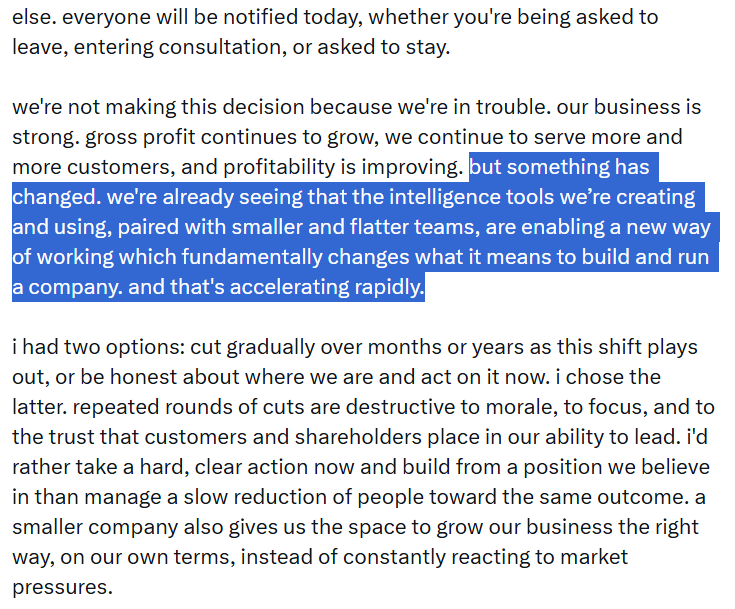
His call to action moves beyond the common narrative of "AI adoption" to "AI anticipation." It implies that the pace of capability expansion is so rapid that a reactive strategy—waiting for a technology to mature before implementing it—is a recipe for obsolescence.
The Broader Executive Sentiment
Dorsey joins a chorus of tech executives publicly grappling with AI's acceleration. Similar sentiments have been echoed by leaders like Satya Nadella of Microsoft, who has emphasized the need to "diffuse" AI across every layer of a company, and Jensen Huang of NVIDIA, who consistently describes accelerated computing and AI as fundamental shifts requiring re-architected workflows.
The unique angle in Dorsey's statement is the emphasis on personal, daily surprise. It underscores that the cutting edge of AI is not just evolving quarterly with major model releases, but is presenting novel, emergent behaviors to hands-on users on a much shorter timescale. This experiential reality is what makes strategic planning particularly challenging and urgent.
What "Shift Ahead" Means in Practice
For technical leaders, "shifting ahead" likely involves several concrete steps beyond typical R&D:
- Embedding Exploration in Workflows: Encouraging engineering and product teams to allocate time not just to implementing known AI solutions, but to systematically probing the latest models for unexpected capabilities relevant to their domain.
- Architectural Flexibility: Building software and data infrastructure that is inherently modular and adaptable, allowing new AI capabilities to be swapped in with minimal friction.
- Talent and Culture: Prioritizing the hiring of personnel who are not just practitioners but explorers of AI, and fostering a culture that rewards creative experimentation with new tools.
- Ethical and Operational Guardrails: As companies push ahead, establishing robust frameworks for evaluating the safety, fairness, and operational reliability of these surprising new applications becomes parallel critical work.
gentic.news Analysis
Dorsey's brief comment is a significant data point in the ongoing narrative of 2026, where the initial wave of LLM adoption has given way to a more nuanced and urgent phase of integration. The surprise he references is likely the emergent reasoning and problem-solving abilities observed in models like DeepSeek-R1, Claude 3.5 Sonnet, and the latest iterations of GPT, which continue to outperform benchmarks in unpredictable ways. As we covered in our analysis of DeepSeek-R1's performance on SWE-Bench, these models are now solving real-world coding problems at a level that was unthinkable just two years prior, directly impacting the product development cycles of companies like Dorsey's Block.
His warning aligns with a trend we've tracked: a move from centralized AI research teams to pervasive, embedded AI experimentation. This was evident in Databricks' $1.5B acquisition of Lilac AI last year, a move aimed at putting advanced data curation tools directly into the hands of every data engineer. Dorsey's call to "shift your company" is essentially an argument for this pervasive model, driven from the top.
However, this imperative exists in tension with other major trends. While Dorsey advocates for running ahead, the regulatory and safety landscape is applying brakes. The finalization of the EU AI Act and ongoing FTC scrutiny of AI partnerships create a complex environment where rapid deployment must be balanced with compliance. Furthermore, the staggering cost of training frontier models, highlighted by xAI's $6B funding round to compete with OpenAI and Google, means that "shifting ahead" is a game increasingly reserved for well-capitalized players or those with exceptionally clear use cases. Dorsey's Block, with its strong cash flow, is in the former category, but his advice is a stark reminder of the widening gap between companies that can afford to experiment daily and those that cannot.
Frequently Asked Questions
What AI tools is Jack Dorsey likely using?
While not specified, Dorsey, as a CEO of a major fintech company, likely has access to the full suite of frontier models via APIs from OpenAI (GPT-4o/5), Anthropic (Claude 3.5 Sonnet), Google (Gemini 2.0), and open-source leaders like Meta (Llama 3.2) and DeepSeek. His surprise likely stems from testing the limits of these models in complex, multi-step tasks related to finance, code, and strategy.
What does "shift your company to be ahead of it" mean?
It means moving from a passive, adoption-based AI strategy to an active, anticipatory one. Instead of waiting for proven AI solutions for a specific business problem, companies should be architecting their systems and training their teams to rapidly identify and integrate new AI capabilities as soon as they emerge, even if the immediate application isn't fully defined.
Is Dorsey's view on AI consistent with his past statements?
Dorsey has historically been a proponent of decentralized technologies, like Bitcoin. His push for companies to get ahead of AI is a pragmatic business stance rather than a purely ideological one. It reflects his experience running Block, where AI is a tool for competitive advantage in payments and financial services, aligning with his practical, builder-centric approach to technology.
How can a small company "shift ahead" with limited resources?
For smaller teams, "shifting ahead" may focus less on training models and more on agile integration. This means leveraging cloud-based AI APIs, using agentic workflow platforms (like Cognition's Devin or Magic.dev's tools), and prioritizing a culture of experimentation. The key is flexibility and speed in testing how new, off-the-shelf AI capabilities can be applied to core business challenges.