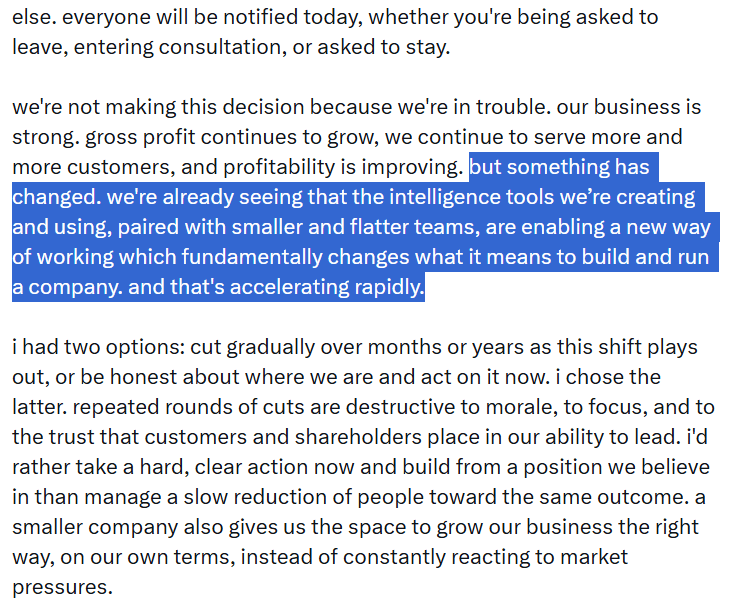
In a move that signals a profound shift in corporate strategy, Block, the fintech company co-founded by Jack Dorsey, is reportedly reducing its headcount by approximately 40%, from 10,000 employees to fewer than 6,000. According to sources, this drastic workforce reduction is not a response to business weakness but a direct result of artificial intelligence enabling unprecedented productivity gains. This development, first highlighted by commentator Kim Monismus, suggests we may be witnessing the beginning of a widespread corporate restructuring driven by AI's transformative impact on operational efficiency.
The Block Restructuring: Beyond Traditional Layoffs
Traditional workforce reductions typically occur during economic downturns, market contractions, or company-specific struggles. Block's situation appears fundamentally different. The company's core businesses—Square, Cash App, Tidal, and TBD—have shown resilience and growth potential in the competitive fintech landscape. Instead of reacting to failure, Block seems to be proactively restructuring around a new reality: AI systems can now perform or augment work that previously required significant human labor.
This 40% reduction represents approximately 4,000 employees affected across various departments. While specific roles haven't been detailed, such a substantial cut suggests AI integration is affecting multiple business functions, from customer service and data analysis to administrative operations and possibly elements of software development and financial processing.
The AI Productivity Revolution: From Incremental to Transformational
For years, AI promised productivity enhancements, but recent advancements in large language models, automation platforms, and specialized AI tools have moved these promises into tangible reality. Companies are discovering that AI can:
- Automate complex processes that previously required human judgment and intervention
- Generate and analyze data at speeds impossible for human teams
- Handle customer interactions with increasing sophistication
- Optimize operations in real-time based on predictive analytics
What makes Block's move particularly significant is the scale of workforce reduction attributed directly to these productivity gains. A 40% reduction suggests AI isn't merely augmenting human workers but in some cases replacing entire workflows and roles.
Industry Context: The Coming Wave of AI-Driven Restructuring
As Monismus warned in the original post, "Brace yourself: you'll read many more of such posts." Block's restructuring may represent an early indicator of a broader trend across multiple industries. Several factors suggest this could be the beginning of a larger movement:
- Economic Pressure: Even successful companies face investor pressure to improve margins and efficiency
- AI Maturation: The technology has reached a point where implementation yields immediate, measurable returns
- Competitive Dynamics: Once one company in a sector demonstrates significant cost savings through AI, others must follow or risk disadvantage
This trend extends beyond tech companies. Industries from finance and healthcare to manufacturing and professional services are experimenting with AI implementations that could similarly transform their workforce needs.
Implications for the Workforce and Economy
The Block restructuring raises critical questions about the future of work in an AI-augmented economy:
Job Displacement vs. Transformation
While AI eliminates some roles, it also creates new ones and transforms existing jobs. The challenge for companies and workers alike will be navigating this transition. Block's scale of reduction suggests displacement may initially outpace transformation and creation.
Skills Gap Acceleration
Workers whose roles are automated will need to develop new skills to remain employable. This accelerates the existing trend toward continuous learning and skill adaptation but on a potentially more urgent timeline.
Economic Productivity Paradox
Historically, technological advancements that increase productivity eventually create new economic opportunities and job categories. However, the transition period can be disruptive, particularly if AI adoption occurs rapidly across multiple sectors simultaneously.
Corporate Responsibility
Companies implementing AI-driven restructuring face ethical questions about how to manage workforce transitions responsibly. The scale of Block's reduction puts pressure on leadership to provide adequate support, retraining, and severance packages.
The Strategic Calculus Behind AI-Driven Cuts
From a business perspective, Block's move represents a strategic calculation with several dimensions:
Financial Efficiency: Reducing workforce by 40% while maintaining or growing output dramatically improves operating margins and profitability metrics.
Competitive Positioning: Being an early adopter of AI-driven efficiency could give Block a cost advantage over competitors still relying on traditional workforce models.
Investor Expectations: In today's market, investors increasingly expect companies to leverage AI for efficiency gains. Block's restructuring demonstrates aggressive adoption of available technology.
Future-Proofing: By restructuring now around AI capabilities, Block positions itself for a future where AI integration becomes table stakes rather than competitive advantage.
Looking Ahead: The New Corporate Playbook
Block's workforce reduction may establish a new template for corporate restructuring in the AI era. Key elements of this emerging playbook include:
- Proactive rather than reactive restructuring based on technological capability rather than business performance
- Radical rather than incremental workforce adjustments reflecting AI's transformative rather than marginal impact
- Cross-functional implementation affecting multiple departments rather than isolated automation of specific tasks
- Public attribution to AI productivity as justification, signaling technological sophistication to markets
As more companies follow this pattern, we may see accelerated development of support systems for displaced workers, new models for corporate retraining programs, and potentially regulatory responses to manage the societal impact of rapid workforce transformation.
Source: Initial report from Kim Monismus on X/Twitter analyzing Block's workforce restructuring.