A new research framework called MemFactory aims to solve what its creators describe as the "duct tape" problem in building memory-augmented AI agents. Currently, most agent architectures cobble together separate systems for memory storage, retrieval, and training policy optimization. MemFactory proposes a unified approach where memory is treated as a first-class, trainable component within a single coherent framework.
The work, introduced via a research paper and summarized by AI researcher Omar Sar on X, addresses a growing bottleneck in AI development: as conversational agents and assistants evolve from single-turn tools into persistent, long-horizon collaborators, their ability to maintain, access, and learn from memory becomes critical. MemFactory provides researchers with standardized, modular infrastructure to build, train, and evaluate memory-driven agents without rebuilding core plumbing for each new approach.
What the Framework Provides
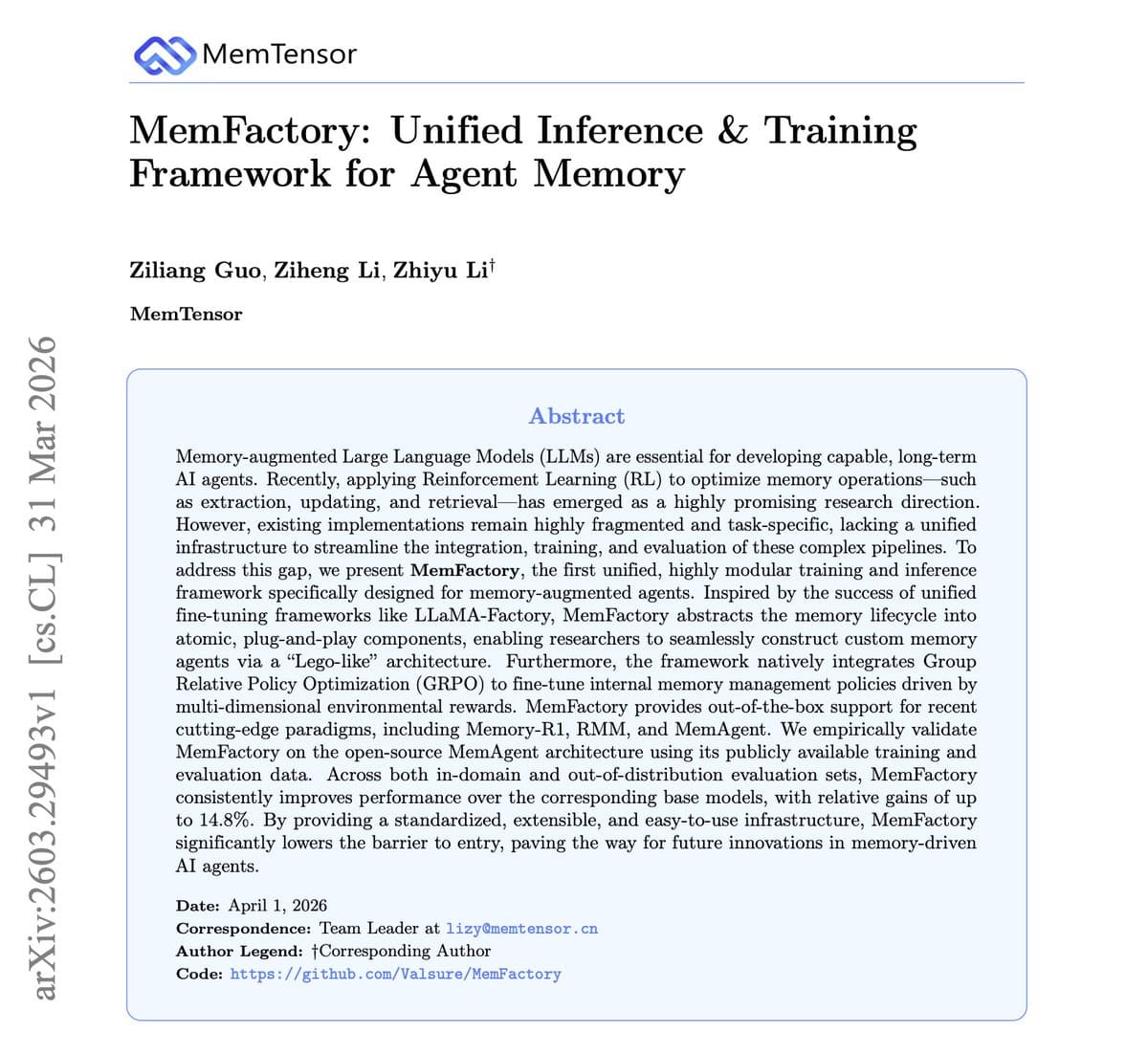
MemFactory is designed as a modular, plug-and-play system for memory components. Its key technical integration is native support for GRPO (Generalized Reinforcement Learning Policy Optimization) for fine-tuning memory management policies through reinforcement learning. This allows the memory retrieval and storage strategies themselves to be optimized based on downstream task performance, rather than being hand-engineered or using fixed heuristics.
The framework explicitly supports three contemporary agent memory paradigms in one system:
- Memory-R1: A retrieval-augmented approach that emphasizes dense vector search over stored episodes.
- RMM (Retrieval-Augmented Memory Management): Focuses on learning when to store, retrieve, or ignore information.
- MemAgent: An architecture where the memory module is an active, decision-making component.
By providing a common foundation, MemFactory enables direct comparison and hybridization of these approaches, reducing implementation variance that often clouds research comparisons.
Key Results
The paper reports up to 14.8% relative gains over baseline methods in evaluated tasks. While the tweet summary doesn't specify the exact benchmarks, gains of this magnitude in agent performance typically refer to success rates in multi-step decision-making environments or accuracy in long-context question answering.
A unified framework also reduces the engineering overhead for prototyping new memory architectures. Researchers can swap components—different vector stores, retrieval scorers, or storage policies—while maintaining the same training and evaluation pipelines.
How It Works: Unified Training and Inference
Traditionally, agent memory systems are designed during inference: they store observations, then retrieve relevant ones when needed. Training, if done at all, often involves separate fine-tuning of the retrieval model or the agent's policy using the memory. This decoupling can lead to suboptimal coordination.
MemFactory unifies this pipeline. During training, the memory module's parameters—including what to store, how to index it, and when to retrieve—are optimized via GRPO alongside the agent's main policy. The reward signal is based on the agent's overall task performance, allowing the memory system to learn strategies that genuinely improve outcomes.
For example, rather than always retrieving the top-3 most semantically similar past episodes, the memory system might learn to occasionally retrieve a seemingly unrelated memory that provides crucial procedural knowledge, or to avoid storing redundant information that bloats the memory bank without benefit.
Why It Matters
Memory is a fundamental challenge in creating truly persistent AI assistants. Current systems often struggle with consistency, long-horizon planning, and personalization across sessions. MemFactory doesn't propose a new memory architecture itself, but rather a standardized experimental and engineering platform that could accelerate innovation in this space.
For AI engineers building production agents, the promise is fewer bespoke, brittle memory systems. For researchers, it means more reproducible experiments and clearer comparisons between approaches. The reported performance gains suggest that co-optimizing memory management with the agent's policy is a fruitful direction, moving beyond static retrieval-augmented generation (RAG) patterns.
gentic.news Analysis
This work enters a competitive and rapidly evolving niche. The push for persistent, memory-equipped agents has become a central theme in 2025-2026, moving beyond the initial hype of "AI agents" to tackle the hard engineering problems of statefulness. MemFactory's release follows a pattern of increasing formalization in agent infrastructure, similar to how frameworks like LangChain and LlamaIndex initially provided structure for RAG applications.
Its explicit support for GRPO integration is particularly notable. GRPO has emerged as a favored RL method for fine-tuning large language models due to its stability and sample efficiency compared to older methods like PPO. Its application here to tune a memory subsystem reflects a broader trend: using lightweight RL to optimize subcomponents of AI systems that were previously rule-based. This aligns with other research we've covered, such as DeepMind's work on using RL to tune retrieval weights in modular reasoning systems.
The three supported paradigms—Memory-R1, RMM, and MemAgent—represent the current spectrum of research approaches. Memory-R1 is closely associated with the DeepSeek series of models and their focus on long-context, retrieval-augmented reasoning. RMM often appears in academic papers focusing on the theoretical optimality of memory operations. MemAgent reflects a more holistic view where memory is an agent itself. Providing a common bench for these competing philosophies could help converge on best practices.
Practically, MemFactory's biggest impact may be on reproducibility. Agent research has been plagued by inconsistent implementations, making it difficult to discern whether a performance improvement comes from a novel idea or simply better engineering. A standard framework, if adopted, could separate signal from noise. However, its success will depend on community uptake and whether it remains flexible enough to accommodate the next wave of memory ideas, which are likely to involve more sophisticated world models and episodic memory compression.
Frequently Asked Questions
What is GRPO in AI training?
GRPO (Generalized Reinforcement Learning Policy Optimization) is a reinforcement learning algorithm designed for fine-tuning large language models. It is known for being more stable and data-efficient than previous methods like Proximal Policy Optimization (PPO), making it suitable for optimizing specific sub-components of an AI system, such as a memory retrieval policy, without requiring massive amounts of interaction data.
How does MemFactory differ from using a vector database for AI memory?
A vector database (like Pinecone or Weaviate) is primarily a storage and retrieval engine for semantic search. MemFactory is a higher-level framework that uses such tools as components within a larger, trainable system. It decides what to store in the vector database, when to store it, how to retrieve from it, and how to integrate retrieved memories into the agent's reasoning process. These decisions are optimized through learning, not just hand-coded rules.
What are the practical applications of trainable agent memory?
Trainable memory enables AI assistants that get better at helping you over time. For example, a coding assistant could learn which past code snippets or explanations you found most useful and prioritize similar content. A customer service agent could learn to remember the specific details of a user's problem history to provide more consistent support. The system optimizes for what actually improves task success, not just semantic similarity.
Is MemFactory available for developers to use?
Based on the source, a research paper is available (link in the tweet), which typically contains the theoretical framework and experimental results. Whether the code is open-sourced as a usable library would need to be verified by checking the paper's associated repository. The tweet promotes an "academy" for learning to build agents, suggesting educational resources may be available alongside the research.