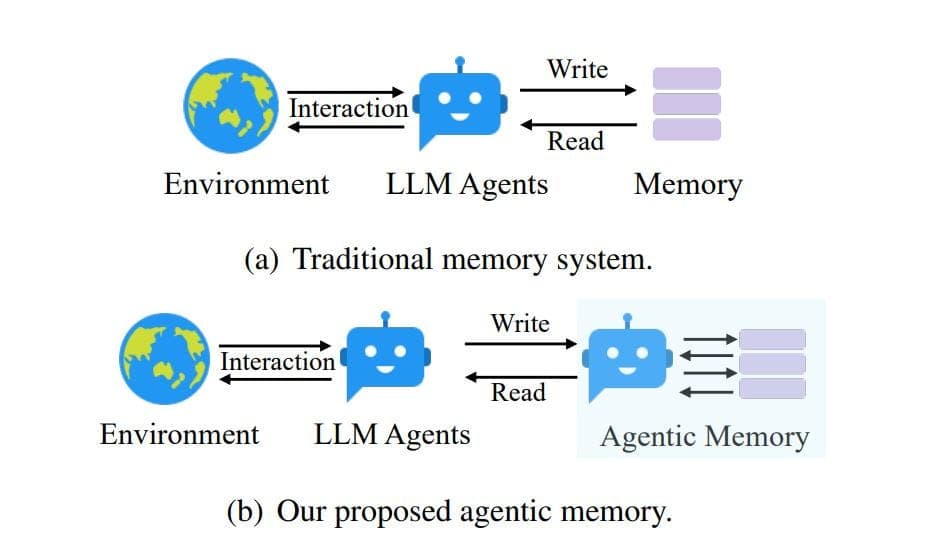
A new paper, 'Memory as a Model,' augments any LLM with a separate trained memory model. The approach stores, retrieves, and integrates external knowledge to improve long-term recall.
Key facts
- Paper augments any LLM with a separate trained memory model
- Memory model stores, retrieves, and integrates external knowledge
- Aims to improve long-term recall without retraining base LLM
- Model-agnostic approach attachable to existing systems
- No benchmark numbers disclosed in the tweet
A new paper shared by @dair_ai and RT'd by @omarsar0 introduces 'Memory as a Model,' a method that augments any LLM with a separate trained memory model. [According to @omarsar0] The memory model handles storing, retrieving, and integrating external knowledge, aiming to improve long-term recall without retraining the base LLM.
The key innovation is that the memory model is trained separately and can be attached to existing LLMs, making it model-agnostic. This contrasts with approaches like retrieval-augmented generation (RAG), which typically relies on external databases and retrieval mechanisms. The paper positions this as a more integrated solution for persistent memory.
No benchmark numbers or specific model names were disclosed in the tweet. The paper itself, if available, would likely provide comparisons on tasks requiring long-term knowledge retention, such as multi-turn dialogue or factual recall over long contexts. The approach could reduce the need for large context windows by offloading memory to a dedicated module.
The unique take: This mirrors a trend in 2025-2026 where researchers move beyond static context windows toward dynamic memory architectures. OpenAI's GPT-5 reportedly uses a similar 'memory layer' for persistent user context, and Google's Gemini 2.0 introduced 'context caching.' The 'Memory as a Model' paper formalizes this as a general-purpose augmentation, potentially lowering the barrier for any LLM to have persistent memory.
How it differs from RAG
Traditional RAG retrieves documents from a vector database at inference time but doesn't train a memory module. This paper trains a separate model to act as memory, learning which information to store and how to retrieve it based on the LLM's needs. This could enable more nuanced recall, such as remembering user preferences across sessions.
Open questions
The source tweet is thin on implementation details—no training data size, model architecture, or compute requirements. The paper's arxiv link (not provided) would clarify whether the memory model uses a transformer, a recurrent network, or another architecture. The claim of 'any LLM' suggests a lightweight adapter, but without numbers, the performance impact is unknown.
Key Takeaways
- Paper augments LLMs with trained memory for long-term recall.
- Model-agnostic approach stores external knowledge without retraining.
What to watch

Watch for the arxiv release of the full paper, expected within days. Key metrics: task-specific recall accuracy on long-context benchmarks like SCROLLS or LongBench, and inference latency overhead from the memory module.