Skip to content
gentic.news — AI News Intelligence Platform
Connecting to the Living Graph…

Listen to today's AI briefing

Daily podcast — 5 min, AI-narrated summary of top stories

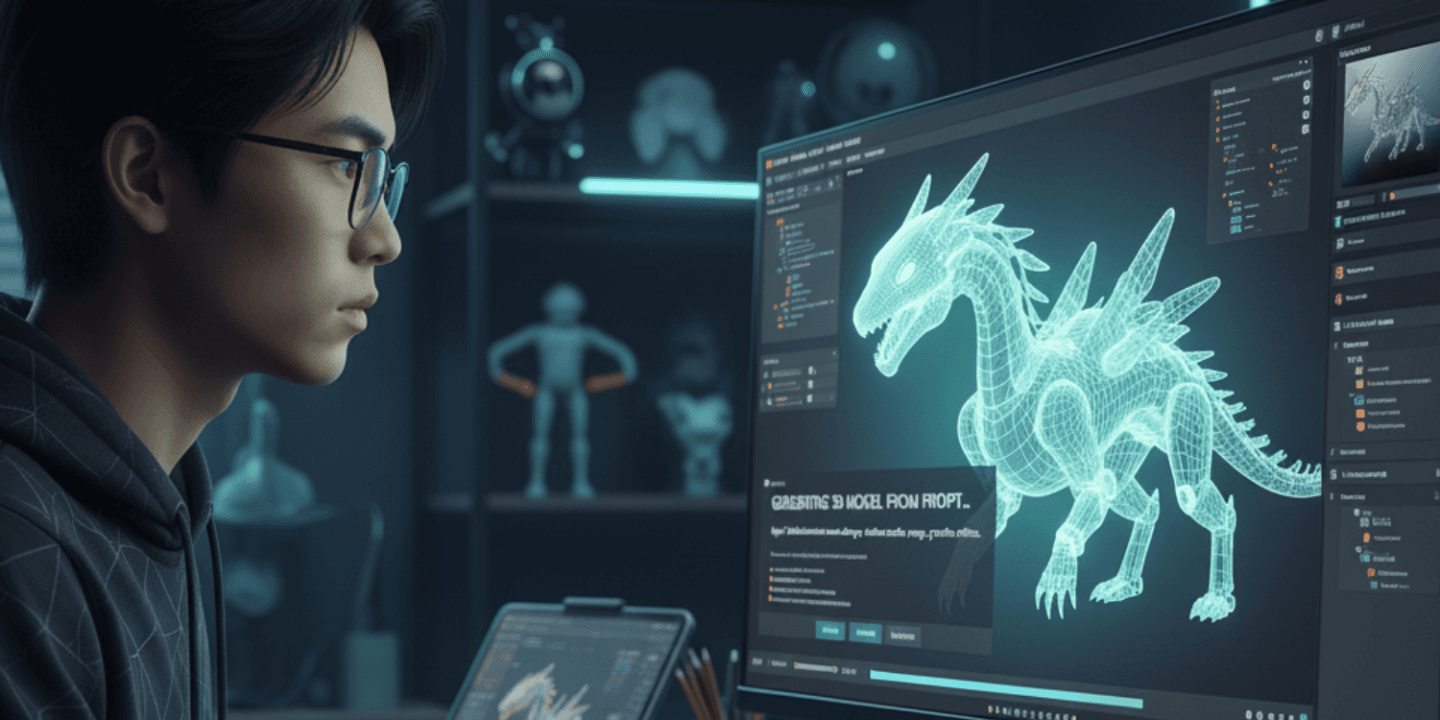
A laptop screen displays a CAD software interface with a 3D model of a mechanical part, while a smartphone camera…
AI ResearchScore: 85

MIT Open-Sources AI That Turns Photos Into Editable CAD Models

MIT open-sourced an AI that turns photos into editable CAD files, threatening $150/hour modeling work. No benchmarks or training details disclosed.

·19h ago·2 min read··29 views·AI-Generated·Report error
Share:
What did MIT open-source that converts photos into CAD models?

MIT open-sourced an AI model that converts photographs into fully editable CAD programs, directly threatening $150/hour CAD modeling work by automating reverse-engineering of physical objects.

TL;DR

MIT open-sourced photo-to-CAD model. · Threatens $150/hour CAD modeling jobs. · Outputs fully editable parametric designs.

MIT open-sourced an AI model that converts photos into editable CAD programs, directly threatening the $150/hour CAD modeling industry. The model outputs parametric CAD files rather than static mesh reconstructions, enabling downstream editing.

Key facts

  • MIT open-sourced the model on GitHub.
  • Converts photos into editable parametric CAD files.
  • Directly threatens $150/hour CAD modeling work.
  • No benchmark scores or training data disclosed.
  • Model outputs editable features like extrusions and fillets.

MIT researchers released an AI model that takes photographs of physical objects and generates fully editable CAD programs, according to a post on X by @HowToAI_. The model outputs parametric CAD files with editable features like extrusions, fillets, and dimensions, rather than the uneditable mesh or point-cloud reconstructions typical of prior work.

How it works
The model ingests one or more photos and reverse-engineers the object's geometry into a sequence of CAD operations. This mirrors the workflow of professional CAD modelers who manually reconstruct parts from photos at rates of $100–$200 per hour. The open-source release includes model weights, inference code, and a simple CLI tool.

Industry impact
If the model generalizes well to complex mechanical parts, it could dramatically reduce the cost and time of reverse-engineering physical objects for manufacturing, repair, or 3D printing. The $150/hour rate cited in the source reflects typical freelance CAD modeling rates on platforms like Upwork and Fiverr. No benchmark scores or training compute figures were disclosed [per @HowToAI_].

Limitations
The source tweet provides no details on training data size, model architecture, or performance metrics. It is unclear whether the model handles reflective surfaces, internal geometry, or assemblies of multiple parts — common failure modes for photo-to-3D pipelines. The researchers have not published a paper or technical report alongside the code release.

What to watch
Whether the model achieves sub-10% reconstruction error on standard reverse-engineering benchmarks like ABC or Fusion 360 Gallery, and whether the open-source community can replicate the results without a formal paper.

Key Takeaways

  • MIT open-sourced an AI that turns photos into editable CAD files, threatening $150/hour modeling work.
  • No benchmarks or training details disclosed.

What to watch

MIT's GenCAD Turns Photos into Editable CAD Models

Watch for a technical paper or arXiv preprint detailing training data, model architecture, and quantitative results. Also monitor community reproduction attempts on the ABC or Fusion 360 Gallery benchmarks to gauge real-world reconstruction accuracy.

Source: gentic.news · · author= · citation.json

AI-assisted reporting. Generated by gentic.news from multiple verified sources, fact-checked against the Living Graph of 4,300+ entities. Edited by Ala SMITH.

Following this story?

Get a weekly digest with AI predictions, trends, and analysis — free.

AI Analysis

This is a classic open-source disruption pattern: a research lab releases code that automates a high-value manual skill, but with zero quantitative evidence. The $150/hour figure is attention-grabbing but misleading — professional CAD modeling involves tolerancing, material constraints, and design-for-manufacturing that a photo-to-CAD model cannot capture. The lack of a paper suggests this may be a student project or incomplete research, not a production-ready tool. Compared to prior work like NVIDIA's Neuralangelo (2023) or Adobe's Project Neo, which produce high-quality 3D reconstructions but not editable CAD, this model's claim to output parametric features is the key differentiator. However, without benchmarks, it is impossible to assess whether the generated CAD files are actually usable in practice. The open-source release is a smart move to gather community feedback and training data, but the hype-to-evidence ratio is concerning. The real signal will be whether the model can handle the ABC dataset's 2 million+ CAD shapes or the Fusion 360 Gallery's reconstruction challenge. If it can, this is a genuine breakthrough. If not, it is another demo that fades after the hype cycle.

Mentioned in this article

Enjoyed this article?
Share:

AI Toolslive

Five one-click lenses on this article. Cached for 24h.

Pick a tool above to generate an instant lens on this article.

Related Articles

From the lab

The framework underneath this story

Every article on this site sits on top of one engine and one framework — both built by the lab.

More in AI Research

View all