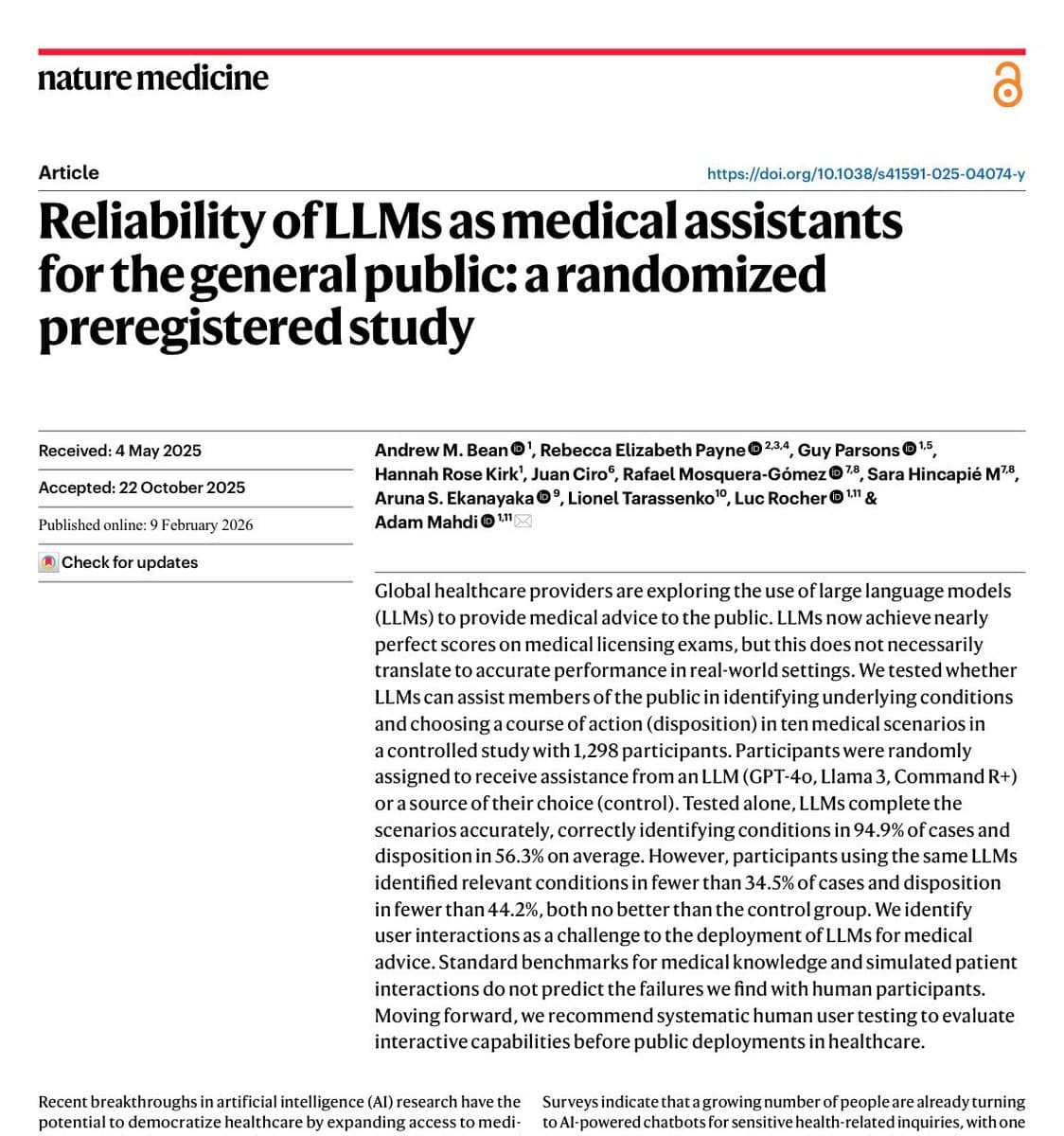
A new study published in Nature underscores a critical, often overlooked challenge in deploying AI: the user interface itself can become a bottleneck, degrading performance even when the underlying model is capable. The research, highlighted by Wharton professor Ethan Mollick, found that AI models performed well at diagnosing medical issues in controlled settings, but when users had to interact with these models through standard chatbot interfaces, the resulting confusion led to worse answers.
What the Study Found
The core finding is a disconnect between model capability and user-mediated outcomes. The AI models used in the study—described as "old models," suggesting they are not the latest frontier LLMs—demonstrated competent diagnostic accuracy when evaluated directly. However, when human users were tasked with obtaining a diagnosis by conversing with these models via a typical text-chat interface, the quality of the final diagnostic answer suffered.
The problem is attributed to the interface, not the model's core reasoning. The chat format, with its open-ended prompts, potential for miscommunication, and lack of structured guidance, introduced noise and error. Users struggled to formulate effective queries or interpret the model's responses correctly, leading to a degradation in the diagnostic process that would not be apparent from benchmarking the model in isolation.
The Interface Problem in Practice
This study points to a "last-mile" problem in AI application. Developers and researchers often focus on pushing benchmarks on static datasets (like MMLU or medical QA boards), where a model consumes a clear, structured prompt and emits an answer. Real-world application, however, involves a human in the loop who must:
- Translate their problem (e.g., a set of symptoms) into a prompt.
- Engage in a multi-turn dialogue to refine the query.
- Correctly interpret and act upon the AI's output.
Each of these steps is a potential failure point introduced by the interface design. A confusing, overly verbose, or poorly constrained chat window can lead users to ask suboptimal questions or misunderstand confident but incorrect AI suggestions.
Why This Matters for AI Deployment
For AI engineers and product leaders, this research is a stark reminder that model performance is not product performance. A state-of-the-art model behind a poorly designed interface can underperform a weaker model with a superior, task-optimized user experience. This has direct implications for:
- Medical AI Tools: Deploying diagnostic aids requires carefully designed interfaces that guide clinicians and patients through structured data entry and present findings with clear confidence intervals and caveats, not just open-ended chat.
- Enterprise Copilots: The rush to add "chat with your data" features to business software may backfire if the chat interface is not deeply integrated with the workflow and domain language of the users.
- Benchmarking Philosophy: It calls for the development of more holistic evaluation frameworks that incorporate user interaction, not just model output on static tasks.
gentic.news Analysis
This Nature study directly validates a growing concern in applied AI: the deployment gap. As we covered in our analysis of Anthropic's Constitutional AI (2024), alignment techniques focus on making the model's outputs safer and more helpful, but they do not inherently design the human interaction layer. This research suggests that even a well-aligned model can be misused or yield poor outcomes through a suboptimal interface.
The findings also intersect with trends we've observed in enterprise AI. Companies like Glean and Sierra are trending (📈) precisely because they are moving beyond raw chat to build agentic workflows and structured copilots that reduce the cognitive load and prompt-engineering burden on the user. Their increased market activity reflects a growing demand for solutions that bridge this interface gap identified in the Nature paper.
Furthermore, this connects to our previous reporting on AI usability studies in coding, which found that developers' success with GitHub Copilot depended heavily on their ability to craft effective prompts and snippets—a skill gap that itself acts as an interface barrier. The lesson is consistent: the frontier of AI utility is increasingly shifting from pure model capability to human-AI interaction design. The companies and research labs that treat the interface as a first-class citizen—constraining inputs, guiding dialogues, and designing for specific cognitive tasks—will likely see more successful real-world adoption.
Frequently Asked Questions
What were the "old models" used in the Nature study?
The source tweet does not specify the exact models, referring to them as "old models." This likely indicates they were large language models (LLMs) that are not the most recent releases (e.g., GPT-4, Claude 3.5, etc.), possibly models from the 2022-2023 era. The key point of the study is that even with these capable-but-not-cutting-edge models, the interface was the primary limiting factor.
Does this mean AI is bad at medical diagnosis?
No, the study suggests the opposite about the raw models: they did "a good job diagnosing medical issues" in a non-interactive setting. The problem emerged when humans used a chatbot to access that capability. The issue is one of interface and interaction design, not fundamental model incompetence at the task.
How can AI interfaces be improved for tasks like diagnosis?
Improvements would move away from open-ended chat boxes toward more structured interfaces. This could include: form-based symptom entry with guided questions, multi-choice differential diagnosis selectors, visual aids for describing symptoms, and interfaces that clearly separate AI suggestions from user-provided data with explicit confidence scores and references.
Is this just a problem for medical AI?
While the study focused on medical diagnosis, the principle applies universally. Any high-stakes or complex domain where a user must extract precise, actionable information from an AI—such as legal research, financial analysis, or technical troubleshooting—faces the same risk. A poor interface can negate the underlying model's strengths.