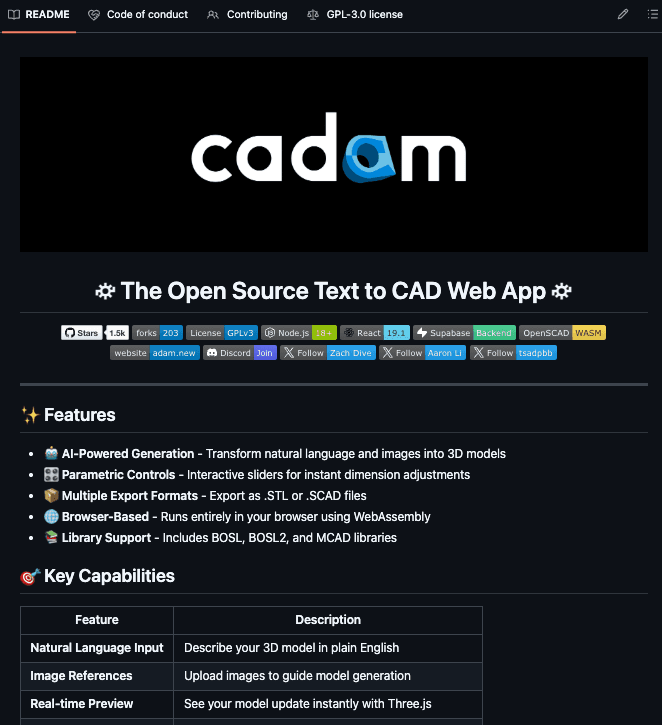
A developer has built and released a fully browser-based text-to-CAD (Computer-Aided Design) tool that allows users to generate editable 3D models from plain English descriptions. The tool, highlighted by AI educator @aiwithjainam, requires no installation, runs on WebAssembly, and exports models in STL or SCAD formats ready for 3D printing. It represents a significant step in democratizing 3D model creation by removing traditional software and expertise barriers.
What the Tool Does
The application operates through a simple, three-step workflow:
- Text Description: A user types a description of the desired 3D object in plain English (e.g., "a hexagonal vase with a flared rim").
- Optional Reference Image: Users can upload an image to guide the model's shape or style.
- Generation & Adjustment: The AI generates a 3D model and presents it in an interactive viewer. Crucially, it also generates a set of interactive sliders that control every key dimension of the object (e.g., height, width, wall thickness, fillet radius).
The output is not a static mesh but a parametric model. Changing a slider updates the model in real-time, allowing for rapid iteration and customization.
Technical Implementation & Accessibility
The core technical achievement is the fully client-side execution. The entire AI model and CAD kernel run in the user's browser via WebAssembly, a binary instruction format that allows high-performance applications to run on the web. This means:
- No server costs or latency for the developer.
- No data is sent to external servers, potentially keeping designs private.
- Zero installation—users only need a modern web browser.
The tool is open-source and released under the GPL-3.0 license, allowing for inspection, modification, and redistribution. The export functionality to STL (the standard format for 3D printing) and SCAD (the scripting format for OpenSCAD) means the generated designs can immediately enter a manufacturing workflow or be further edited programmatically.
Context in the AI-CAD Landscape
Text-to-3D generation has been a challenging frontier in generative AI. While image and video generation has advanced rapidly, creating functional, watertight 3D geometry suitable for manufacturing has lagged. Major efforts like OpenAI's Shap-E and Google's DreamFusion have focused on generating 3D neural radiance fields or meshes from text, but these are often not natively parametric or easily editable for engineering purposes.
This browser-based tool takes a different, more practical approach by targeting the CAD and maker community directly. It prioritizes editable parameters and standard export formats over photorealism, aligning with the needs of hobbyists, engineers, and designers who need to fabricate objects.
Limitations and Current Scope
Based on the announcement, key questions remain:
- Model Capability: The complexity and fidelity of objects it can generate are untested. Can it handle assemblies, complex mechanical parts, or organic shapes?
- Underlying AI: The specific model architecture (e.g., fine-tuned LLM, diffusion model) and training data are not detailed in the tweet.
- Performance: Generation speed and stability on complex prompts within browser constraints are unknown.
However, the open-source nature means the community can now explore, improve, and benchmark these aspects directly.
gentic.news Analysis
This development is a tangible implementation of a trend we've tracked closely: the move of specialized AI from cloud APIs to the edge—and now to the browser client. In December 2025, we covered wasm-llm, a project that enabled 7B-parameter LLMs to run in browsers via WebGPU and WebAssembly, noting its implications for privacy and cost. This CAD tool applies the same principle to a different domain, showing how client-side AI can enable new classes of interactive, privacy-sensitive applications.
It also directly intersects with the maker and open-source hardware movement. The choice of SCAD as an export format is telling. OpenSCAD is a script-based, programmer-oriented CAD tool beloved in the open-source community. By bridging natural language to parametric SCAD code, this tool could significantly lower the barrier to entry for programmatic CAD, a niche but powerful design paradigm. This follows the broader industry trend of using AI for code generation (GitHub Copilot) and UI generation (v0.dev) but applies it to the domain of geometric construction.
While not competing with professional CAD suites like SolidWorks or Fusion 360, this tool carves out a space for rapid prototyping and idea exploration. Its success will depend on the robustness of its generative backbone and the community that forms around its open-source codebase. If the underlying model proves capable, we could see it integrated into existing maker platforms like Printables or Thingiverse as a built-in "idea to model" generator.
Frequently Asked Questions
How do I access this text-to-CAD tool?
The tool is accessible via a web browser. The original tweet by @aiwithjainam indicates the link is available in the comments/replies to that post. As it is open-source, the code will also likely be hosted on a repository like GitHub.
What are the system requirements to run it?
The primary requirement is a modern web browser (like Chrome, Edge, Firefox, or Safari) that supports WebAssembly. Performance may vary based on the complexity of the model generation and your device's hardware, but no dedicated GPU or special software installation is needed.
Can I use the models generated for commercial purposes?
The tool is released under the GPL-3.0 open-source license. This license governs the software itself. The ownership and licensing of the 3D model designs you create with the tool are typically considered separate from the software license. You should review the tool's specific terms of use, but generally, designs you generate are your own intellectual property to use as you see fit, including for commercial purposes.
How does this compare to other AI 3D generators like Shap-E?
Tools like Shap-E from OpenAI are focused on generating 3D assets—often as neural radiance fields or textured meshes suitable for games or AR/VR. This browser-based tool is focused on engineering CAD: it outputs parametric, dimensionally editable models in standard formats (STL, SCAD) meant for manufacturing and 3D printing. It prioritizes editability and manufacturability over visual realism.