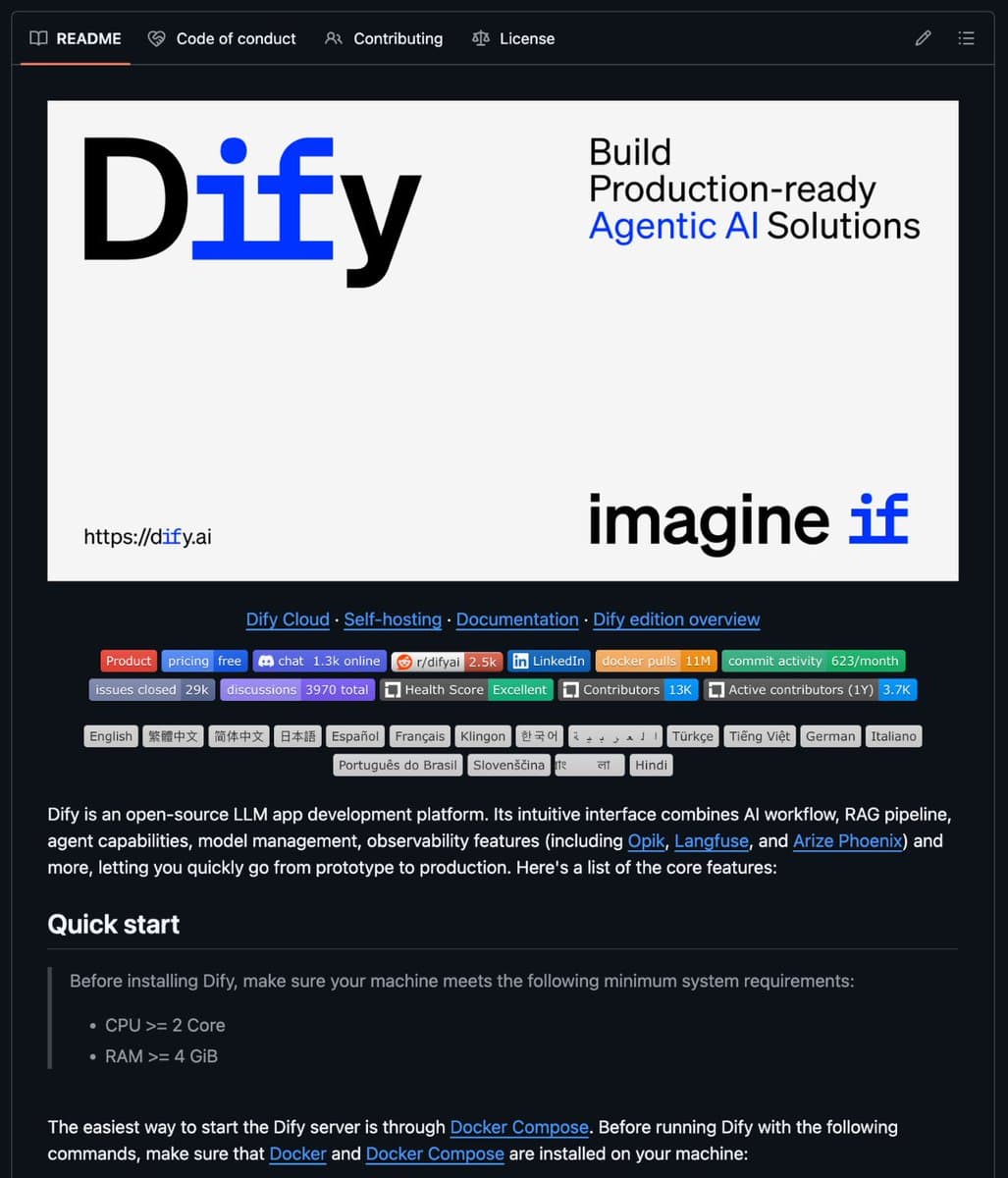
An open-source platform for building production AI applications has reached 136,000 stars on GitHub, signaling strong developer adoption for tools that reduce the infrastructure burden of AI development. Dify positions itself as a comprehensive layer between AI logic and deployable products, handling everything from RAG pipelines to agent orchestration and monitoring.
What Dify Actually Does
Dify is a visual workflow builder that abstracts away the infrastructure complexity typically required to ship AI applications. Instead of manually integrating LangChain, vector databases, API frameworks, and monitoring tools, developers can use Dify's unified interface to build and deploy AI workflows.
The platform handles five core functions:
RAG Pipelines: Built-in hybrid search combining BM25 (keyword-based) and vector similarity, with automatic chunking and support for PDFs, Notion documents, DOCX files, and web scraping.
Agent Orchestration: Visual workflow builder for creating ReAct-style agents using tools, API calls, and logic blocks without writing manual Python loops.
Model Routing: Easy switching between different LLM providers including OpenAI GPT, Anthropic Claude, and local models via Ollama or vLLM.
Auto-generated APIs: Every saved workflow automatically generates a REST endpoint ready for integration into applications.
LLMOps & Monitoring: Full tracing, latency tracking, token usage monitoring, and annotation support for production deployment.
Technical Architecture & Deployment
Dify operates as a web application that can be self-hosted or used via their cloud service. The platform is built with a microservices architecture that separates the workflow engine, model gateway, and monitoring components. This allows teams to deploy it in their own infrastructure while maintaining the visual development experience.
Key technical features include:
- Unified API Gateway: Handles authentication, rate limiting, and routing to different model providers
- Vector Database Integration: Supports multiple vector stores including Pinecone, Weaviate, and Qdrant
- Workflow Versioning: Git-like version control for AI workflows with rollback capability
- Team Collaboration: Multi-user support with role-based access control
How It Compares to Alternatives
Dify enters a crowded space of AI development tools but takes a distinct approach by combining multiple functions into one platform:
Dify Full-stack AI app development Visual workflow builder + RAG + LLMOps in one platform LangChain LLM application framework Python library for chaining components LlamaIndex RAG optimization Specialized data indexing and retrieval Flowise Visual LLM workflows Drag-and-drop interface similar to Dify Vercel AI SDK Frontend AI integration React hooks and edge function templatesUnlike LangChain which requires significant coding to connect components, Dify provides a visual interface. Compared to Flowise, Dify offers more comprehensive production features including monitoring and team collaboration tools.
What This Means in Practice
For developers building AI applications, Dify represents a significant reduction in boilerplate code. Instead of writing hundreds of lines to connect a vector database to a LangChain agent, then wrapping it in a FastAPI server with monitoring, developers can build the same functionality through Dify's interface in minutes.
The platform is particularly valuable for:
- Startups needing to quickly prototype and iterate on AI features
- Enterprise teams requiring production monitoring and collaboration features
- Indie developers who want to build AI applications without managing multiple infrastructure components
gentic.news Analysis
The rapid growth of Dify to 136K GitHub stars reflects a broader trend in the AI development ecosystem: the shift from framework-centric to platform-centric tooling. This follows similar patterns we've seen with Vercel's evolution from a deployment platform to a full-stack development environment. Developers are increasingly seeking integrated solutions that reduce cognitive overhead and infrastructure management.
This development aligns with our previous coverage of the "AI Infrastructure Stack Consolidation" trend, where tools like LangChain initially provided modular components but created integration complexity. Dify represents the next evolutionary step—bundling these components into a cohesive platform. The 136K stars milestone places Dify among the top AI-related repositories on GitHub, alongside established projects like LangChain (75K stars) and LlamaIndex (30K stars), suggesting it's addressing a genuine pain point in the developer workflow.
From a competitive standpoint, Dify's approach contrasts with cloud providers' managed AI services (like AWS Bedrock or Azure AI Studio) by remaining open-source and self-hostable. This positions it well for organizations with data sovereignty requirements or those wanting to avoid vendor lock-in. However, the platform faces challenges around customization limits compared to code-first approaches and potential performance overhead from its abstraction layers.
Frequently Asked Questions
Is Dify really free to use?
Yes, Dify is 100% free to start with both self-hosted and cloud options. The open-source version includes all core features, while their cloud service offers free tiers with usage limits. Enterprise features and higher usage tiers require paid plans.
How does Dify compare to building with LangChain directly?
Dify provides a visual interface and pre-built integrations that significantly reduce development time but offer less customization than writing code with LangChain. LangChain gives you complete control over every component but requires more infrastructure code. Dify is better for rapid prototyping and production deployment, while LangChain is better for highly customized implementations.
Can I use Dify with local LLMs?
Yes, Dify supports local models through Ollama and vLLM integration. You can route workflows to locally hosted models alongside cloud providers like OpenAI and Anthropic, making it suitable for hybrid deployment scenarios.
What programming languages does Dify support?
Dify itself is built with Python and JavaScript/TypeScript, but the workflows you create generate REST APIs that can be called from any programming language. The visual interface means you can build complex AI applications without writing extensive code in any language.
Is Dify suitable for enterprise production use?
Yes, Dify includes enterprise-ready features like team collaboration, role-based access control, comprehensive monitoring, and audit trails. The ability to self-host on your own infrastructure makes it suitable for organizations with strict security and compliance requirements.