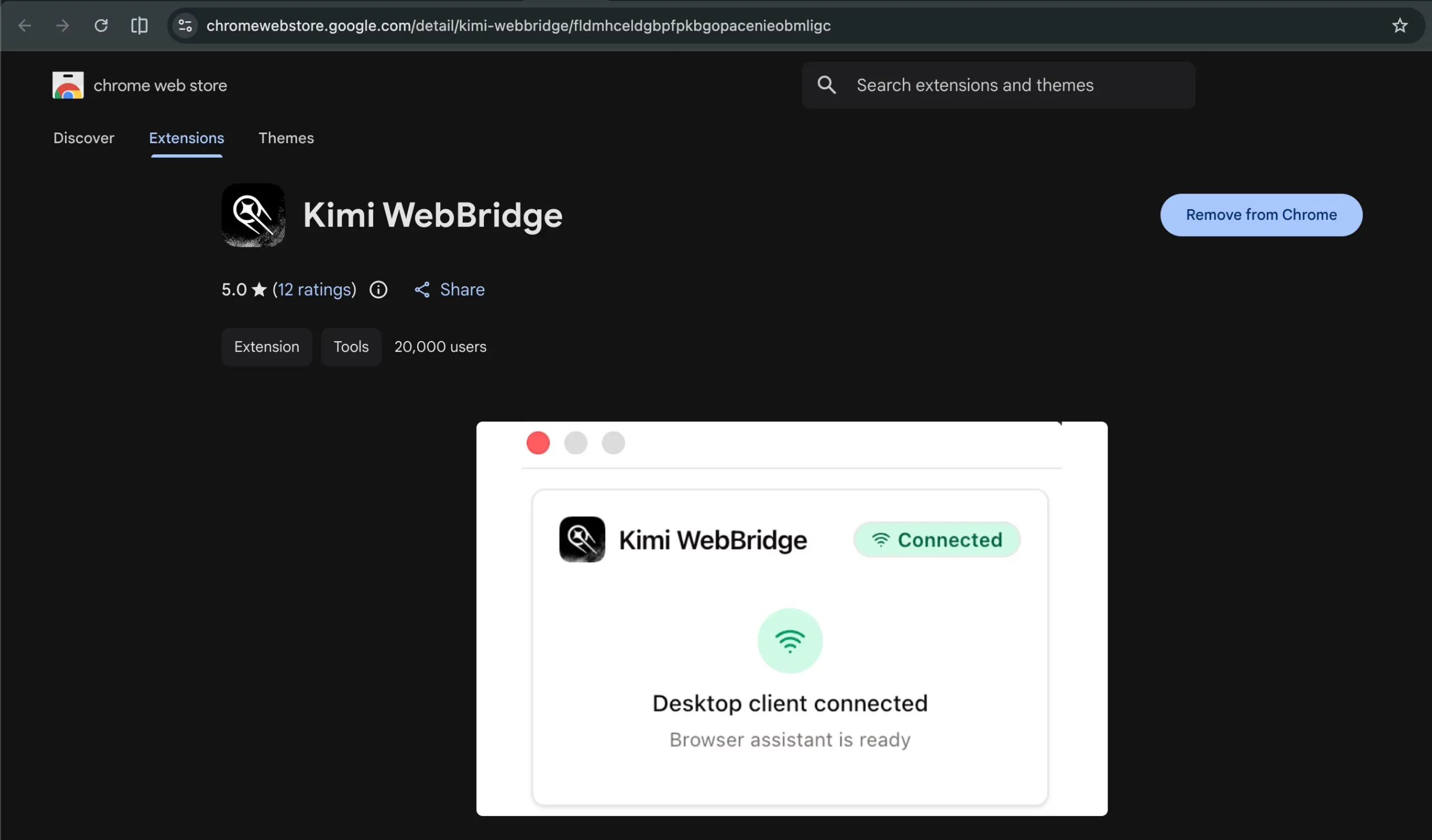
Moonshot AI released Kimi WebBridge, a browser extension that gives its Kimi agent full access to your logged-in sessions. The extension lets the AI operate with your browser identity — cookies, accounts, and sessions — to perform tasks autonomously.
Key facts
- Moonshot AI valued at $18B+
- Backed by Alibaba and Tencent
- Kimi WebBridge uses logged-in sessions and cookies
- Competes with Anthropic and OpenAI
- Released for Chrome-based browsers
Moonshot AI, the Beijing-based company valued at $18B+ and backed by Alibaba and Tencent, released Kimi WebBridge, a browser extension that lets its Kimi AI agent operate with your full browser identity — your logged-in sessions, cookies, and accounts — to perform tasks autonomously on your behalf [According to Pandaily].
Unlike previous agent tools that work in isolated sandboxed environments, Kimi WebBridge operates directly within the user's authenticated browser context. This means the agent can access services like Gmail, Slack, or corporate dashboards without requiring users to re-enter credentials or grant API-level access.
Key Takeaways
- Moonshot AI released Kimi WebBridge, a browser extension that lets its Kimi agent use your logged-in sessions.
- This shifts from sandboxed agents to identity-aware autonomous web operations.
Why This Matters More Than the Press Release Suggests
The unique take here is that Kimi WebBridge represents a structural shift from "agent as tool" to "agent as you." Most competing agents — including Anthropic's Claude Code and OpenAI's Operator — operate in sandboxed environments or require explicit API integrations. By contrast, Kimi WebBridge piggybacks on the user's existing authentication, which dramatically reduces friction but introduces a fundamentally different security model.
Industry leaders predicted 2026 as the breakthrough year for AI agents across all domains [per recent industry reports]. Moonshot AI's move aligns with this prediction but takes a more aggressive stance on identity delegation than Western counterparts have been willing to adopt.
The Security Calculus
The extension raises obvious questions: if the agent has access to all your logged-in sessions, what prevents it from performing unauthorized actions? Moonshot AI has not disclosed specific security mechanisms or how it prevents prompt injection attacks that could hijack authenticated sessions. The company's blog post [according to Pandaily] focuses on capability rather than safeguards.
Moonshot AI competes directly with Anthropic and OpenAI in the agent space. The company's earlier Kimi K2.6 model was noted for inference speed [per CoreWeave benchmarks], and Kimi WebBridge extends that competitive pressure into the agent deployment layer.
What This Means for Developers
For developers and technical operators, Kimi WebBridge offers a path to automate web workflows that previously required brittle browser automation scripts (Selenium, Playwright) or custom API integrations. The trade-off is surrendering session control to an AI agent — a risk many enterprises will weigh carefully.
The extension is available now for Chrome-based browsers. Moonshot AI did not disclose adoption numbers or whether the extension will be monetized separately from the Kimi chatbot subscription.
What to watch
Watch for Moonshot AI's security whitepaper detailing how Kimi WebBridge prevents session hijacking and prompt injection. Also watch whether enterprise adoption follows, given the identity delegation model — a Q3 2026 enterprise customer count would signal trust.