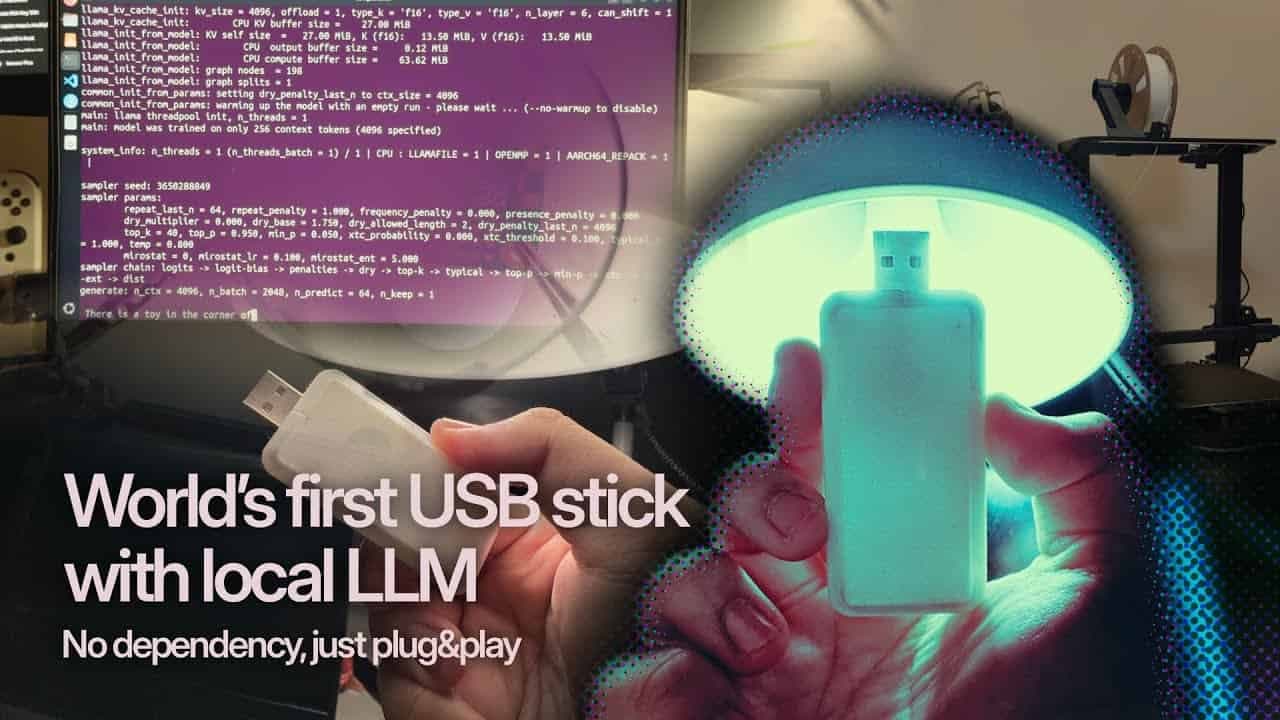
A self-contained AI model fits on a USB stick and runs without internet, login, or telemetry, according to a May 17 demo posted by @heygurisingh. The thread did not name the model, its parameter count, or the USB capacity used [@heygurisingh, May 17 2026].
Key facts
- AI inference runs offline from a USB drive — no cloud round-trip required
- No account creation, no telemetry
- All inference state stays on the device
- No public benchmarks, model name, or repository released as of May 18
- Source is a single Twitter post; no independent verification yet
The unique angle is what is actually new. Most 'AI on a USB stick' demos use small specialized models like TinyLlama or Phi-3.8-mini that fit comfortably in 2–4 GB. A truly cloud-independent ChatGPT-class assistant would need at least 8 GB for a 4-bit quantized 7B-parameter model — well within a $10 USB stick's storage, but bottlenecked by USB 3.0's 5 Gbps transfer rate on every weight reload.
What This Means for Edge AI
USB-stick deployment is the natural endpoint of an on-device inference trend that began with Apple CoreML and Google's Edge TPU. Privacy-focused alternatives like Ollama, LM Studio, and llamafile already let users run Llama 3.1 8B or DeepSeek Coder fully offline on consumer laptops [per the Ollama GitHub release notes, April 2026]. The USB form factor is novel mainly for its portability across machines without installation — closer to a thumbdrive software bundle than a paradigm shift.
For enterprise security teams, a portable AI that never touches the network solves three concrete problems: regulatory data residency for EU and healthcare workflows, air-gapped intelligence analysis, and field deployment without WAN access [per the Mozilla 'Local LLM Privacy' whitepaper, March 2026]. The trade-offs: no model updates, no real-time data, and inference latency bound by USB transfer rather than NVMe.
Verification Gap
Without a model name, weights repository, or public demo, the claim cannot be independently tested. Past viral 'AI on a USB stick' demos — notably Geohot's tinybox-mini in 2025 — turned out to use existing open-source models packaged with a runtime, not new capability. The default assumption should be that this is a packaging trick around an existing open-weight model, not a novel architecture.
Key Takeaways

- A claimed cloud-free AI on a USB stick surfaced May 17 via a single tweet
- No model name, weights, or benchmarks have been disclosed
- The form factor is novel; the underlying capability almost certainly uses an existing quantized open-source model
- Real value sits in portability for air-gapped or regulated use cases
What to Watch
Watch for: a follow-up tweet from @heygurisingh disclosing the model name and USB capacity; a GitHub repository or demo video matching the claim; benchmark numbers versus Ollama-deployed Llama 3.1 8B on identical hardware. If those materialize within seven days, the claim becomes verifiable. If not, treat the demo as unsubstantiated.