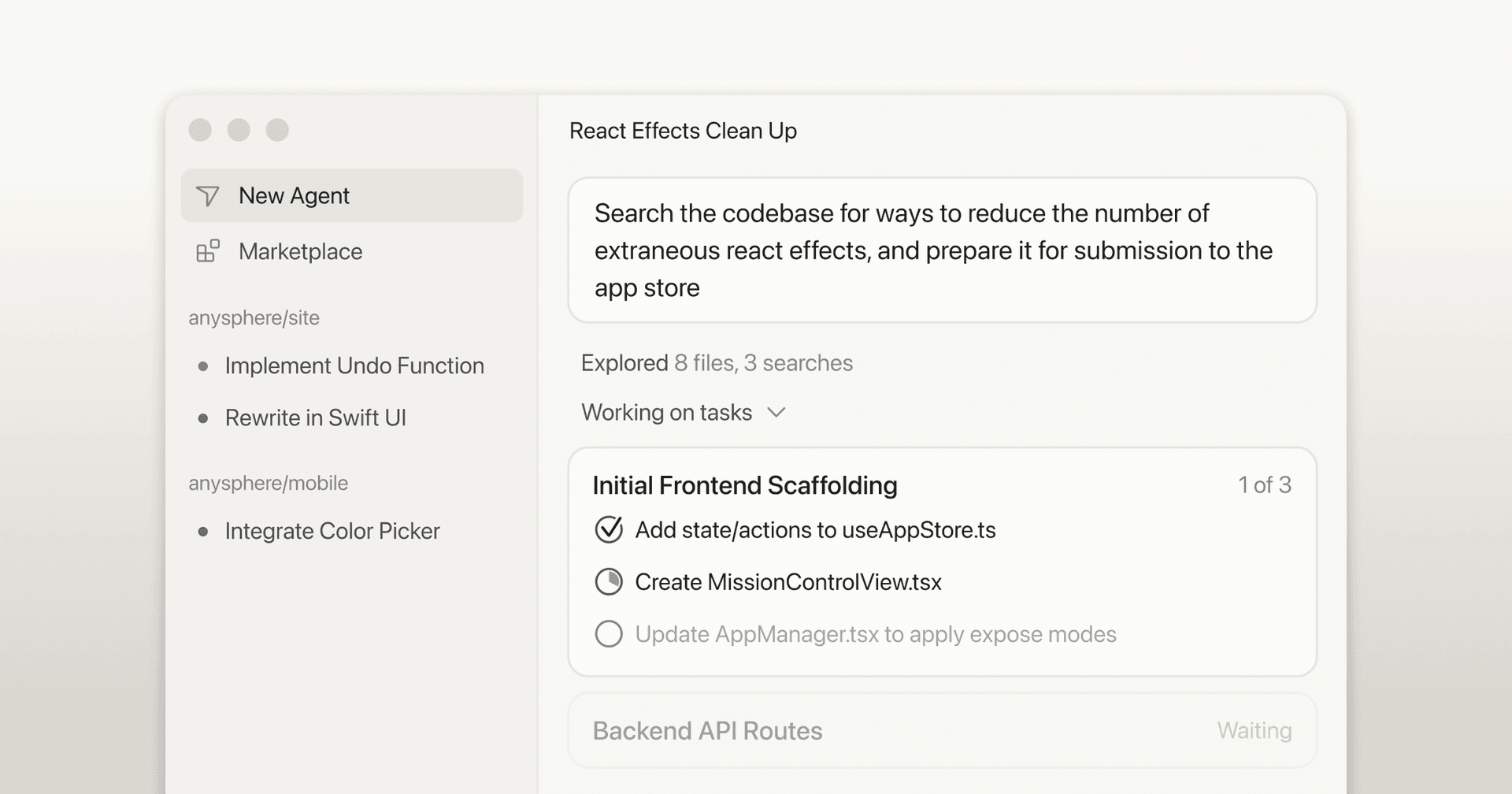
Cursor has launched Cursor 3, a ground-up redesign of its AI coding platform that puts autonomous agents at the center of the developer experience. The release, codenamed "Glass" internally, represents Cursor's most ambitious bid yet to challenge Anthropic's Claude Code and OpenAI's Codex in the rapidly expanding agentic coding market.
What Is Cursor 3?
Cursor 3 replaces the traditional IDE-first workflow with what the company calls a "unified workspace for building software with agents." Instead of writing code line by line with AI autocomplete — the paradigm that GitHub Copilot popularized — Cursor 3 lets developers describe tasks in natural language and delegate them to a team of AI agents that can read entire codebases, execute terminal commands, run tests, and perform multi-file refactors autonomously.
The new interface pulls developers up to a higher level of abstraction. A multi-repo layout lets users manage several projects simultaneously, while a newly added sidebar shows all active agents and their progress in real time.
Local and Cloud Agents
The headline feature is Cursor's dual-agent architecture. Cloud agents run on Cursor's infrastructure with access to more compute resources and can execute tasks in parallel — up to 10 concurrent workers per user. Local agents run on the developer's own machine, with full access to their file system, environment variables, and local tooling.
The handoff between environments is seamless. A developer can start a task locally, push it to the cloud to keep running while they step away, and pull it back to their desktop when they want to inspect or test the results. This addresses a common pain point with pure cloud-based agents: developers want the raw power of cloud execution but the control and security of local development.
Composer 2 and Model Flexibility
Cursor 3 ships with Composer 2, Cursor's proprietary coding model tuned for high-throughput iteration. The company claims significantly higher edit acceptance rates compared to Composer 1. Developers can also plug in their own model APIs — including Claude, GPT-4, and open-weight models — giving teams flexibility in model selection based on cost, speed, or capability requirements.
Design Mode
For frontend developers, Cursor 3 introduces Design Mode: a visual overlay that lets developers click on UI elements and describe changes in natural language. The AI agents then implement the modifications automatically, bridging the gap between visual design intent and code implementation. This is a direct response to the "vibe coding" trend, where non-engineers use AI tools to build applications through natural language alone.
Self-Hosted Cloud Agents
Enterprise customers now have access to generally available self-hosted cloud agents. This means organizations can run Cursor's agent infrastructure within their own network perimeter, keeping source code, build artifacts, and tool execution entirely in-house. Cursor handles the orchestration layer while the company's intellectual property never leaves its own servers.
The Competitive Landscape
The timing is deliberate. Claude Code has captured an estimated 54% of the AI coding market according to Menlo Ventures data, with its terminal-based agent approach resonating with professional developers. OpenAI's Codex, meanwhile, has been gaining ground in enterprise environments. Cursor's bet is that developers want the best of both worlds: the autonomous capability of a CLI agent with the visual clarity of an IDE.
Cursor is not short on resources to make this bet. The company has raised over $3 billion from Nvidia, Google, and other investors, reaching a $29.3 billion valuation after crossing $1 billion in annual recurring revenue in November 2025. That war chest gives Cursor room to iterate aggressively on the agent experience while subsidizing compute costs for cloud agents.
What This Means for Developers
For the average developer, Cursor 3 lowers the barrier to agentic coding without requiring them to leave their IDE. Claude Code users already comfortable with terminal-based agents may find less reason to switch, but developers who prefer a visual interface now have a serious alternative that matches the agentic capabilities of CLI tools.
The broader trend is clear: the future of software development is shifting from human-writes-code-with-AI-help to human-directs-agents-that-write-code. Cursor 3 is the latest and most polished entry in that race.