Key Takeaways
- The source outlines a future architecture for real-time recommendation systems, arguing that batch processing misses critical purchase windows.
- It posits that streaming SQL will be key to closing the latency gap between user action and system response by 2026.
What Happened

A new article on Medium's Real-Time Data Evolution blog presents a forward-looking vision for the architecture of recommendation systems in 2026. The core thesis is straightforward: traditional batch-computed recommendations are too slow, often missing the fleeting "purchase window" when a user's intent is highest. The proposed solution is a shift to real-time systems built on streaming SQL, which can process user actions—like a click, view, or add-to-cart—and generate a relevant recommendation within moments.
While the article is a conceptual piece rather than a research paper, it highlights a critical and persistent pain point in digital commerce. The promise is to close the latency gap entirely, creating a feedback loop where the system's understanding of a user evolves with every interaction, not just at daily or hourly intervals.
Technical Details
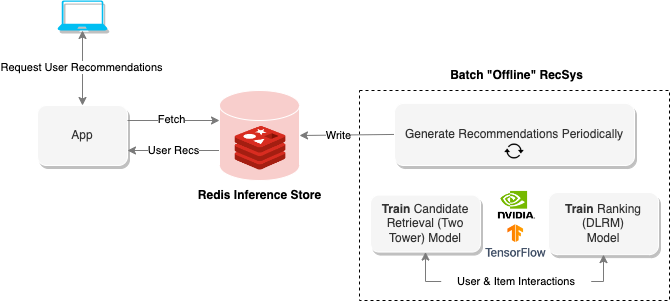
The article's argument centers on architectural paradigms. Batch processing, the incumbent standard, involves running complex algorithms over large, static datasets at scheduled intervals (e.g., nightly). The resulting recommendations are then served from a cache. This method is robust for learning long-term preferences but is fundamentally blind to a user's current session.
In contrast, a real-time streaming architecture treats user events as a continuous data stream. Here, streaming SQL (offered by platforms like Apache Flink, ksqlDB, or RisingWave) becomes the operational layer. It allows developers to define recommendation logic—such as session-based co-visitation rules or lightweight feature scoring—using familiar SQL-like queries that execute on the fly as data flows through the system. This enables sub-second recommendation updates based on the last user action.
The envisioned 2026 stack likely combines this real-time layer with a more traditional batch or near-real-time layer for computing deep user embeddings and training complex models (like two-tower or sequence models). The real-time layer would then dynamically blend these pre-computed scores with fresh, contextual signals.
Retail & Luxury Implications
For luxury and retail, the implications of this architectural shift are profound, though the path to 2026 implementation is non-trivial.
The High-Value, High-Intent Session: In luxury e-commerce, the consideration phase is often elongated, but the final decision can be impulsive and highly influenced by immediate context. A customer browsing silk scarves after looking at a handbag is signaling a complementary purchase intent now. A batch system from yesterday cannot see this. A real-time engine could instantly pivot recommendations to showcase scarves that stylistically match the viewed bag, potentially securing a higher-value basket.
Personalizing the Journey, Not Just the Product: Real-time systems move beyond "users who bought X also bought Y" to "users who just did X in this session might want Y." This allows for dynamic journey personalization. For example, if a user spends significant time on a product's craftsmanship video, the system could immediately prioritize recommendations for items with similar artisanal narratives or behind-the-scenes content.
Operational Challenges: The vision is compelling, but its execution demands significant investment. It requires a mature data infrastructure with robust event streaming (e.g., Kafka), low-latency feature stores, and engineering teams skilled in streaming data processing. For many heritage luxury brands, legacy system integration poses a major hurdle. The cost-benefit analysis must justify the engineering lift against the potential for incremental conversion rate uplift.
Business Impact
The potential business impact is an increase in conversion rate and average order value through superior contextual relevance. However, the article does not provide quantified metrics. The value proposition is strategic: capturing demand the moment it materializes. In a competitive landscape where customer attention is the ultimate luxury, reducing recommendation latency from hours to milliseconds could become a key differentiator.
Implementation Approach
Adopting this vision would be a multi-year journey for most retailers:
- Foundation: Instrument all user-facing digital touchpoints to emit granular, structured event streams.
- Streaming Layer: Implement a streaming processing engine (Flink, Spark Streaming) and a feature store for low-latency access to user and item vectors.
- Hybrid Architecture: Develop a hybrid recommendation service that blends predictions from batch-trained models (handling long-term taste) with real-time scoring from streaming SQL jobs (handling session context).
- Testing & Validation: Rigorously A/B test real-time recommendations against batch baselines to measure impact on session-level metrics.
Governance & Risk Assessment
Real-time personalization amplifies existing governance challenges:
- Privacy & Compliance: Processing data instantaneously complicates compliance with right-to-be-forgotten requests (e.g., GDPR). Systems must be designed to propagate deletions through streaming pipelines.
- Bias & Fairness: Real-time feedback loops can rapidly amplify biases. If a model starts recommending only bestsellers in real-time, it can create a snowball effect, burying new or niche products.
- System Complexity: Increased architectural complexity leads to higher operational risk. Failures in the streaming layer could directly degrade the customer experience.
- Maturity: While the technology exists today, seamlessly integrating it into a production e-commerce stack at scale remains a cutting-edge challenge. 2026 is a plausible timeline for this to become a more mainstream aspiration.
gentic.news Analysis
This conceptual article taps directly into the most active frontier in recommender systems research and engineering: the compression of time between signal and action. It aligns with the broader trend we are covering, where the focus is shifting from purely static, batch-oriented algorithms to dynamic, session-aware models.
This discussion connects naturally to our recent coverage. For instance, the IAT: Instance-As-Token Compression for Historical User Sequence Modeling article (2026-04-13) addresses a core enabler for this vision: efficiently modeling long user histories so they can be used as context in low-latency settings. Furthermore, the New arXiv Study Finds No Saturation Point for Data in Traditional Recommender Systems (2026-04-09) underscores that while real-time context is critical, the foundational batch-computed models that understand deep user preferences are not going away—they are becoming more data-hungry and accurate. The future, as this Medium piece suggests, is a symbiotic architecture where massive batch-trained models provide the "understanding," and nimble real-time systems provide the "context."
For luxury AI leaders, the takeaway is to build data infrastructure with this hybrid future in mind. Prioritize event capture and streaming capabilities now, even if full real-time recommendation is a 2-3 year roadmap item. The brands that master this blend of deep historical personalization and instantaneous contextual adaptation will define the next generation of digital clienteling.