In the rapidly advancing field of artificial intelligence, a persistent challenge has been the inefficient way AI agents develop and utilize skills. Currently, most agents approach each new task as if starting from scratch, "reinventing the wheel" rather than building upon previously acquired capabilities. This fundamental limitation has constrained the development of truly sophisticated AI systems capable of complex, multi-step reasoning and problem-solving.
The Problem: Reinventing the Wheel
Traditional AI agent development has followed a fragmented approach where skills are typically created as transient solutions to specific problems. When faced with new challenges, agents must either start from scratch or undergo extensive retraining, resulting in significant computational overhead and limited ability to transfer knowledge between domains. This approach mirrors early human learning before the development of systematic education—each generation must rediscover fundamental principles rather than building upon accumulated wisdom.
Introducing SkillNet: A Unified Skill Infrastructure
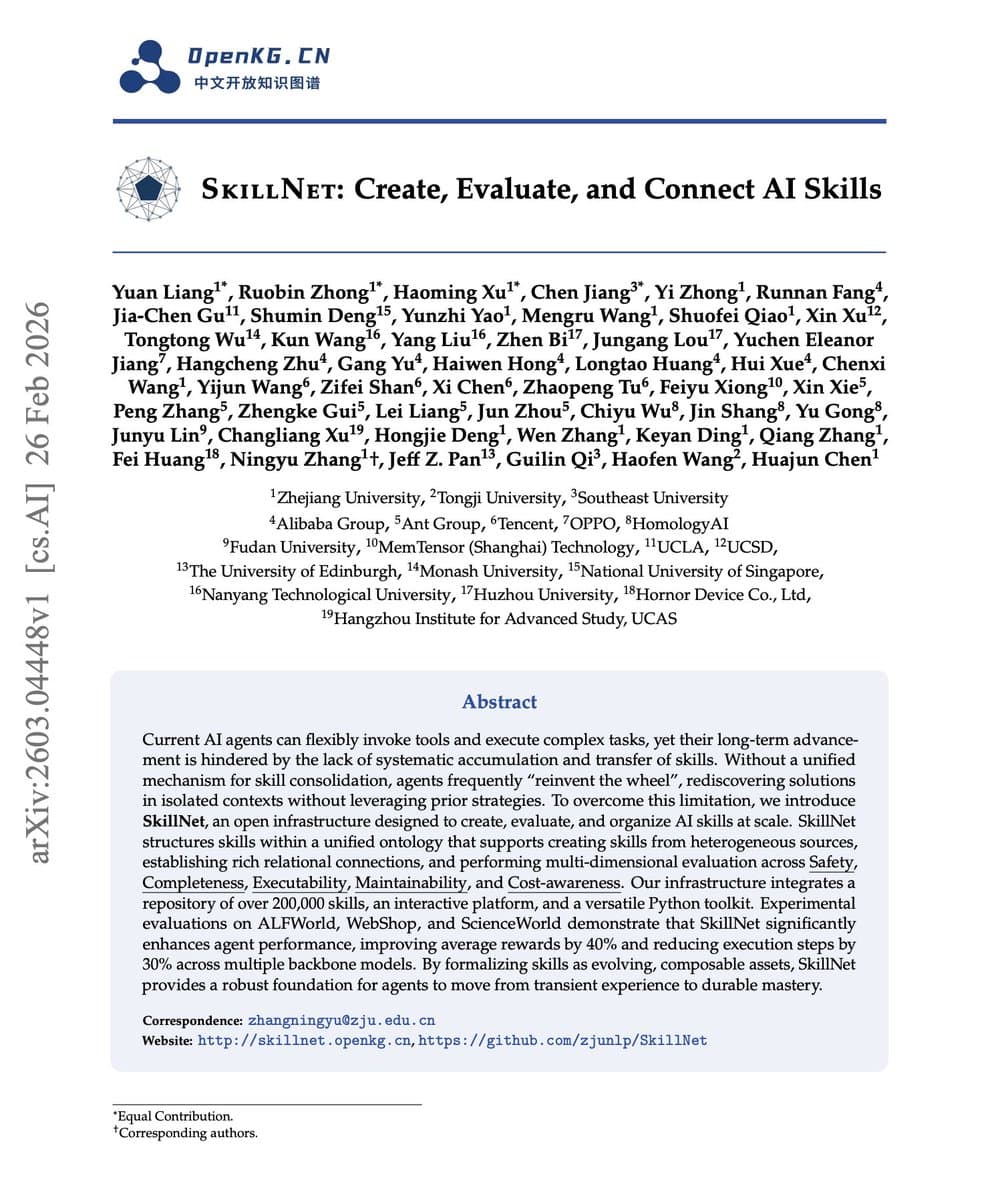
Researchers have developed SkillNet, described as "an open infrastructure for creating, evaluating, and organizing AI skills at scale." The system represents a paradigm shift in how AI capabilities are developed and maintained. Rather than treating skills as isolated solutions to specific problems, SkillNet structures them within a comprehensive ontology that currently encompasses over 200,000 distinct skills.
This unified framework establishes rich relational connections between skills, including:
- Similarity relationships that identify overlapping capabilities
- Composition relationships that enable complex skills to be built from simpler ones
- Dependency relationships that map prerequisite knowledge
Performance Breakthroughs
SkillNet's impact has been quantified across multiple challenging benchmarks, demonstrating substantial improvements in agent efficiency and effectiveness:
- ALFWorld: A text-based environment where agents must complete household tasks through natural language commands
- WebShop: An e-commerce simulation requiring product search, comparison, and purchase decisions
- ScienceWorld: A scientific reasoning environment testing hypothesis formation and experimental design
Across these diverse domains, SkillNet improved average rewards by 40% while reducing execution steps by 30%. These metrics translate to more capable agents that accomplish tasks more efficiently with fewer computational resources.
The Skill Evolution Paradigm
The fundamental innovation of SkillNet lies in its treatment of skills as "evolving, composable assets rather than transient solutions." This perspective mirrors how human expertise develops—through gradual refinement, combination of existing knowledge, and adaptation to new contexts. The system enables:
- Skill accumulation: Once acquired, skills remain available for future use
- Skill refinement: Existing capabilities can be improved based on new experiences
- Skill composition: Complex behaviors emerge from combining simpler skills
- Skill transfer: Capabilities developed in one domain can be adapted to others
Implementation and Architecture
While the source material doesn't provide exhaustive technical details, SkillNet appears to implement several key architectural innovations:
- Unified skill representation: A standardized format for describing capabilities across domains
- Relational mapping: Systems for identifying connections between seemingly disparate skills
- Multi-dimensional evaluation: Assessment frameworks that measure skills across multiple performance axes
- Open infrastructure: Designed to be extensible and accessible to the broader research community
Implications for AI Development
The development of SkillNet represents more than just another incremental improvement in AI capabilities. It signals a fundamental shift toward more systematic, efficient, and sustainable AI development. By creating a framework where skills persist and evolve, researchers are addressing one of the core limitations of current AI systems: their inability to accumulate and build upon knowledge over time.
This approach has particular significance for developing AI agents that can operate in complex, real-world environments where tasks rarely exist in isolation. Just as human professionals develop expertise through years of accumulated experience and skill refinement, AI agents using SkillNet can gradually become more capable without requiring complete retraining for each new challenge.
Future Directions and Applications
The SkillNet framework opens numerous possibilities for future AI development:
- Lifelong learning agents: Systems that continuously improve throughout their operational lifespan
- Specialized AI assistants: Agents that develop deep expertise in specific domains through skill accumulation
- Collaborative AI systems: Multiple agents sharing and building upon a common skill repository
- Rapid adaptation: Quick deployment of capable agents in new domains by leveraging existing skill libraries
Challenges and Considerations
While SkillNet represents significant progress, several challenges remain:
- Skill ontology maintenance: Ensuring the skill classification system remains coherent as capabilities expand
- Evaluation standardization: Developing consistent metrics for comparing skills across different domains
- Computational efficiency: Managing the growing skill library without excessive resource requirements
- Transfer limitations: Understanding when and how skills can effectively transfer between domains
Conclusion
SkillNet marks a crucial step toward more sophisticated, efficient, and capable AI systems. By treating skills as persistent, evolving assets rather than disposable solutions, researchers have addressed a fundamental limitation in current AI development approaches. The demonstrated performance improvements—40% better rewards with 30% fewer steps—suggest this framework could accelerate progress across numerous AI applications.
As the system evolves and expands beyond its current 200,000 skills, it may fundamentally change how we develop artificial intelligence, moving from isolated model training toward systematic capability accumulation. This shift could eventually enable AI systems that develop true expertise through experience rather than just pattern recognition through data.
Source: Based on research presented in the SkillNet paper and analysis by Omar Sar (formerly known as Omar Sanseviero) via X/Twitter.