Tencent has released MegaStyle, a large-scale, open-source dataset containing 1.4 million images specifically designed for training and evaluating style transfer and text-to-image models. The dataset is now available on Hugging Face.
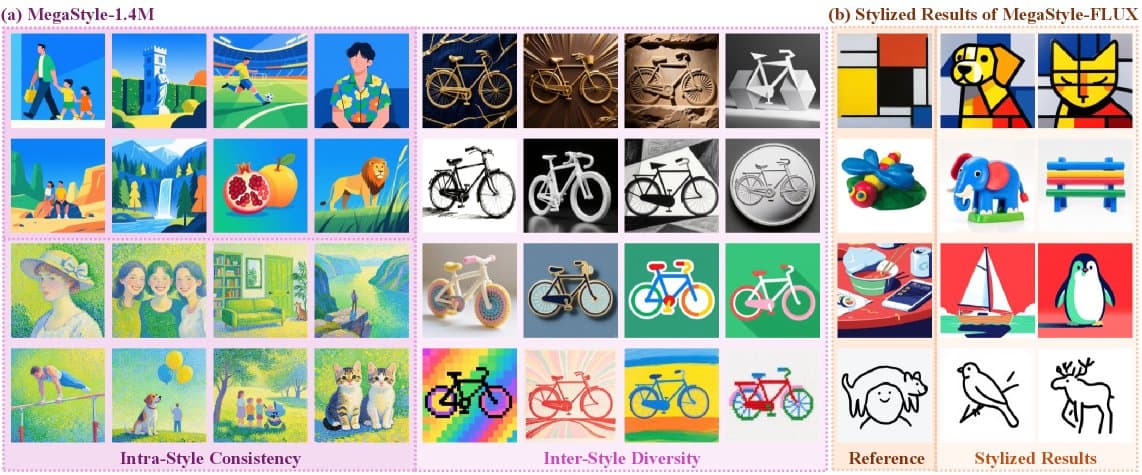
The core innovation of MegaStyle is its structured generation process, which aims to provide both strong intra-style consistency and rich inter-style diversity. This addresses a common challenge in style datasets where examples of a single style can be inconsistent, or the overall range of styles is limited.
Key Takeaways
- Tencent has open-sourced MegaStyle, a 1.4 million image dataset for style transfer and text-to-image fine-tuning.
- It was generated by systematically pairing 170,000 style prompts with 400,000 content prompts using the Qwen-Image model.
What's in the Dataset?

MegaStyle was generated using Tencent's own Qwen-Image multimodal model. The team created it by systematically pairing two distinct sets of prompts:
- 170,000 Style Prompts: These text descriptions define the artistic or aesthetic style to be applied (e.g., "van Gogh's Starry Night," "cyberpunk neon," "watercolor sketch").
- 400,000 Content Prompts: These describe the underlying subject matter or scene (e.g., "a cat sitting on a windowsill," "a futuristic cityscape").
By crossing these two sets, the Qwen-Image model generated a massive matrix of images where the same content is rendered in multiple styles, and the same style is applied to multiple contents. This structure is intended to provide clear, paired data for training models to understand and disentangle "content" from "style."
Technical Details & Potential Use Cases
The dataset's primary stated purpose is for fine-tuning text-to-image diffusion models (like Stable Diffusion) and training style transfer networks. The paired structure makes it particularly suitable for:
- Controllable Generation: Training models to reliably follow a style prompt while maintaining content fidelity.
- Style Transfer Benchmarking: Providing a standardized testbed to evaluate how well an algorithm can extract a style from one image and apply it to another.
- Improving Style Fidelity: Helping models avoid "style collapse" or inconsistency when generating multiple images from the same style description.
Releasing the dataset on Hugging Face suggests Tencent aims for easy integration into the open-source ML workflow, allowing researchers and developers to download it via the datasets library.
gentic.news Analysis

This release is a strategic move by Tencent in the increasingly competitive landscape of foundational AI assets. While much attention is focused on large language models (LLMs), high-quality, large-scale datasets for specific vision tasks remain critical infrastructure. By open-sourcing MegaStyle, Tencent is contributing to the community while also promoting its own Qwen-Image model as a capable tool for synthetic data generation.
This follows a pattern of Chinese tech giants releasing significant AI resources to establish ecosystem influence. It aligns with Tencent's broader push in multimodal AI, as seen with its Qwen series of models developed by Alibaba Cloud (a key partner/competitor in the cloud space). The use of Qwen-Image for generation also serves as a tacit benchmark of the model's reliability and prompt-following capabilities.
For practitioners, the value of MegaStyle will depend on the actual quality and diversity of the generated images, which will need community validation. If successful, it could become a standard dataset for style-related research, similar to how COCO or ImageNet are used for object recognition. The key question is whether a purely synthetic dataset, even at this scale, can match the nuance and complexity of styles found in curated, human-created art collections. This release will test the limits of AI-generated data for training the next generation of AI models.
Frequently Asked Questions
What is the MegaStyle dataset used for?
MegaStyle is designed for training and evaluating AI models related to image style. Its primary uses are fine-tuning text-to-image generation models (like Stable Diffusion) to better follow style prompts, and training or benchmarking neural style transfer algorithms that apply the aesthetic of one image to another.
How was the MegaStyle dataset created?
The dataset was created synthetically using Tencent's Qwen-Image AI model. The researchers generated 170,000 unique text prompts describing artistic styles and 400,000 prompts describing content. The Qwen-Image model was then used to generate an image for every possible pair between these two sets, resulting in 1.4 million stylized images.
Is the MegaStyle dataset free to use?
Yes. Tencent has released MegaStyle on the Hugging Face platform, which typically hosts open-source datasets and models. Users can likely download and use it for research and commercial purposes under a permissive open-source license, though it's essential to check the specific license terms on its Hugging Face page.
How does MegaStyle compare to other style datasets?
Most existing style datasets are either smaller in scale, less structured, or based on human-curated artwork. MegaStyle's main differentiators are its massive size (1.4M images) and its systematic, paired structure (style x content), which is explicitly designed to provide consistent examples within a style and broad diversity across styles. Its purely AI-generated nature is also a distinguishing factor.