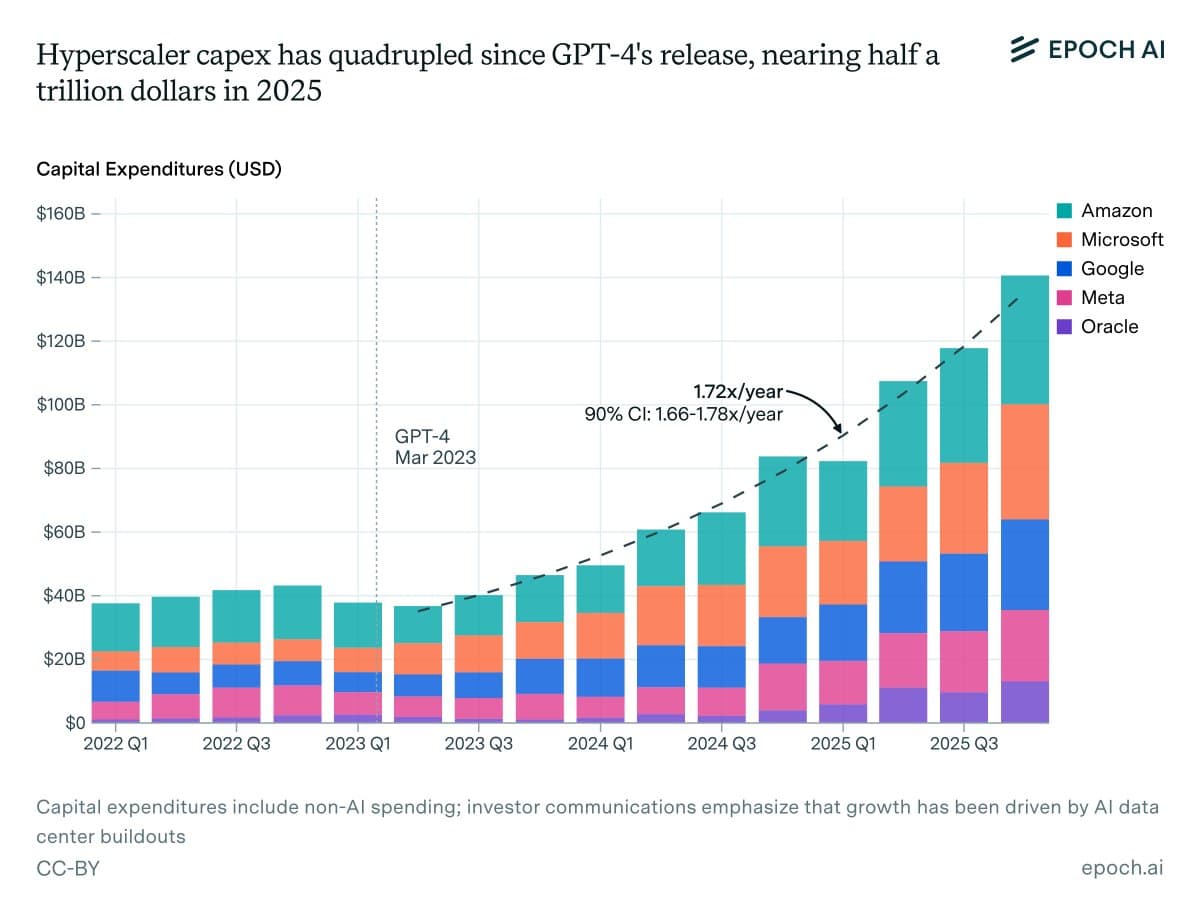
A quiet revolution is unfolding in the technology sector, one measured not just in algorithms and models but in concrete, steel, and silicon. According to recent projections shared by industry observers, artificial intelligence infrastructure spending is experiencing explosive growth that will fundamentally reshape the global technological landscape. Data center capital expenditures (CapEx) dedicated to AI are growing at approximately 70% annually and are expected to reach $800 billion by 2026 before crossing the $1 trillion threshold in 2027.
The Scale of the Investment Surge
These figures represent more than just incremental growth—they signal a fundamental reallocation of global capital. To put this in perspective, the projected $1 trillion annual spending on AI infrastructure by 2027 would exceed the current GDP of countries like Switzerland or Turkey. This investment wave is driven by the insatiable computational demands of large language models, generative AI systems, and increasingly sophisticated machine learning applications that require specialized hardware and massive data processing capabilities.
The 70% annual growth rate in AI CapEx dramatically outpaces traditional technology infrastructure spending, which typically grows in the single digits. This acceleration reflects both the immediate needs of current AI systems and anticipation of future requirements as models grow larger and more complex.
What's Driving the Spending Spree?
Several converging factors are fueling this infrastructure boom. First, the computational requirements for training state-of-the-art AI models have been doubling every few months, a trend that shows no signs of slowing. Second, the shift from training to inference—running trained models in production—requires even more infrastructure as AI applications move from research labs to mainstream products and services.
Third, there's an architectural shift toward specialized AI chips. While traditional data centers relied heavily on general-purpose CPUs, modern AI infrastructure increasingly incorporates GPUs, TPUs, and other specialized accelerators that offer better performance per watt for AI workloads but come with higher price tags and different infrastructure requirements.
Finally, the geographical distribution of this spending is noteworthy. While the United States currently leads in AI infrastructure investment, significant growth is occurring in Asia and Europe as nations recognize AI capability as both an economic imperative and a strategic priority.
The Hardware Ecosystem Transformation
This spending surge is transforming entire hardware ecosystems. Semiconductor companies like NVIDIA, AMD, and Intel are racing to develop increasingly powerful AI chips, while cloud providers—Amazon Web Services, Microsoft Azure, and Google Cloud—are making unprecedented investments in data center construction and expansion.
Beyond processors, the infrastructure boom extends to networking equipment, storage systems, cooling technologies, and power delivery systems. Liquid cooling solutions, once a niche technology, are becoming mainstream as AI clusters generate heat densities that traditional air cooling cannot manage efficiently.
Perhaps most significantly, the energy requirements of these facilities are forcing a reexamination of power generation and distribution. Some estimates suggest that by 2027, AI data centers could consume as much electricity as entire mid-sized countries, pushing the industry toward more sustainable energy sources and innovative efficiency measures.
Economic and Strategic Implications
The economic implications of this spending wave are profound. On one hand, it represents a massive stimulus for the technology hardware sector and related industries. On the other, it raises questions about capital allocation, with some analysts concerned that such concentrated investment could lead to bubbles or misallocation of resources.
Strategically, nations and corporations are recognizing that AI capability is increasingly tied to computational infrastructure. The ability to train and deploy cutting-edge AI models requires access to specialized hardware that is both expensive and, in some cases, subject to export controls and supply chain constraints.
This reality is driving increased government involvement in AI infrastructure development, with various nations implementing policies to encourage domestic capacity. The European Union's AI Act, the United States' CHIPS and Science Act, and similar initiatives worldwide reflect growing recognition that AI leadership requires infrastructure leadership.
Challenges on the Horizon
Despite the optimistic projections, significant challenges could impact this growth trajectory. Supply chain constraints for advanced semiconductors, regulatory hurdles related to energy consumption and environmental impact, and potential economic headwinds could all moderate the pace of investment.
Additionally, there are questions about whether software and algorithmic improvements might eventually reduce hardware requirements. While current trends point toward ever-larger models requiring ever-more computation, breakthroughs in efficiency or alternative approaches could change this trajectory.
The Future Beyond 2027
Looking beyond the $1 trillion threshold, the fundamental question becomes: What happens when AI infrastructure spending reaches these levels? Some analysts suggest we may see a plateau or shift in spending patterns as certain technological maturities are reached. Others believe this represents a new normal, with AI infrastructure becoming a persistent, massive sector of the global economy akin to telecommunications or transportation infrastructure.
What's clear is that we're witnessing the early stages of building what might be considered the "nervous system" of an AI-powered world—a physical infrastructure that will underpin economic activity, scientific discovery, and daily life for decades to come.
Source: Analysis based on projections shared by @kimmonismus and industry data on AI infrastructure investment trends.