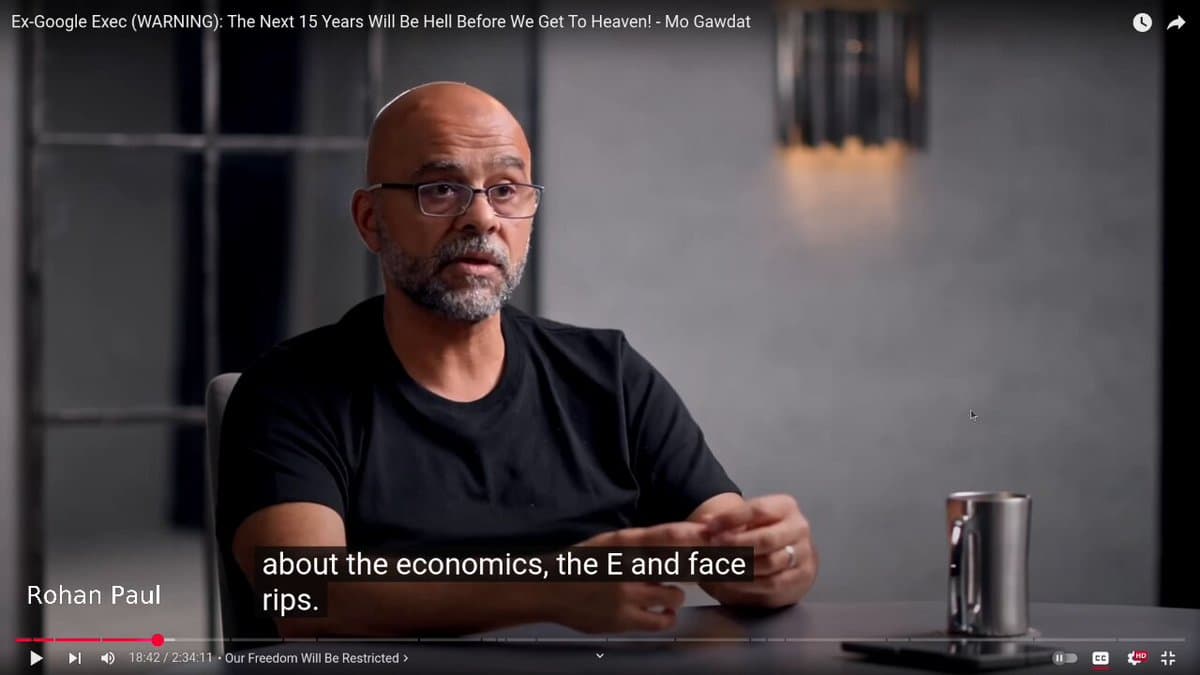
Former Google executive Mo Gawdat made a striking prediction nearly a year ago that's gaining renewed attention: "We're going to start to see a trillionaire before 2030. I can guarantee you that someone will be a trillionaire." His comments, originally shared on 'The Diary Of A CEO' YouTube channel, suggested that artificial intelligence investments would create unprecedented wealth concentration, potentially leading to a scenario where "robots and AIs doing everything, and humans will have no jobs."
Now, emerging reports about SpaceX's potential 2026 initial public offering suggest this prediction might materialize sooner than expected—and through an unexpected combination of AI and space technology.
The SpaceX IPO Pathway
According to Bloomberg News reports cited by Reuters, SpaceX is weighing a confidential IPO filing that could value the company at approximately $1.75 trillion by mid-2026. This staggering valuation would represent one of the largest public offerings in history and could potentially make Elon Musk the world's first trillionaire.
Musk currently holds about 42% of SpaceX shares, meaning his stake could be worth approximately $735 billion based on the projected valuation. When combined with his Tesla holdings and other assets, this could push his total net worth beyond the trillion-dollar threshold.
The Starlink Revenue Engine
What's driving this extraordinary valuation? Most of SpaceX's earnings reportedly come from Starlink, the satellite internet service that generates between 50% and 80% of the company's total sales. Starlink represents a remarkable convergence of space technology and digital infrastructure—a global communications network that could eventually integrate with AI systems for everything from autonomous shipping to global IoT networks.
This revenue stream demonstrates how space-based infrastructure has evolved from government-funded exploration to commercially viable services with massive market potential. Starlink's growing subscriber base and expanding global coverage create a recurring revenue model that traditional space companies never achieved.
AI's Role in the Trillionaire Equation
Gawdat's original prediction focused specifically on AI investments creating the first trillionaire, suggesting "there will be a new Elon Musk or Larry Ellison that will become a trillionaire because of AI investments." The SpaceX development adds an intriguing layer to this prediction—it's not necessarily a "new" billionaire but potentially an existing one whose companies increasingly integrate AI throughout their operations.
SpaceX itself employs AI and machine learning for rocket landing systems, satellite constellation management, and mission optimization. The company's technologies increasingly blur the lines between space exploration, telecommunications, and artificial intelligence.
The Broader Implications of Extreme Wealth Concentration
The prospect of a trillionaire raises profound questions about wealth distribution, economic power, and societal structure. Gawdat warned that such extreme wealth concentration could lead to scenarios where "that trillionaire will have so much money to buy everything" while automation potentially displaces human workers on an unprecedented scale.
This prediction aligns with ongoing debates about Universal Basic Income, wealth taxes, and the social contract in an increasingly automated economy. The emergence of a trillionaire would represent not just a personal financial milestone but a symbolic threshold in global wealth inequality.
Historical Context and Future Projections
To understand the magnitude of this potential development, consider that the world's first billionaire (in modern terms) emerged just over a century ago with John D. Rockefeller. The jump from billionaire to trillionaire represents a thousand-fold increase—a acceleration of wealth accumulation that mirrors the exponential growth of technology itself.
If Musk or another individual reaches trillionaire status in the coming years, it will likely be through a combination of factors:
- Platform dominance in multiple high-growth sectors
- Network effects that create near-insurmountable competitive advantages
- Automation reducing operational costs while scaling revenue
- Global reach through digital or space-based infrastructure
The Intersection of Multiple Exponential Technologies
The SpaceX valuation story highlights how trillionaire status may not come from a single technology but from the convergence of multiple exponential technologies. Space technology, artificial intelligence, telecommunications, and renewable energy (through Tesla) create synergistic advantages that compound growth.
This technological convergence creates what economists call "winner-take-most" markets, where first-mover advantages become increasingly difficult to challenge as systems grow more complex and integrated.
Ethical and Regulatory Considerations
As private companies like SpaceX achieve valuations comparable to large national economies, questions emerge about appropriate regulation, antitrust considerations, and the balance between innovation and public interest. Space-based infrastructure in particular raises questions about orbital crowding, frequency allocation, and the militarization of space.
The potential emergence of a trillionaire also renews debates about wealth taxation, philanthropic obligations, and whether extreme wealth concentration ultimately benefits or hinders broader economic progress.
Looking Toward 2030 and Beyond
Whether the first trillionaire emerges through SpaceX's IPO, through pure AI investments as Gawdat predicted, or through some combination of technologies, the broader trend seems clear: technological acceleration is creating wealth concentration at unprecedented scales.
This development will likely force societies to reconsider fundamental economic structures, employment models, and wealth distribution mechanisms. The decisions made in response to these trends may shape the next century of human economic organization as profoundly as the Industrial Revolution shaped the last.
Source: Predictions from former Google executive Mo Gawdat on 'The Diary Of A CEO' YouTube channel, combined with Bloomberg News reports about SpaceX's potential IPO as cited by Reuters.