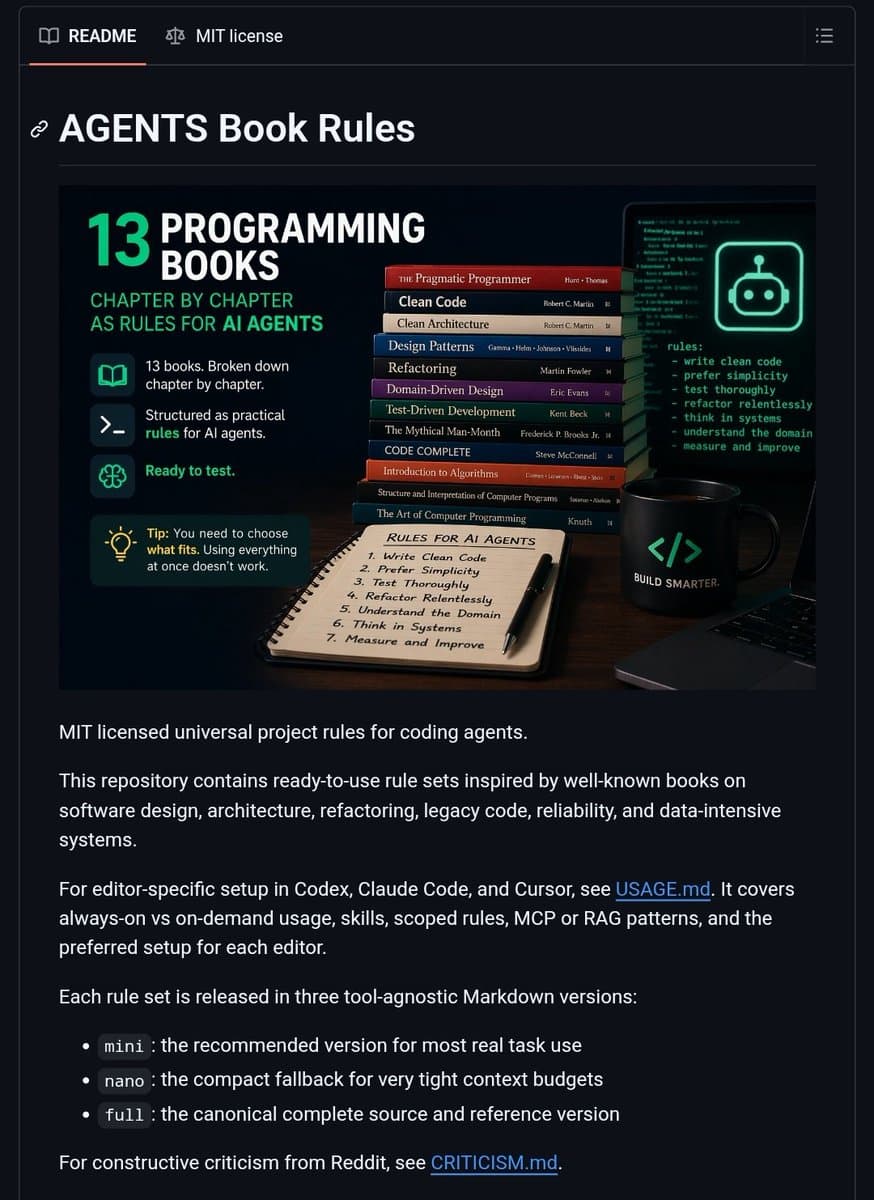
A developer compiled rules from 14 classic software engineering books into ready-to-use instruction files for AI coding agents. The project covers Clean Code, Clean Architecture, Refactoring, Designing Data-Intensive Applications, The Pragmatic Programmer, Release It!, and Working Effectively with Legacy Code.
Key facts
- 14 classic software engineering books converted
- Works with Claude Code, Cursor, Codex
- Unified set synthesizes all 14 books
- Modular rule sets per book or task
- Open-source, one copy command to load
The repository, shared on X by user @_vmlops, converts each book into a distinct rule set that can be loaded into AI coding agents — specifically Claude Code, Cursor, and Codex — via a single copy command. [According to @_vmlops] the idea is simple: instead of giving an AI agent zero context on coding standards, you give it 14 books worth of engineering principles in one folder.
The rule sets are modular. For working with legacy code, you drop in the Working Effectively with Legacy Code rules. For building production services, the Release It! rules load in. For everyday coding, Clean Code rules keep things readable. There is also a unified set that synthesizes all 14 books into one coherent instruction file for users who want a single strong default.
The unique take here is not the content — these books are decades old — but the packaging. Most AI agent setups give the model zero structured guidance on software engineering best practices. This project bridges that gap by turning canonical knowledge into agent-native formats. It's a pattern that could scale: any domain with established literature could produce similar rule sets, from system design to security.
How It Works

The rule sets are plain-text instruction files designed to be appended to the system prompt or loaded as context. Each file distills the book's core principles into actionable guidelines — for example, Clean Code rules emphasize meaningful names, small functions, and no commented-out code. The unified set merges all 14 into a single file, prioritizing principles from DDIA for data modeling and Clean Architecture for dependency management.
Who This Affects
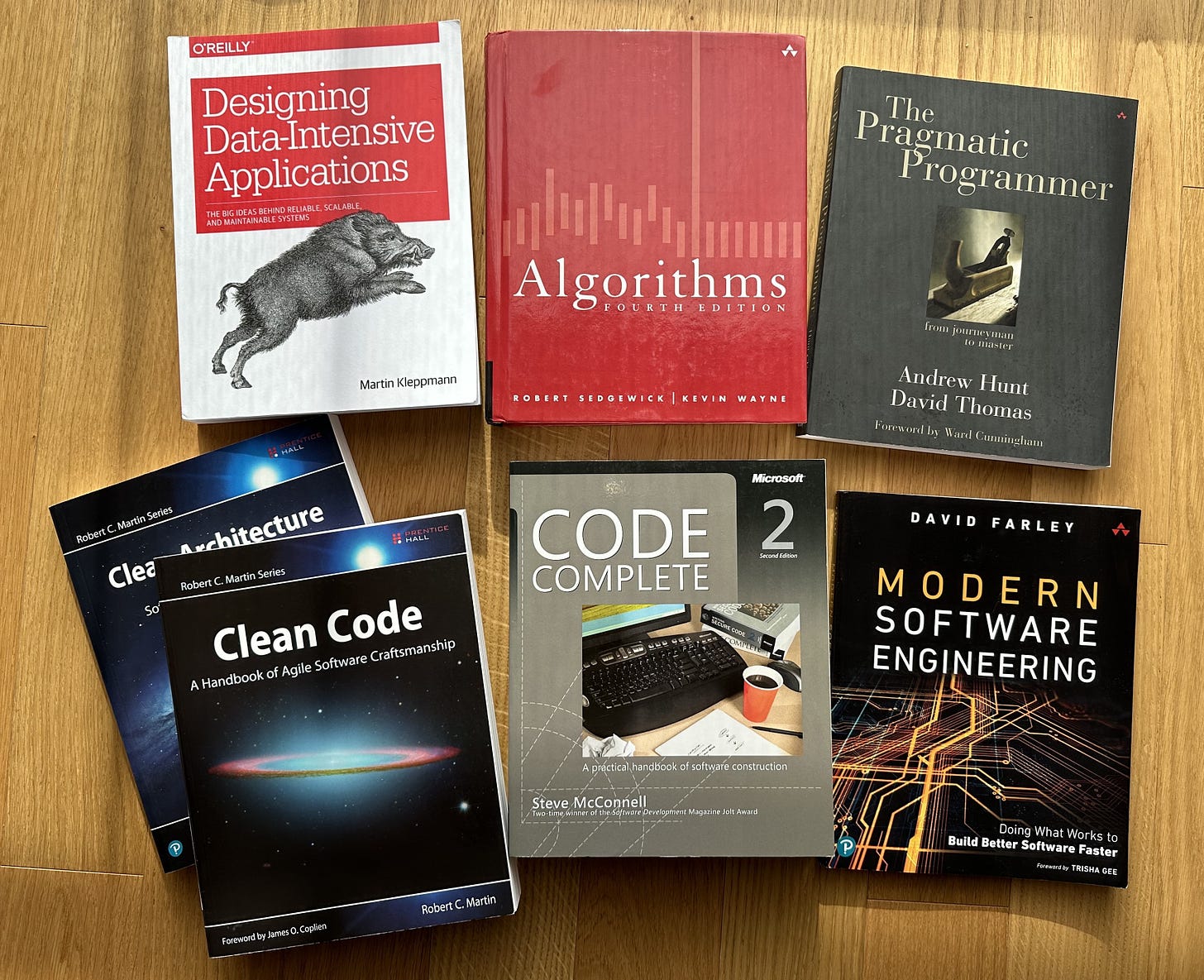
This directly impacts developers using AI coding agents for serious software engineering. Instead of the agent generating code with no structural philosophy, it now inherits the judgment of authors like Robert C. Martin, Martin Fowler, and Michael Feathers. The modular design means a developer can swap rule sets depending on the task — legacy refactoring vs. greenfield microservices — without retraining or fine-tuning.
The project is open-source and available on GitHub. No pricing or licensing details were disclosed.
What to watch
Watch for community adoption metrics — how many GitHub stars and forks the repo accumulates in the first month, and whether other developers contribute rule sets for additional books like The Mythical Man-Month or Designing Data-Intensive Applications updates.