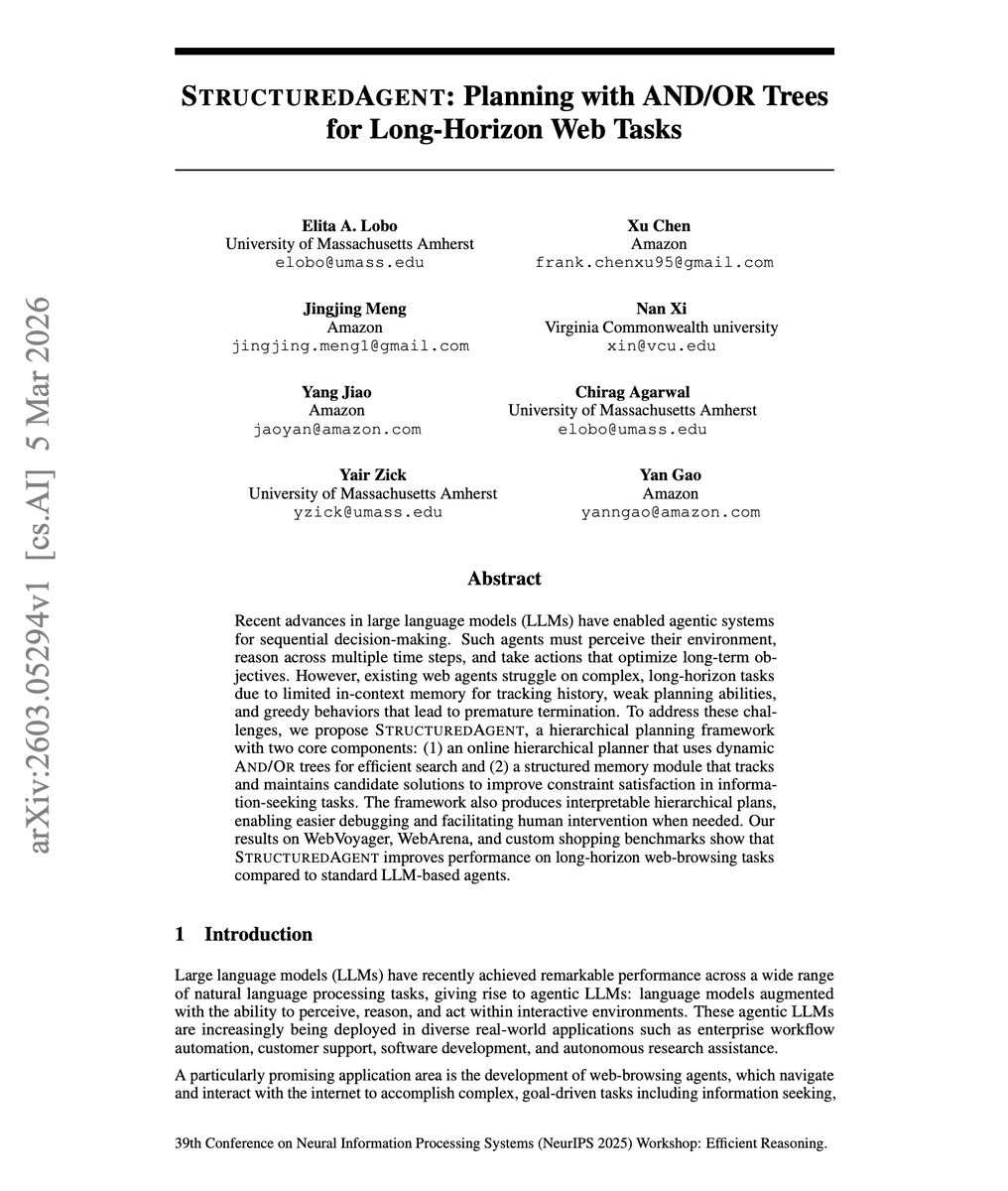
In a significant advancement for autonomous AI systems, researchers have developed STRUCTUREDAGENT—a new framework that enables web agents to handle complex, long-horizon tasks through sophisticated hierarchical planning. This development addresses a fundamental limitation in current AI agents that struggle with multi-step operations requiring backtracking and alternative solution tracking.
The Problem with Current Web Agents
Today's web agents typically operate with a greedy, step-by-step approach that proves inadequate for complex tasks. As noted in the research, these agents "act greedily and lose track of alternatives," making them ineffective for tasks requiring multiple decision points and potential revisions. This limitation becomes particularly apparent in real-world scenarios like online shopping, where users might need to compare products, check availability, read reviews, and navigate through multiple pages before making a purchase decision.
How STRUCTUREDAGENT Works
The breakthrough comes from STRUCTUREDAGENT's two key innovations: a hierarchical planning framework using dynamic AND/OR trees for efficient search, and a structured memory module for tracking candidate solutions across browsing steps.
Dynamic AND/OR Trees
The AND/OR tree structure allows the agent to represent tasks as hierarchical plans where nodes can represent either sequential steps (AND nodes) or alternative approaches (OR nodes). This enables the agent to explore multiple pathways simultaneously and backtrack when necessary—a capability previously lacking in web agents.
Structured Memory Module
The memory system maintains a structured state throughout the browsing session, allowing the agent to keep track of candidate solutions and partial results. This prevents the common problem of agents "forgetting" earlier alternatives when they encounter dead ends or suboptimal paths.
Performance Results
The framework demonstrates impressive results, achieving 46.7% success on complex shopping tasks while outperforming all baseline methods. This represents a substantial improvement over existing approaches that struggle with the same challenges. The structured approach gives agents "the ability to backtrack, revise, and maintain structured state"—capabilities essential for real-world task completion.
Interpretability and Human Intervention
Another significant advantage of STRUCTUREDAGENT is its interpretability. The system "produces interpretable hierarchical plans that make debugging and human intervention easier." This addresses growing concerns about AI transparency and control, particularly as autonomous systems become more capable. The hierarchical nature of the plans allows developers and users to understand the agent's reasoning process and intervene when necessary.
Implications for AI Development
This advancement has far-reaching implications for the future of AI agents. The ability to handle long-horizon tasks opens up new possibilities for automation in areas previously considered too complex for AI systems. From e-commerce and customer service to research assistance and data collection, web agents with planning capabilities could transform how we interact with digital systems.
The research also suggests a shift in how we approach AI agent design—moving from reactive systems to proactive planners capable of strategic thinking. This aligns with broader trends in AI development toward systems that can reason, plan, and adapt to changing circumstances.
Future Directions
While STRUCTUREDAGENT represents a significant step forward, challenges remain. The 46.7% success rate, while impressive compared to baselines, indicates there's still room for improvement in handling the most complex tasks. Future research will likely focus on refining the planning algorithms, expanding the memory systems, and testing the framework across a wider range of applications.
The framework's success also raises questions about scaling—how well these planning capabilities will extend to even more complex tasks involving dozens or hundreds of steps, and how the system will handle ambiguous or poorly defined objectives.
Conclusion
STRUCTUREDAGENT marks an important milestone in the evolution of AI web agents. By introducing hierarchical planning and structured memory, researchers have addressed fundamental limitations that have hindered progress in this field. As these systems continue to develop, we can expect more capable, reliable, and transparent AI agents that can handle the complex tasks that characterize real-world web interactions.
Source: Research shared by @omarsar0 on Planning for Long-Horizon Web Tasks, detailing the STRUCTUREDAGENT framework and its performance improvements.