What Happened
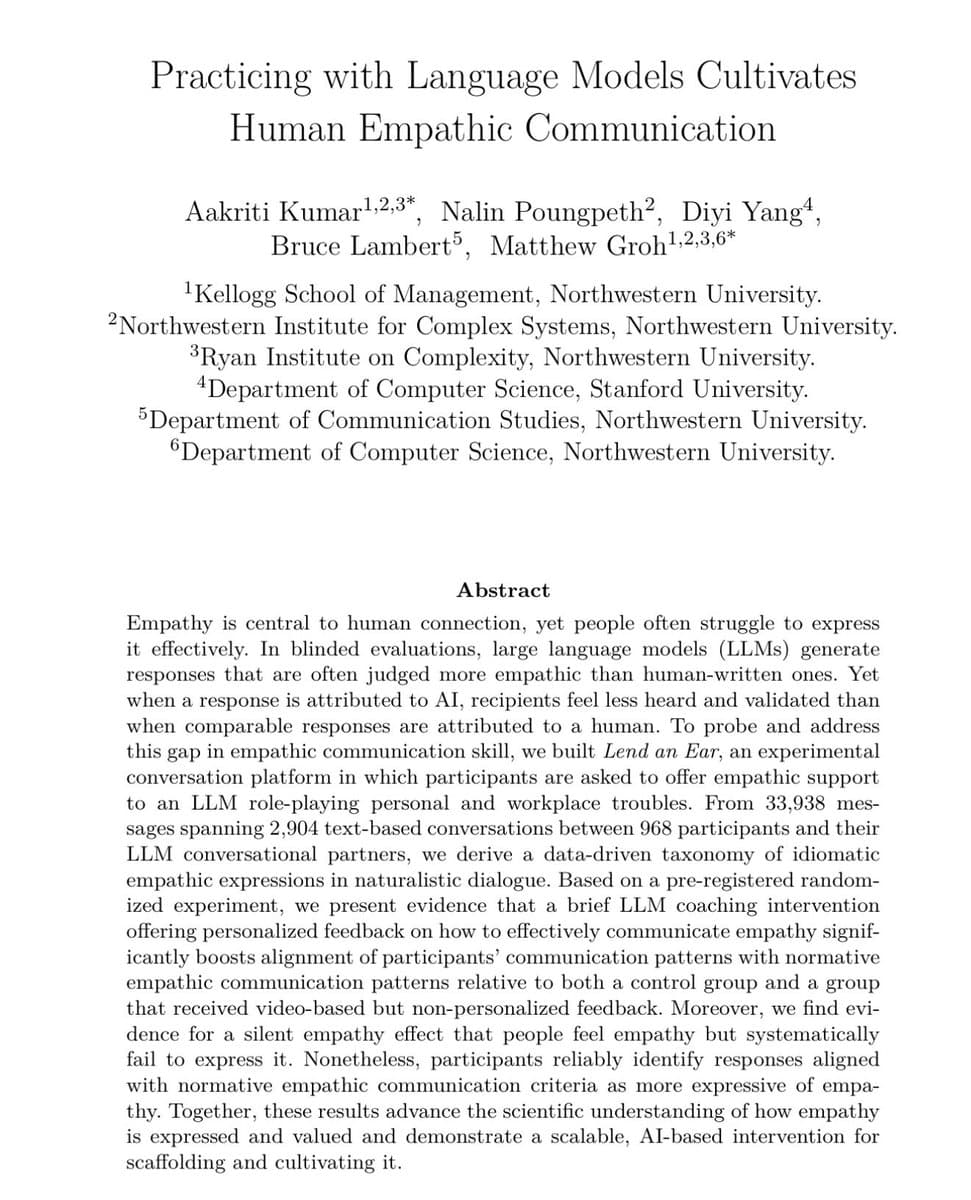
A study involving 968 people, shared by researcher Ethan Mollick, investigated whether AI could help teach the difficult skill of empathetic communication. The study was preregistered, meaning its hypotheses and analysis plan were documented in advance to reduce bias in reporting.
The core finding was twofold:
- Weak Correlation: The researchers found "almost no correlation" between a person's internal feeling of empathy and their ability to effectively communicate empathy to another person. This suggests that feeling empathetic and demonstrating it are distinct skills.
- AI Coaching Efficacy: Participants who engaged in a single practice session with an AI coach showed a measurable improvement in their ability to communicate empathy. The AI provided a simulated environment for practicing responses to emotionally charged scenarios.
The study implies that empathetic communication, often considered an innate "soft skill," can be treated as a trainable competency, and that AI-driven simulation may be an effective tool for this training.
Context
This research fits into a growing body of work exploring AI's role in social skills training and behavioral coaching. Unlike traditional methods that might rely on theoretical instruction or infrequent human role-play, AI coaches can offer scalable, on-demand practice with immediate feedback. The finding that felt empathy doesn't guarantee expressed empathy highlights a specific gap that targeted training—potentially via AI—could address.
Ethan Mollick, a professor at the Wharton School who shared the finding, frequently researches the practical applications of AI in business and education. The study points toward a future where AI assistants are used not just for productivity tasks but for developing complex interpersonal and leadership skills.