What Happened
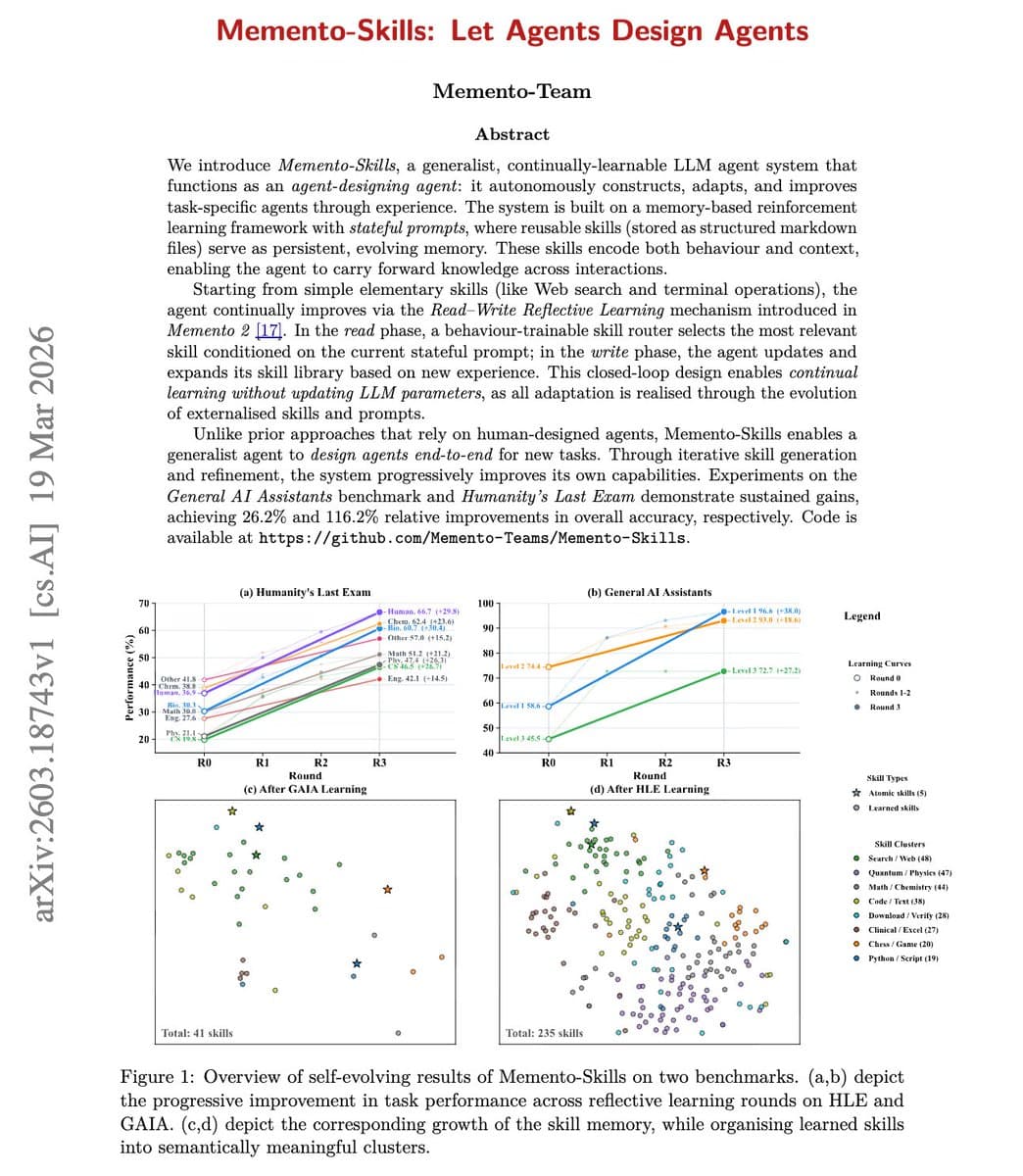
Researchers have introduced Memento-Skills, a generalist agent system that autonomously constructs and adapts task-specific agents through accumulated experience. The core innovation is a framework that enables continual learning without updating the underlying large language model (LLM) parameters.
According to the announcement, the system achieves 26.2% relative improvement on the GAIA benchmark and a 116.2% relative improvement on Humanity's Last Exam. These gains come from the system's ability to design specialized agents for specific tasks based on past interactions, rather than requiring fine-tuning or parameter updates to the base LLM.
Context
The development addresses a fundamental challenge in AI agent systems: how to adapt general-purpose models to specific, evolving tasks without the computational cost and catastrophic forgetting risks associated with continual fine-tuning. Most current approaches either require task-specific fine-tuning (which doesn't scale) or rely on prompt engineering within a static model.
Memento-Skills represents a different approach where the system itself becomes a meta-agent that designs and deploys specialized sub-agents based on accumulated knowledge. This "agents designing agents" paradigm could enable more efficient adaptation to new domains while preserving the general capabilities of the base model.
The reported benchmarks are significant:
- GAIA: A challenging benchmark testing general AI assistants on real-world tasks requiring reasoning, tool use, and multi-step planning
- Humanity's Last Exam: A comprehensive evaluation of AI capabilities across reasoning, knowledge, and problem-solving
The 116.2% improvement on Humanity's Last Exam suggests the system is particularly effective at complex, multi-faceted tasks that benefit from specialized agent design.
Technical Approach
While the source doesn't provide architectural details, the core mechanism appears to be a skill library or memory system where the meta-agent stores and retrieves successful agent designs. When encountering a new task, the system:
- Analyzes the task requirements
- Retrieves relevant past agent designs from memory
- Adapts or composes these designs into a task-specific agent
- Executes the task with the specialized agent
- Updates the memory with successful designs for future use
This approach avoids the need to modify the base LLM's weights while still enabling the system to improve over time through experience accumulation.
Limitations and Unknowns
The announcement lacks several key details:
- Specific architecture and implementation details
- Computational overhead of the meta-agent system
- Performance on standard agent benchmarks beyond the two mentioned
- Comparison to other continual learning approaches
- Whether the improvements are absolute or relative to a specific baseline
- Training data and evaluation methodology details
Without these details, it's difficult to assess the system's practical utility or how it compares to existing approaches like retrieval-augmented generation, prompt tuning, or adapter-based methods.