What Happened
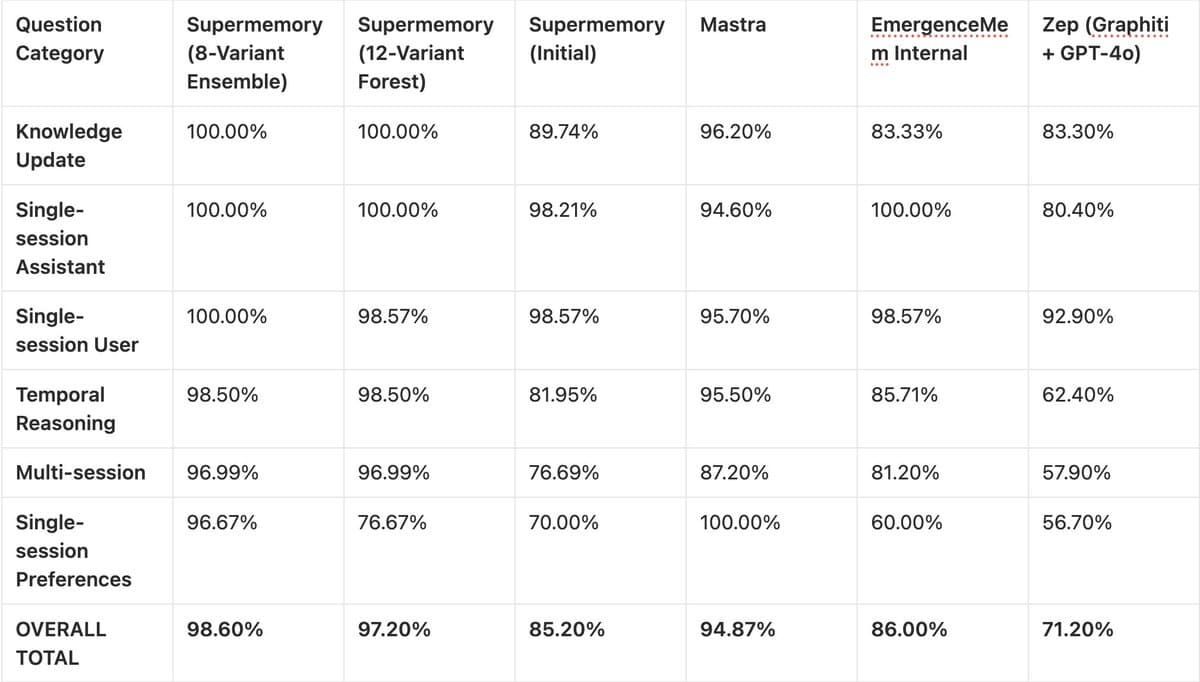
A developer using the handle @kimmonismus announced on X (formerly Twitter) that an experimental system called "Supermemory" has achieved approximately 99% performance on the LongMemEval_s benchmark. The claimed result was achieved using a novel technique named ASMR, which stands for Agentic Search and Memory Retrieval.
According to the announcement, the core innovation is a complete architectural shift away from traditional vector search and embeddings. Instead, the system employs parallel observer agents that extract structured knowledge across six distinct vectors directly from raw, multi-session conversation histories.
The Technical Claim: ASMR
The ASMR technique, as described, involves deploying specialized search agents with different functions:
- Direct Fact Agents: For retrieving specific, explicit information.
- Related Context Agents: For pulling in semantically relevant background or supporting information.
- Temporal Reconstruction Agents: For understanding and reconstructing sequences of events or information over time.
A key claim is that this agentic approach eliminates the need for a traditional vector database. The system processes raw history in parallel to build a structured, multi-vector knowledge representation on-the-fly for querying.
Context & Pending Release
The LongMemEval benchmark is used to test long-context memory and retrieval capabilities in language models, a critical challenge for applications like prolonged conversational agents or document analysis. A score approaching 99% would, if verified, represent a significant leap in reliable long-term memory recall.
The announcement concludes with a commitment to open-source the project: "Will be open source in 11 days!" This suggests the code, and potentially the model or method details, will be publicly released, allowing for independent verification and implementation.
The information is currently sourced solely from a social media announcement. Technical details, evaluation methodology, and independent benchmark verification are pending the open-source release.