What Happened
On May 28, 2025, Tesla released its Q1 2025 Vehicle Safety Report, which included a specific comparison between vehicles operating with its Full Self-Driving (FSD) Beta software and those driven by humans without the system active. The report states that for Q1 2025, Tesla vehicles using FSD Beta experienced airbag deployment crashes at a rate of 0.18 per million miles driven. In the same period, Tesla vehicles without FSD Beta active (driven by humans) experienced a rate of 2.30 airbag deployment crashes per million miles.
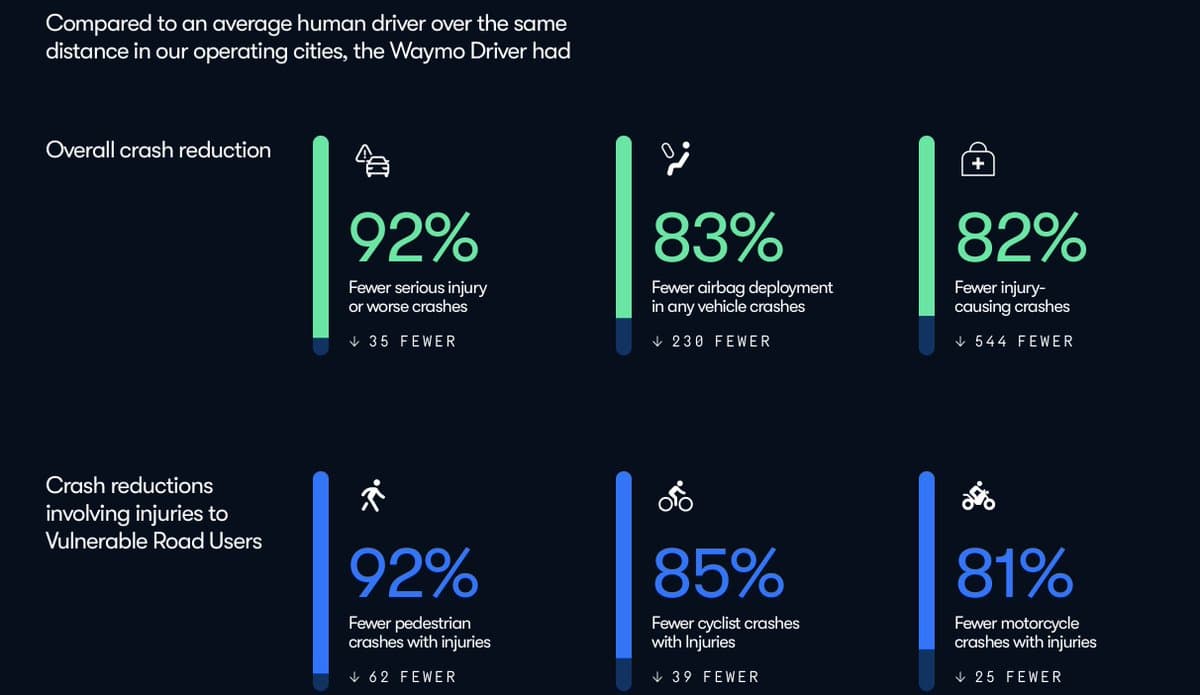
This results in a claimed 92% lower crash rate for the FSD Beta cohort. The report defines a "crash" specifically as an event that triggers the deployment of an airbag.
Context
Tesla has published quarterly Vehicle Safety Reports since 2018, typically comparing crash rates for Tesla vehicles with Autopilot engaged, without Autopilot engaged, and against national averages for all vehicles. The inclusion of a separate, direct statistic for its advanced FSD Beta software represents a notable shift in its reporting.
FSD Beta is Tesla's driver-assistance system designed for city streets, handling tasks like making turns at intersections and navigating complex urban environments. It requires active driver supervision and is not an autonomous system. The software has been rolled out to hundreds of thousands of customer vehicles in North America through Tesla's "public beta" program.
Previous safety reports have shown lower crash rates for Tesla's standard Autopilot (highway driving) compared to national averages. This new FSD Beta-specific claim is the first time Tesla has published a comparative injury-rate statistic for its most advanced software.
Important Caveats from the Report & Methodology:
- Definition of "Injury": The metric is based solely on airbag deployment, which is a proxy for a crash of significant severity. It does not account for property-damage-only crashes or minor collisions that do not trigger airbags.
- Driving Environment: The report does not specify if the driving conditions (e.g., highway vs. city streets, time of day, weather) were comparable between the FSD Beta and human-driven groups. FSD Beta is primarily used on city streets, while human driving includes all scenarios.
- Driver Behavior: Drivers who opt into and use FSD Beta may be more safety-conscious or engaged than the average driver, which could influence the results independently of the software's capabilities.
- Mileage Basis: The comparison is on a "per million miles" basis, a standard metric in vehicle safety analysis.
Tesla's report concludes: "These numbers show that advanced driver assistance systems, when used properly, have the potential to improve safety."